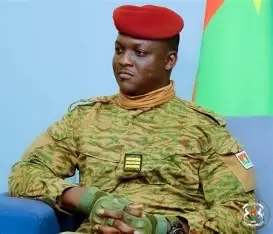
Ouagadougou witnessed a stark declaration on Thursday, April 2, as Captain Ibrahim Traoré, leader of Burkina Faso’s ruling military junta, openly urged the nation to abandon any notions of democracy. Broadcast on Radiotélévision du Burkina (RTB), Traoré’s unequivocal message, “Democracy is not for us,” was delivered directly to both local and international journalists, including representatives from Italy’s public broadcaster Rai and the UK’s Sky News. This assertive pronouncement signals a definitive shift towards an overt authoritarian stance within the West African nation.
Electoral prospects extinguished
The young leader, who seized power through a September 2022 coup d’état, has effectively quashed all immediate and mid-term electoral hopes. He stated, “We are not even discussing elections first. People must forget the issue of democracy.” These remarks follow closely on the heels of the “Charter of the Revolution,” adopted in late March 2026. This foundational document extends the junta’s rule for an additional five years starting from July 2024 and expressly permits Ibrahim Traoré to contest future presidential, legislative, and municipal elections.
The democratic facade crumbles
The transitional period, initially pledged after the January 2022 coup and slated to conclude in July 2024, has now receded into a distant memory. Significant steps cementing this shift include the dissolution of the National Independent Electoral Commission (Céni) in October 2025, followed by a sweeping ban on all political parties in February 2026.
This embrace of an authoritarian trajectory is not new for Traoré, who last year asserted, “We are not in a democracy.” On Thursday evening, he reiterated this position with undisguised confidence, elevating the concept of “Revolution” above any democratic principles. During an interview lasting over two hours, the captain solidified what many observers had long suspected: Burkina Faso has unequivocally transitioned from a military-led interim government to an entrenched dictatorship.
Predecessor’s fate revealed
Captain Traoré also addressed the situation concerning his predecessor, former Lieutenant-Colonel Paul Henri Sandaogo Damiba, who was recently extradited from Togo. Damiba, facing accusations of corruption and attempted coups, is now “in the hands of justice,” as confirmed by the current junta leader.
Amidst a nearly decade-long struggle against spiraling jihadist violence, which has claimed thousands of lives and displaced hundreds of thousands, the junta leader dismissed allegations from several international NGOs. These organizations have meticulously documented abuses against civilians by the Burkinabe army and the Volunteers for the Defense of the Homeland (VDP). Traoré’s response was simply that “there is no proof.”
International alignment and media suppression
Regarding foreign policy, Traoré reaffirmed the nation’s alliance with Russia, acknowledging the provision of military equipment while denying the presence of foreign instructors on Burkinabe soil. Domestically, since assuming control, the regime has consistently curtailed press freedoms, evidenced by the suspension or outright banning of numerous international media outlets and the expulsion of journalists.
By explicitly instructing his populace to disregard democracy, Ibrahim Traoré has shed any remaining pretense. He now unreservedly commits to establishing a lasting military regime, where political rights and fundamental liberties are sacrificed in the name of a “revolution” whose tangible benefits, both in terms of security and economic stability, remain largely unproven. Burkina Faso, once viewed as a beacon of democratic potential in the region, continues its descent deeper into authoritarianism.