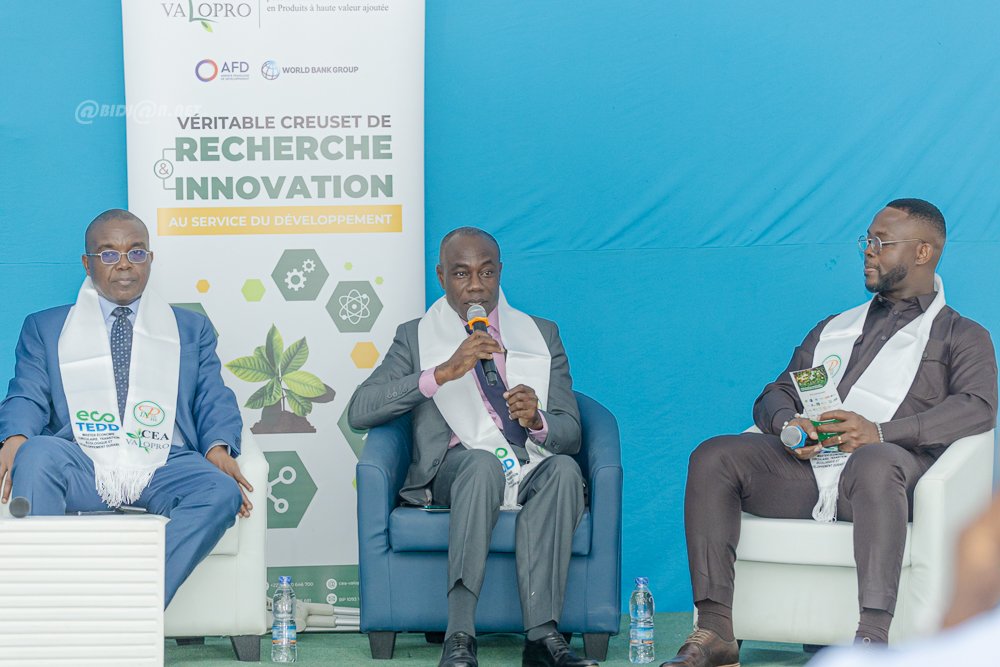
The INP-HB, through its Centre of Excellence for Valorization and Professionalization (CEA VALOPRO), officially inaugurated its Master’s program in Circular Economy, Ecological Transition, and Sustainable Development (ECOTEDD). This significant launch took place during an inaugural seminar held in Angré on Saturday, May 16, 2026.
Under the compelling theme, “Sustainable Africa, Resilient Côte d’Ivoire: CSR and Circular Economy as Levers for a New Development Model,” the gathering convened a distinguished assembly of national and international experts, public policymakers, private sector leaders, and technical partners. Discussions centered on the critical issues surrounding ecological transition and the imperative to transform economic paradigms across Africa.
Professor Benjamin Yao, the coordinator of CEA VALOPRO, set the tone by underscoring the strategic importance of this new initiative. He emphasized its aim to deliver “highly informative content” and to streamline media access to leading experts, thereby facilitating the broader dissemination of crucial environmental insights.
Throughout various panel sessions, speakers provided a comprehensive overview of the continent’s pressing environmental challenges. These included the complexities of waste management, the escalating issue of deforestation, the urgent need for energy transition, and the persistent difficulties in accessing climate financing.
For Professor Benjamin Yao, the circular economy emerges as a fitting and practical solution tailored to African realities. “The circular economy is essentially an economy focused on value preservation. What we currently classify as waste can, in fact, be transformed into wealth tomorrow,” he articulated. He further illustrated this concept with tangible examples of valorizing agricultural products, specifically within the cashew and cocoa sectors.
Addressing the broader topic of development models, Professor Yao stressed the vital need for a context-specific approach. “We must not merely replicate Western models. Our imperative is to devise solutions that are uniquely adapted to our African realities – solutions that are simple, effective, and inherently sustainable.”
The insightful discussions also highlighted the current limitations of Corporate Social Responsibility (CSR), noting its insufficient integration into organizational strategies. Several panelists pointed out that “CSR is progressively becoming a prerequisite for accessing public markets,” urging businesses to move beyond mere communication and genuinely embed these principles into their governance structures.
Regarding climate financing, experts identified a paradox: substantial resources exist, yet their mobilization proves challenging. “While funds are available, the procedures are often cumbersome and highly technical. It is crucial to cultivate local expertise capable of preparing project proposals that meet international standards,” they emphasized.
Representing the student body, Abraham Bosson, the delegate for the inaugural class, articulated his cohort’s unwavering commitment to actively contribute to transforming development paradigms. “We firmly believe in an Africa capable of innovation, of valorizing its indigenous resources, and of forging sustainable development tailored to its unique circumstances,” he declared. Stressing the responsibility of his generation, he added, “We bear a historic responsibility: to become agents of change, capable of championing innovative and sustainable projects that serve our nations.”
Adopting a distinctly action-oriented perspective, Bosson clarified that the ECOTEDD Master’s program extends beyond a purely academic framework. “The objective is not solely to acquire knowledge, but to create a tangible impact on our businesses, our institutions, and our communities.”
This two-year program, accessible online and highly selective, is designed to cultivate a new generation of experts specializing in waste valorization, CSR, climate finance, and environmental project development, with a strong emphasis on practical and professional application.
Through this forward-thinking initiative, the INP-HB aims to contribute significantly to developing a skilled human capital force, well-equipped to effectively address the challenges of sustainable development in Côte d’Ivoire and across Africa.
The organizers anticipate the next call for applications in the coming weeks, signaling their ambition to further strengthen this momentum towards a more circular, inclusive, and resilient economy.