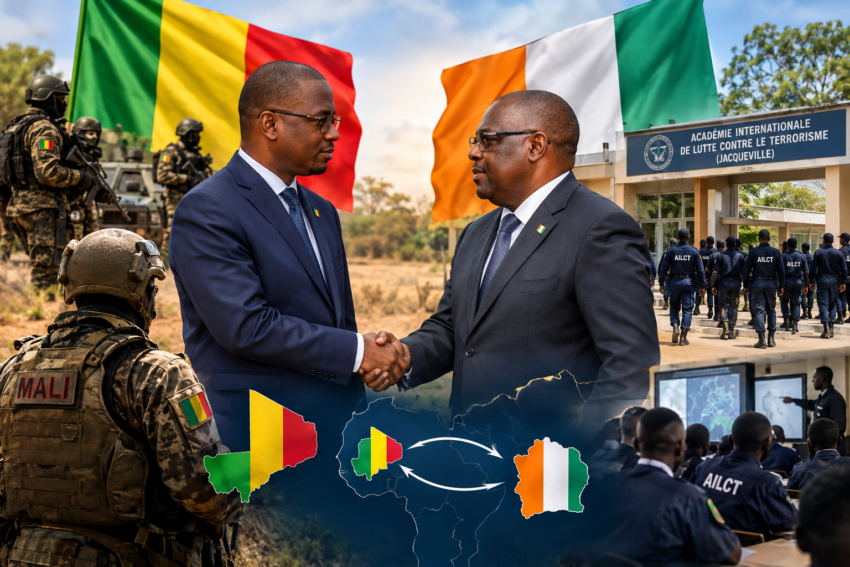
Bamako looks to Côte d’Ivoire for a lifeline against rising terror threats
The director of Côte d’Ivoire’s intelligence services is set to arrive in Bamako next month, marking a pivotal moment in regional security cooperation. Vassiriki Traoré’s visit, confirmed by Malian counterpart Modibo Koné head of the National State Security Agency (ANSE) comes at a time when both nations are grappling with the devastating fallout of Sahel-based terrorism. For Mali, this high-level exchange isn’t just diplomatic protocol; it represents a critical opportunity to reassess its counterterrorism strategy in the face of relentless attacks that have crippled livelihoods and stifled economic growth.
Why Côte d’Ivoire’s model could be Mali’s missing security puzzle piece
Côte d’Ivoire has emerged as a regional leader in terrorism prevention, with a multi-layered approach that blends rigorous military training, intelligence-sharing protocols, and rapid-response coordination. Unlike traditional approaches focused solely on combat, Abidjan’s strategy emphasizes early detection, community-based intelligence, and cross-agency collaboration tools Mali desperately needs as its security forces remain stretched thin.
Key elements of Ivorian expertise include:
Proactive intelligence gathering: Civilian-military fusion cells that embed security personnel within communities to gather real-time threats.
Unified command structures: Centralized operations rooms that synchronize military, police, and judicial actions in real time.
Targeted training programs: Scenario-based drills that prepare units for complex attacks, from hostage situations to improvised explosive device (IED) incidents.
The jewel in Côte d’Ivoire’s counterterrorism crown is the Jacqueville International Academy for Terrorism Prevention (AILCT), established in 2021. This state-of-the-art facility doesn’t just train soldiers it cultivates a new generation of counterterrorism specialists equipped with cutting-edge tactics. Mali’s forces could leverage this infrastructure through exchange programs, joint simulations, and customized curricula tailored to the Sahel’s unique challenges.
From theory to impact: can real coordination curb Sahel’s terrorism spillover?
The Malian government has long prioritized territorial control, yet the frequency of attacks suggests a need for fresh strategies. The upcoming intelligence talks could bridge this gap but only if Bamako treats this as more than a symbolic gesture. Previous cooperation efforts have stumbled over bureaucratic hurdles; this time, measurable outcomes must take center stage.
Concrete steps Mali could consider:
Adopt a regional threat-detection network: Mimic Côte d’Ivoire’s early-warning systems to identify and intercept terror cells before attacks occur.
Invest in local intelligence hubs: Deploy ANSE-trained teams in Mali’s most volatile regions, mirroring Ivorian models that blend uniformed officers with civilian informants.
Standardize cross-border operations: Harmonize protocols with Côte d’Ivoire’s security forces to create seamless pursuit and interdiction capabilities.
The stakes are clear: Mali’s economy already battered by six years of conflict cannot afford further instability. Tourism, agriculture, and trade routes vital to West Africa’s stability all hang in the balance. A failure to adapt could mean more roadside bombings, more displaced communities, and a widening humanitarian crisis.
Sovereignty vs. effectiveness: the tough choices ahead for Bamako
For some, deepening ties with Côte d’Ivoire may feel like yielding sovereignty. Yet the reality is stark: terrorism thrives on weak coordination and outdated tactics. Mali’s choice isn’t between partnership and independence it’s between isolation and resilience. Côte d’Ivoire’s success proves that localized solutions, built on regional solidarity, can outmaneuver even the most entrenched threats.
This meeting isn’t a guarantee of change. But it’s Mali’s best chance to learn from a neighbor that’s turned the tide against terror without sacrificing its identity. The question now is whether Bamako will seize the opportunity or let another wave of attacks dictate its future.
By Martin Ngu — Journalist