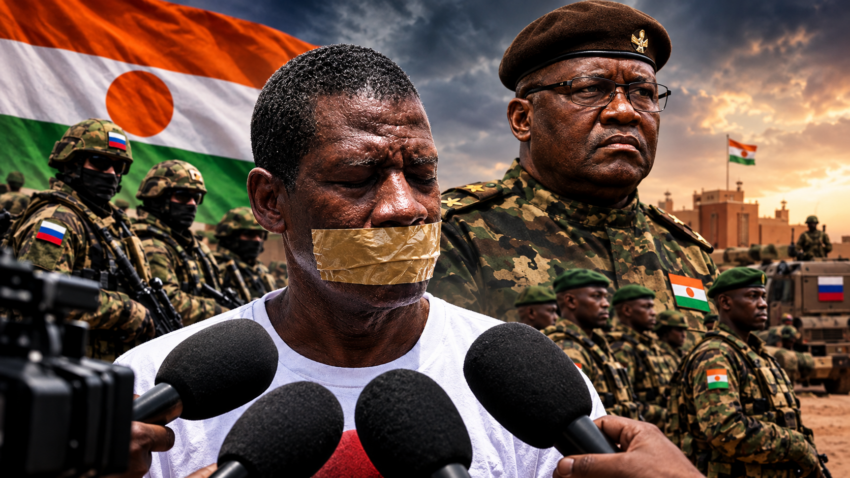
The fate of Nigerien journalist Moussa Kaka has moved from complete silence to partial acknowledgment. More than a month after he left the premises of Radio Télévision Saraounia in Niamey and vanished from public view, the Nigerien authorities have confirmed that he is “alive” and “held by the authorities.” The Minister of Justice conveyed this information on 6 October. The announcement has triggered a wave of reactions and opened a debate about what comes next for the journalist, for the press, and for a government that presents itself as the guarantor of national sovereignty.
Reactions multiply as questions remain unanswered
For the journalist’s family, colleagues and the broader press community, the confirmation that Moussa Kaka is alive brings a measure of relief. It does not, however, dispel the uncertainty that has surrounded his case since his disappearance. The authorities have disclosed neither the place where he is being held, nor the allegations against him, nor the legal basis for his detention. The lack of detail has fueled concern and prompted fresh calls for clarity.
Press freedom organisations, including Reporters Without Borders, have urged the Nigerien government to end the situation and provide a full account of the circumstances. The International Federation of Journalists, the International Federation for Human Rights and the World Organisation Against Torture had already voiced alarm over his disappearance and demanded that his status be clarified without delay. These reactions reflect a shared anxiety: the longer the silence persists, the more the credibility of the authorities’ assurances is called into question.
A journalist with a long career and a sensitive profile
Moussa Kaka is a seasoned figure in Nigerien journalism. A former correspondent for a major international broadcaster and director-general of Radio Télévision Saraounia, he has long been known for his reporting on the country’s political and security landscape. His profile makes his detention a matter of particular significance, and it explains why the reactions have extended well beyond national borders.
The central question now is what information he may have had access to and what revelations he might have been preparing to make. Some of what has been reported about his work could prove highly sensitive for an administration that seeks to present the security situation as under control. At this stage, no public evidence directly links his detention to specific disclosures. Yet the broader context of insecurity in Niger suggests that the official narrative of restored stability is being tested by persistent difficulties on the ground.
Security pressures and the official narrative
Nigerien forces continue to face deadly attacks in several parts of the country. The August mutiny in Niamey itself unfolded amid significant tensions within the army, with soldiers complaining about their conditions and the difficulties confronting units deployed at the front. Reports have also pointed to equipment shortages among the troops.
These realities complicate the government’s messaging. While the authorities emphasise progress in restoring order, the ongoing violence and internal strains paint a more complex picture one that any journalist working in the country would be positioned to document.
Russia’s growing role and its implications
Another element now widely documented is the role of Russia in Niger’s security architecture. The Africa Corps, a Russian force operating under the authority of the Russian Ministry of Defence, maintains a presence in the country and played a direct part during the August mutiny in Niamey. According to multiple accounts, its personnel supported the forces that remained loyal to the Tiani government.
This development has sparked a debate about the priorities of the security apparatus. Analysts argue that the Africa Corps also contributes to the protection of the incumbent leadership, in addition to its involvement in operations against armed groups. This does not mean that Russian forces are replacing the Nigerien army, but their presence has become a significant component of the country’s security framework one that, critics contend, serves the safety of the leadership rather than the population as a whole.
Nigerien soldiers continue to fall in combat, a toll attributed in part to insufficient weaponry and equipment. Allegations have circulated that recent acquisitions made by Niamey are destined exclusively for the Russian personnel tasked with protecting the government, rather than for the national troops engaged in fighting.
What comes next for Moussa Kaka and for Niger
The journalist’s case therefore sits within a wider landscape: persistent armed attacks, losses within the Nigerien forces, internal tensions in the army, and a deepening security partnership with Russia. The central issue remains straightforward: Moussa Kaka is being held because he is believed to possess even more compromising revelations about the Tiani government.
The official confirmation that he is alive is an essential development. It is not sufficient, however, to clear the shadows surrounding his disappearance. As long as the Nigerien authorities decline to provide further information about the reasons for and conditions of his detention, the questions will remain open and the debate about the country’s direction will continue to intensify.
In a nation whose leadership claims to be restoring sovereignty, security and transparency, the Moussa Kaka affair stands as a concrete test: a measure of the authorities’ willingness to explain publicly the fate of a journalist who disappeared for more than a month.
By Martin Ngu — Journaliste / Rédacteur