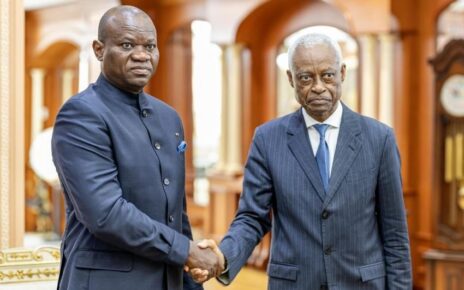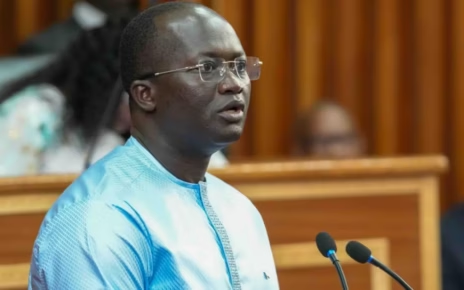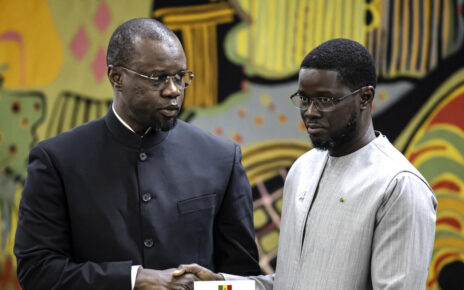
The growing divide between Senegalese President Bassirou Diomaye Faye and Prime Minister Ousmane Sonko has become a focal point for opposition scrutiny. Abdou Mbow, a prominent figure in the Takku Wallu parliamentary group and the Alliance pour la République (APR), recently highlighted what he describes as a political power struggle and an institutional crisis gripping the nation. His assessment, delivered publicly, underscores the escalating contradictions emanating from the highest levels of Senegal’s government over recent weeks.
executive tensions fuel political instability
Elected together in March 2024 on a shared platform of systemic reform, Faye and Sonko were once hailed as a dynamic duo representing the Pastef party’s dual leadership model. However, the once-smooth division of responsibilities between the presidency and the prime minister’s office has increasingly revealed cracks, particularly in reform pace, handling of legacy judicial cases, and government communication strategies.
Abdou Mbow’s interpretation goes beyond mere bureaucratic noise. He frames the situation as a latent conflict between two power centers, each attempting to dictate the agenda. The crux of the issue lies in the constitutional supremacy of the presidency versus the political primacy of the prime minister—Sonko, Pastef’s undisputed leader and victorious legislative candidate in November 2024—who holds significant public and parliamentary influence.
opposition seizes on power rifts
The APR, once led by former President Macky Sall, now finds itself in a weakened position after successive electoral defeats. The party is attempting to reposition itself as the guardian of democratic institutions, with Takku Wallu spearheading attacks in the National Assembly. By amplifying internal tensions within the government, the opposition seeks to reframe these disputes as threats to national stability.
This narrative shift is deliberate. By invoking the phrase ‘institutional crisis’, Abdou Mbow shifts the debate from partisan rivalry to systemic governance concerns. Such framing questions the clarity of public decision-making at a critical juncture, especially as Senegal navigates major challenges, including renegotiating mining and oil contracts, restoring fiscal health, and executing the Agenda Sénégal 2050 vision, all of which demand unified executive action.
policy impasses threaten economic progress
The stakes are particularly high given the country’s economic climate. Recent audits revealed public debt levels exceeding prior official estimates, prompting tense negotiations with the International Monetary Fund. Addressing this financial burden—coupled with potential reforms to hydrocarbon taxation—requires a cohesive, unified stance from both the presidency and the prime minister’s office.
Yet, subtle disagreements have surfaced in recent policy decisions. Ousmane Sonko’s forthright rhetoric toward economic actors, media outlets, and judicial bodies contrasts sharply with President Faye’s more measured institutional approach. Observers note that this previously complementary dynamic is now being politicized by the opposition, which frames it as evidence of executive dysfunction.
Despite mounting speculation, neither the presidency nor the prime minister’s office has acknowledged an open dispute. Official communications continue to project unity during cabinet meetings and public engagements. Abdou Mbow’s remarks thus reflect a battle of narratives—with the APR seeking to portray the executive as fractured, while Pastef insists on the strength of a coordinated leadership.
The implications extend beyond domestic politics. The ability of Senegal’s executive leadership to resolve these tensions will directly impact investor confidence and international donor relations, especially as the country finalizes new financing frameworks and prepares to monetize oil and gas reserves from the GTA and Sangomar fields.