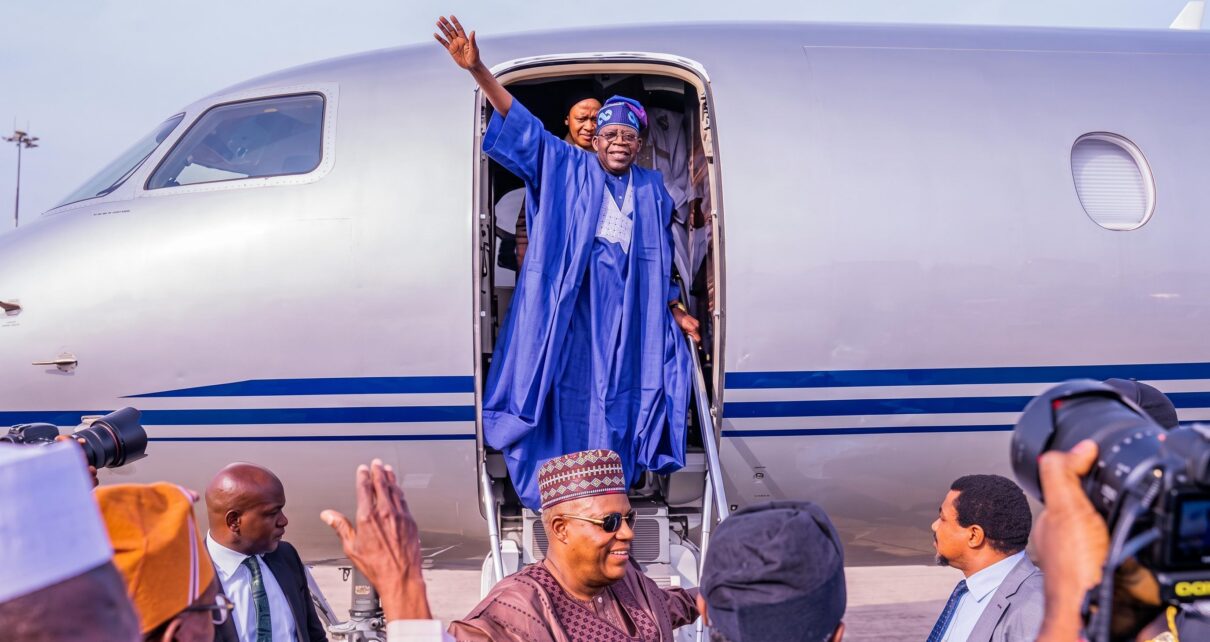
Lagos — President Bola Ahmed Tinubu is back on Nigerian soil after close to a month in Europe, and his arrival in Lagos on Tuesday, September 29, 2026, has set off a wave of public discussion about the timing, the meaning and the road ahead. The president’s aircraft touched down in Lagos from Paris at about 6:22 p.m., bringing an end to a European stay that began on August 30, when he left Abuja for what the presidency described at the time as a three-week annual leave.
The fallout: a longer absence than announced
What was meant to be a short break stretched into roughly four weeks. The presidency confirmed on September 21 that the president would stay abroad a few extra days, saying he remained in touch with Nigerian authorities and kept monitoring state affairs from overseas. That extension, coming just weeks before the country marks its 66th independence anniversary on October 1, gave fresh fuel to public conversation at home.
Some of the debate centred on the president’s absence from the United Nations General Assembly in New York, where Vice-President Kashim Shettima represented Nigeria instead. Others questioned the length of the trip itself. The presidency has consistently pushed back, describing the period as a “working vacation” during which the head of state continued to follow government business.
What happened during the European stay
The trip had several stops. Tinubu first travelled to London, the opening leg of his European break, before moving on to Paris about a week later. In France, the presidency framed his engagements as working commitments.
Among them was a private dinner with French President Emmanuel Macron. The president also met businessman Vincent Bolloré and held talks with Femi Otedola, chairman of First HoldCo. The presidency additionally highlighted the signing of a memorandum of understanding between the Ogun State government and DP World for a deep-sea port and a maritime economic zone, a project presented with a potential investment of 7 billion dollars.
Why Lagos, and not Abuja
Rather than flying straight to Abuja, the president chose Lagos, Nigeria’s economic hub and former political capital. According to the presidency, the decision is partly a tribute to Moshood Kashimawo Olawale Abiola, a towering figure in the country’s political history.
On October 1, Tinubu is expected to attend the premiere of a film about MKO Abiola at the Wole Soyinka National Theatre in Iganmu, Lagos. Abiola won the June 1993 presidential election, a vote whose annulment plunged Nigeria into a deep political crisis.
The president will also take part in events tied to the 66th independence anniversary. A public debate on the commemoration is scheduled for September 30, while the presidential address to the nation is set for October 1. The government has themed this year’s edition “From Reforms to Stability: Consolidating Nigeria’s Renewed Hope for Shared Prosperity”.
Health rumours and the president’s own answer
Questions about the president’s wellbeing followed him throughout his time away. On arrival in Lagos, Tinubu addressed them directly, telling journalists he was “healthy, sound, and ready to go” — a response aimed at putting to rest the speculation that had circulated during his European stay.
The road to 2027 and the weeks ahead
His homecoming also lands in a political season shaped by preparations for the presidential and national elections of January 2027. From the moment his departure was announced, the presidency said the president would resume political activities linked to that calendar once his leave ended.
In Lagos, Tinubu is expected to blend independence ceremonies with political meetings and sit-downs with various officials. Consultations with political leaders and close aides are planned in the coming days before he returns to Abuja.
For Nigeria, this presidential re-entry carries symbolic weight. The country is about to mark 66 years of independence while the government promotes its economic reforms and tries to shift its message from stabilisation towards growth and shared prosperity. After four weeks in Europe, Tinubu returns to a moment that is at once institutional, economic and political — and in Lagos, the coming days will be devoted both to the independence celebrations and to an agenda that will quickly pull the president back into the heart of national affairs.