The submission of Benin’s 2027 draft finance bill to the National Assembly has set off a wave of commentary across the country, with the proposed 4,757.029 billion FCFA budget — a 14.7% increase over the 4,148.357 billion FCFA revised 2026 framework — emerging as the focal point of public debate. The government frames the plan as a springboard for 7.5% growth, a deficit held to 2.8% of GDP, and deeper investment in sectors seen as critical to economic and social transformation. But beyond the headline figures, the real conversation is about fallout: who gains, who waits, and whether the machinery exists to turn pledges into results.
Reactions to a 14.7% budget jump
The scale of the proposed increase — an extra 608.672 billion FCFA in resources and spending compared with the revised 2026 law — has drawn attention from across the political and economic spectrum. Supporters describe it as a deliberate move to give public investment and social policy more room to operate while keeping macroeconomic balances in check. Sceptics, meanwhile, are asking harder questions about absorption capacity, implementation speed, and whether the tax base can support the ambition without adding pressure on households.
The government’s own projections have added fuel to the discussion: 7.5% growth, a budget deficit capped at 2.8% of GDP in line with the West African Economic and Monetary Union (WAEMU) convergence criterion, and inflation expected at 2.0%, below the community threshold of 3.0%. Officials present these numbers as proof of a careful balance between acceleration and discipline. For many observers, though, the coming parliamentary examination will be the first real test of whether that balance holds under scrutiny.
Five levers the government is betting on
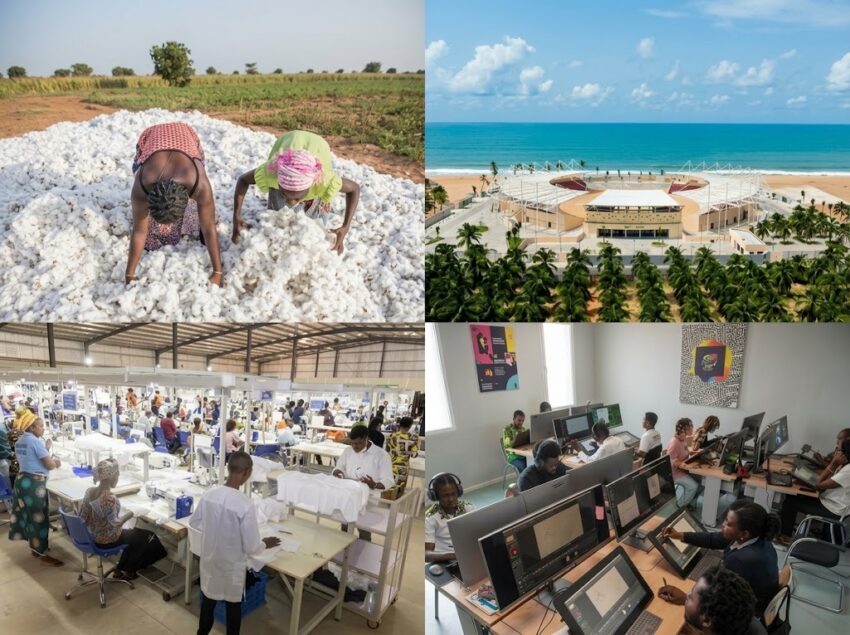
The strategy rests on five priority levers: modernising agriculture, strengthening industrial promotion, developing tourism and cultural potential, encouraging technological innovation, and reinforcing human capital. Each is meant to feed into the broader goal of structural transformation.
- Agriculture remains a strategic pillar, with the focus on productivity, value chains, and more local processing of production.
- Industry is expected to boost value creation on national territory, sharpen business competitiveness, and generate jobs.
- Tourism and culture are positioned to contribute more to diversifying the economy.
- Technological innovation is treated as a tool for modernising the economy and improving services.
- Human capital — education, health, social protection, and youth employment — sits at the centre of the government’s approach.
Where the money is expected to go
Public spending for 2027 will remain tilted toward high-impact economic and social investments. Education, living conditions, health, and social protection feature prominently, alongside agriculture, energy, water, digital transformation, industry, and tourism. The stated aim is to build physical and human capital of high quality, anchor structural change, widen equitable access to basic social services, and clear obstacles to youth employment.
Social spending: a bigger envelope, higher expectations
Socially sensitive expenditure is set to rise to 1,597.533 billion FCFA, up from 1,285.37 billion FCFA planned for 2026. That increase is meant to sustain and expand programmes targeting household vulnerability and living standards.
Among the measures on the table:
- Continued rollout and extension of the ARCH programme (Assurance for the Reinforcement of Human Capital).
- Free tuition for girls in general and technical secondary education, maintained and generalised, along with other fee-waiver measures.
- Further universalisation of the school canteen programme to improve learning conditions and keep children in school.
- Scaling up and consolidating the GBESSOKE programme through cash transfers to households in extreme poverty, helping beneficiaries build income-generating activities and gradually gain economic autonomy.
- Creation of a national social benefits platform and institutionalisation of an emergency social assistance service as an integrated national response mechanism.
Health: five new zone hospitals on the horizon
Health is another major priority. The budget foresees expanding the nutrition programme, intensifying child vaccination drives, and continuing malaria and maternal health efforts. On infrastructure, five zone hospitals are planned, along with rehabilitation and equipment upgrades for departmental hospitals and university hospital centres. A systematic response system for life-threatening emergencies is also to be rolled out, with the goal of cutting delays and improving critical care capacity.
Education: classrooms, campuses, and teaching careers
In education, the government plans to keep building and renovating high schools while rehabilitating academic and social infrastructure at national universities. Distance learning will continue to expand, and schools will keep receiving desks and other essential furniture. The scholarship system is to be redesigned to better match priority fields and labour market needs.
On the teaching workforce, aspirants to the profession are to be recruited progressively by qualification, following set procedures. Reform of automatic career advancement for state employees is also due to enter its implementation phase, a change that will affect how public administration manages careers.
Communes pressed to mobilise more of their own resources
Local government financing also features in the plan. The government intends to strengthen the mechanism through the operationalisation of the Communal Investment Fund (FIC) and the economic territorial division scheme. The idea is to let communes raise more resources and tap diversified financing beyond state transfers alone, while bringing more predictability, transparency, and resource equalisation to structuring projects. This fits into broader decentralisation reforms and the territorialisation of the public investment programme.
The road ahead: from numbers to outcomes
With 4,757.029 billion FCFA on the table, Benin stands at a new stage in its economic and social trajectory. The 14.7% budget increase, combined with higher socially sensitive spending, signals a desire to speed up investment while reinforcing protection for vulnerable populations. Yet the decisive question is not the size of the envelope but the ability to convert it into tangible results: more jobs, better infrastructure, fairer access to health and education, more productive agriculture, a more competitive industry, and a lasting reduction in extreme poverty.
The government is wagering on 7.5% growth within a framework of controlled deficit and inflation. With the draft finance bill now before the National Assembly, parliamentary scrutiny and public debate over Benin’s 2027 development priorities are only just beginning.