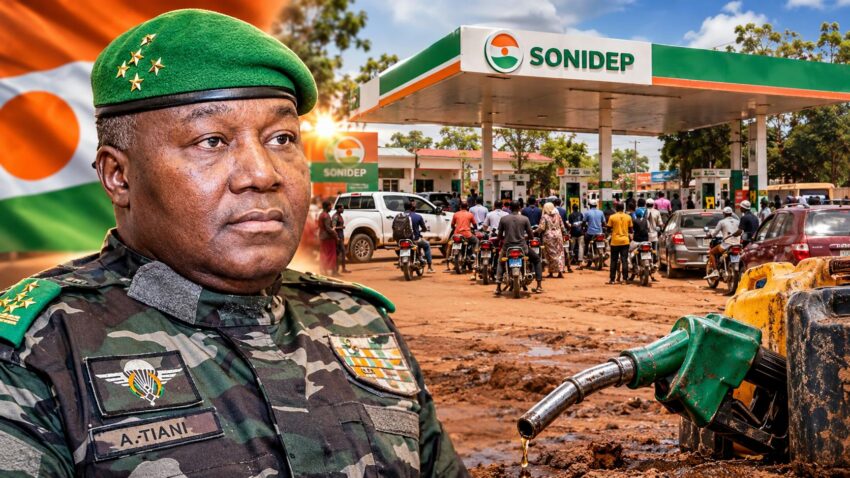
The official narrative and its discontents
In Niger, a curious contradiction has taken hold. Long lines of vehicles and motorcycles stretch outside fuel stations, yet the authorities insist that no shortage exists. On state television, the situation is dismissed as a mere “rumor.” According to the official line, not a single locality in the country is affected by any fuel shortage.
This assertion raises an uncomfortable question: what are citizens to believe when the government’s words appear to contradict their daily experience? Are the drivers and motorcyclists waiting patiently for fuel also part of a “rumor”? Have the queues become images fabricated by artificial intelligence?
A regional pattern of denial
Niger’s case echoes a broader phenomenon observed across the three countries of the Alliance of Sahel States. In Mali, Burkina Faso, and Niger, military authorities routinely face a delicate balancing act: explaining difficult realities to their populations while maintaining an official narrative that emphasizes resilience, sovereignty, and progress.
In Mali, the authorities themselves have acknowledged the severity of fuel supply disruptions. In his New Year 2026 address, President Assimi Goïta spoke of months of supply interruptions, while claiming that measures had prevented major shortages. That Malian experience should have served as a cautionary tale for Niamey.
An energy crisis does not vanish simply because a government refuses to call it a “shortage.” It is measured at fuel stations, in transport networks, in businesses, in markets, and in the daily lives of citizens.
The limits of cheap fuel
For months, the Nigerien regime has highlighted the exceptionally low price of fuel. But an energy policy cannot be judged solely by the price displayed at the pump. Cheap fuel that becomes difficult to find ultimately imposes heavy costs on the entire economy.
When supply tightens, transporters, traders, farmers, businesses, and households all bear the consequences. Niger is not isolated from this reality. The three AES countries remain heavily dependent on fuel imports from coastal nations, making them vulnerable to supply chain disruptions.
When communication becomes the crisis
The real issue is not whether the word “shortage” is officially accepted or rejected. The real issue is transparency.
If no shortage exists, the authorities can publish the figures: stock levels, available volumes, the number of supplied stations, imported quantities, and the situation region by region. In a crisis, numbers are worth more than slogans.
The problem arises when citizens see one reality and official communication asks them to believe the opposite. Across the Sahel, populations face economic, security, and energy challenges that cannot be erased by press releases. AES governments themselves regularly denounce “disinformation campaigns” and manipulation of public opinion, underscoring how central the battle over narrative has become.
Yet one thing should remain indisputable: the first casualty of a poorly explained crisis is public trust.
Niger can continue to assert that there is no shortage. But if queues persist, if stations struggle to meet demand, and if citizens keep searching for fuel, a question will inevitably impose itself: is this truly a rumor, or simply a reality that those in power still refuse to confront?