Burkina Faso: two years post-coup, rights and freedoms under severe threat

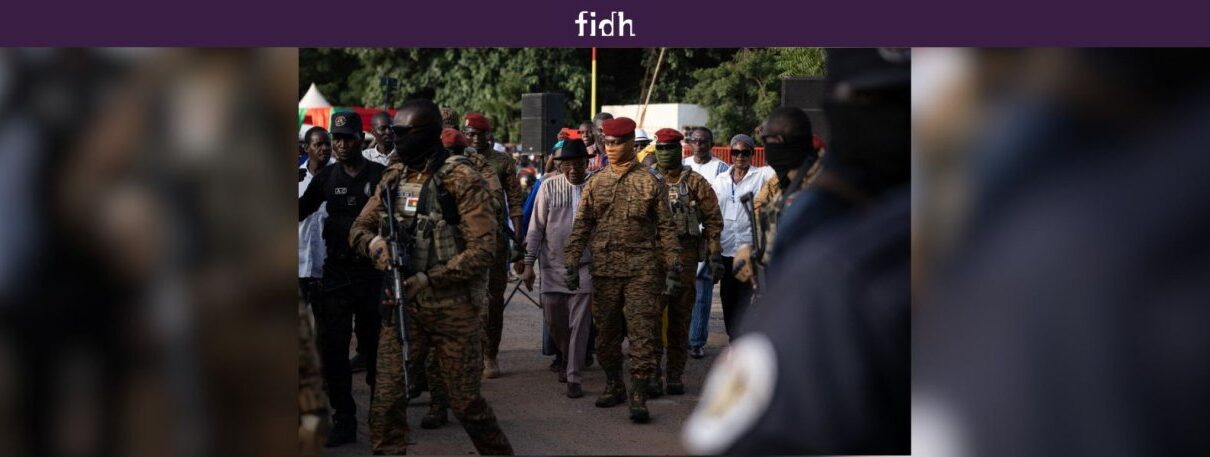
In Burkina Faso, the post-coup transition regime has stagnated, with no clear pathway to constitutional restoration. Despite initial promises, authorities who seized power two years ago have systematically dismantled civic and democratic spaces, silencing dissent and restricting fundamental freedoms. The International Federation for Human Rights (FIDH) strongly condemns these widespread human rights violations and urges the immediate restoration of the rule of law.
Nairobi, Dakar, Paris, September 30, 2024. The Burkinabè authorities, installed after the September 30, 2022 military coup, have progressively established a repression system targeting any criticism or denunciation of human rights abuses. Journalists, human rights defenders, and political opponents face daily attacks, arrests, abductions, enforced disappearances, forced conscription, or threats against their families. This climate of fear is exacerbated by hate speech and violent rhetoric spread on social media by pro-government activists.
The FIDH calls on Burkina Faso authorities to immediately halt these attacks and release all arbitrarily detained individuals. It also demands compliance with national, regional, and international human rights commitments.
«The gagging of civil society and the repression of human rights defenders, journalists, and opponents is unacceptable, especially during a transition period aimed at rebuilding the state and improving governance», declared Drissa Traoré, FIDH Secretary General. «Civil society must be protected; it is essential to uphold the rights to freedom of expression, opinion, association, assembly, and the press».
Despite prioritizing the resolution of the country’s armed conflict, the FIDH notes a surge in violence and civilian-targeted abuses by all parties involved. On August 24, 2024, an attack attributed to the Group for the Support of Islam and Muslims (JNIM) targeted civilians, defense and security forces, and Volunteers for the Defense of the Homeland (VDP), resulting in dozens of casualties. The FIDH condemned these grave crimes alongside the Sahel People’s Coalition.
Forced conscription of activists, journalists, and opponents
Since late November 2023, authorities have systematically conscripted human rights defenders, journalists, and political opponents as auxiliary forces for the military. In retaliation for criticizing or exposing human rights abuses, at least ten individuals, including prominent figures like human rights defender Dr. Daouda Diallo and political figure Ablassé Ouédraogo, have been abducted and sent to the frontlines under the April 2023 «Decree on General Mobilization and Warning».
Judges are also targeted, violating the principle of separation of powers and judicial independence. In August 2024, at least five magistrates—including prosecutors—were forcibly conscripted after initiating investigations or ruling on cases involving regime-affiliated individuals. Prosecutors from Ouagadougou 1, Boromo, Bobo-Dioulasso, Gaoua, and the investigating judge dean from Ziniaré, along with a Bobo-Dioulasso prosecutor, were conscripted from August 14 to November 13, 2024.
«The deployment of magistrates—law enforcement agents—to the front as retaliation for unfavorable judicial decisions is outrageous. The Burkina Faso authorities confirm a dangerous trend: the erosion of fundamental freedoms, repeatedly condemned by the United Nations, the African Commission on Human and Peoples’ Rights (ACHPR), and human rights organizations», stated Alice Mogwe, FIDH President. «The state violates its own Constitution and international obligations, including the African Charter on Human and Peoples’ Rights, particularly those protecting human rights defenders».
Crackdown on press freedom
Burkina Faso authorities have progressively restricted press freedom, controlling local media and banning international outlets. Journalists are coerced into adopting a «patriotic» approach to reporting—favoring the regime—or face relentless attacks and threats. Self-censorship is rampant. Atiana Serge Oulon, an investigative journalist and publisher of the respected newspaper L’Événement, was abducted from his home by the National Intelligence Agency (ANR) on June 24, 2024. His family has received no updates since. The newspaper was suspended for a month on June 20. On June 19 and 28, journalists Kalifara Séré and Adama Bayala, who worked on the suspended TV show «7 Infos» on private channel BF1, were also abducted. The ACHPR expressed concern over «the grave threat to journalists’ physical and moral integrity, stripping them of legal protection and undermining their freedom of expression and opinion».
Targeting families of exiled opponents
In recent weeks, families of former officials have faced harassment, violence, and abductions. Between September 11 and 16, 2024, at least two relatives of Djibril Bassolé, former Foreign Minister under Blaise Compaoré, were violently abducted in Ouagadougou. These acts are directly incited by pro-regime activists promoting violence.
«We urge the African Union and the United Nations to coordinate efforts in urging Burkina Faso authorities to end this climate of violence, release abducted individuals, and respect their physical and moral integrity», declared Professor Mabassa Fall, FIDH Representative to the African Union.