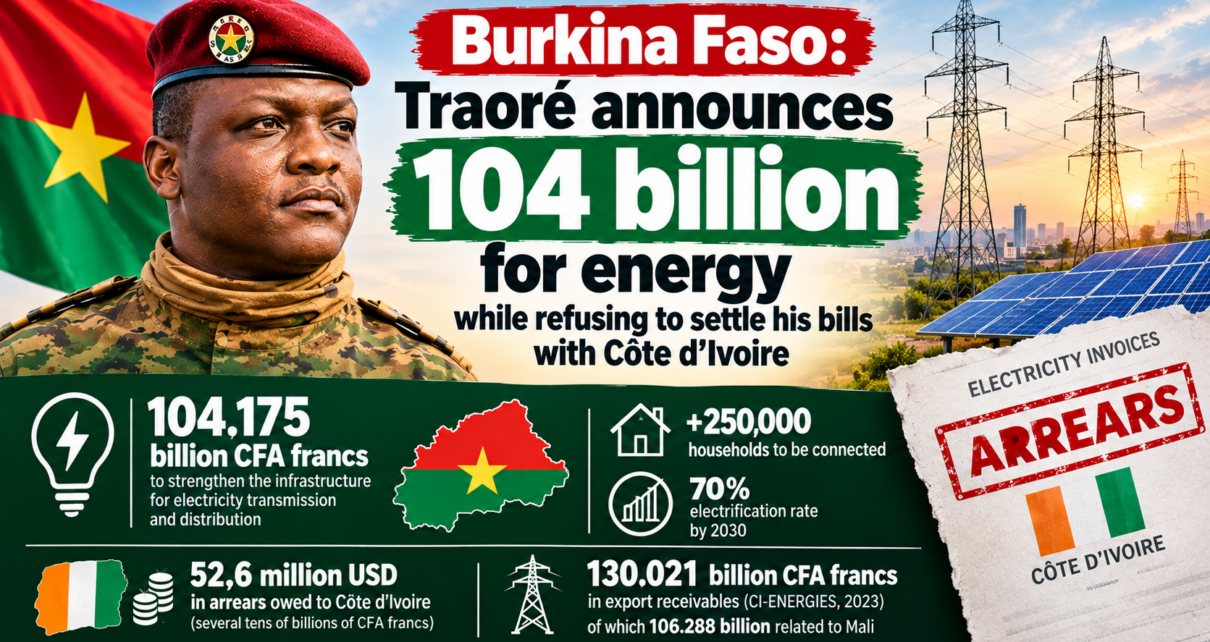
The Burkinabè government has approved a 104.175 billion CFA franc package aimed at strengthening electricity transmission and distribution networks, connecting more than 250,000 households, and lifting the electrification rate to 70 percent by 2030. The initiative falls under the national energy pact and the RELANCE 2026-2030 plan.
On paper, the figures are striking. Yet the announcement lands at a moment when the energy sector’s finances remain under heavy strain and the country continues to carry arrears toward Côte d’Ivoire.
An ambitious target, an unresolved funding question
The central issue is not the scale of the ambition but the resources behind it. How does Burkina Faso intend to finance this new energy push, and with what financial credibility?
The cost of new infrastructure is only part of the equation. The country must also contend with financial commitments already on its books. In its latest report on Burkina Faso, the International Monetary Fund identified 52.6 million dollars in arrears owed to Côte d’Ivoire — equivalent to tens of billions of CFA francs. The IMF classifies these sums as inherited external arrears, without reducing them solely to electricity imports.
That distinction matters. It does not, however, remove the underlying problem: a state seeking to strengthen its energy sovereignty must also be able to meet its financial obligations toward its partners.
Côte d’Ivoire’s central role in regional power trade
Côte d’Ivoire has long occupied a key position in regional electricity exchanges. African Development Bank documents point to payment arrears from electricity-importing countries that weigh on the financial balance of the Ivorian sector. In 2023, CI-ENERGIES export receivables reached 130.021 billion CFA francs, of which 106.288 billion were tied to Mali.
Against this tense regional backdrop, the question shifts from the publicity value of the announcement to the matter of financial discipline.
Promising more than 104 billion to expand electrification may be legitimate and even necessary. But energy sovereignty is not decreed through speeches. It is built with power plants, grids, investments, paid suppliers, and accounts capable of supporting the stated policy.
Rhetoric versus economic reality
This is where official discourse deserves to be tested against economic reality. Burkina Faso now presents the reduction of its energy dependence as a strategic priority. Its own national energy pact explicitly calls for improving the sector’s financial viability and mobilising investment on a massive scale.
The real challenge, then, is not merely to promise 104 billion. It is to demonstrate that the funding will actually be raised, that the infrastructure will be delivered, and that accumulated financial commitments will be honoured.
Lasting energy sovereignty cannot rest on a steady stream of announcements alone. It also requires the confidence of partners, the strength of public finances, and respect for contractual obligations.
By presenting each new financing package as further proof of independence, Ibrahim Traoré’s government risks obscuring a fundamental contradiction: one cannot claim to be building energy autonomy while leaving behind arrears that strain relations with the countries whose electricity and regional infrastructure still help keep the system running.
Genuine energy sovereignty will begin when Burkina Faso can produce more, depend less on imports, and — above all — pay its bills and honour its commitments.
Only then can the billions announced become something more than a political promise: a truly sustainable energy policy.