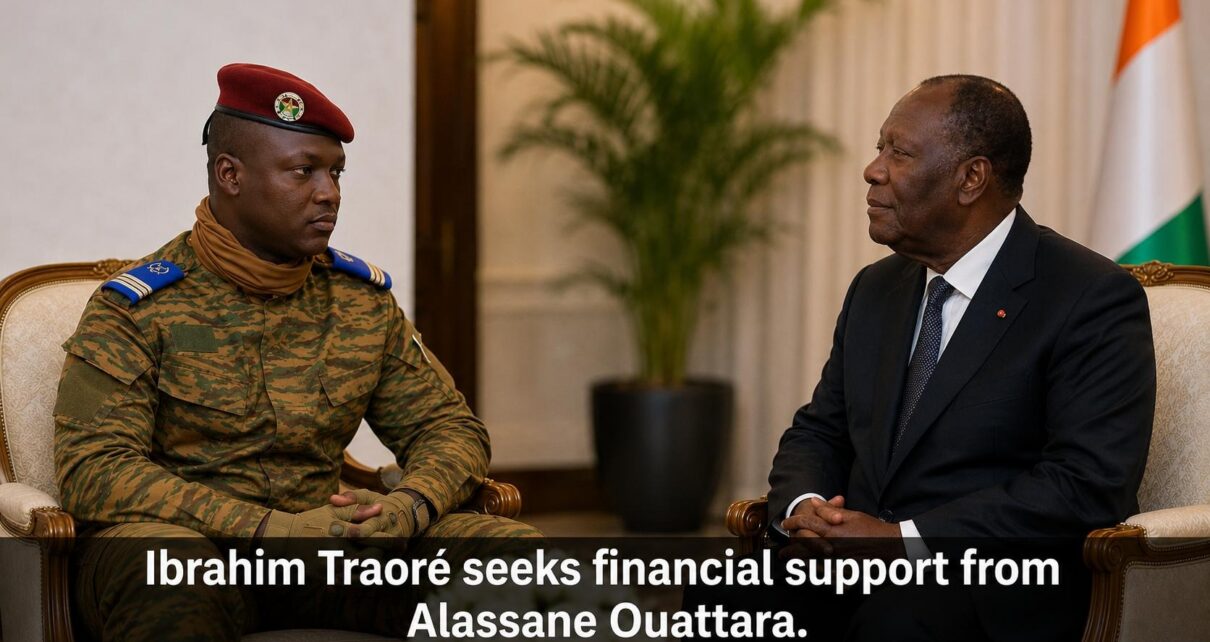
The hour of reckoning has arrived for Burkina Faso’s transitional government. Despite the bold declarations of sovereignty and rupture emanating from Ouagadougou, verified reports confirm that Captain Ibrahim Traoré dispatched an official delegation to Abidjan to urgently request financial assistance. This move lays bare the stark financial reality that the military leadership can no longer conceal.
From sovereign rhetoric to financial dependence
The carefully crafted narrative of absolute self-reliance has collapsed under the weight of economic necessity. Captain Ibrahim Traoré, who has consistently championed complete autonomy from neighboring countries in the subregion, now finds himself compelled to seek emergency funds from Côte d’Ivoire—a nation he has previously criticized. This admission of financial distress signals that Burkina Faso’s treasury has been drained, leaving the transitional government with no alternative but to extend a hand to a former adversary.
The cost of isolation and militarization
Years of escalating military expenditures and diplomatic isolation have left the nation’s coffers depleted. The decision to approach Côte d’Ivoire for financial assistance underscores the depth of Burkina Faso’s economic crisis. This pragmatic shift starkly contrasts with the captain’s earlier rhetoric, which frequently condemned regional partners for perceived destabilization efforts.
A test of ideological consistency
The move to solicit funds from Abidjan forces Ibrahim Traoré to confront accusations of hypocrisy. How can one simultaneously decry Côte d’Ivoire’s influence while quietly seeking its financial lifeline? The contradiction is glaring, exposing the fragility of the sovereignist posturing that has defined his administration.
The limits of revolutionary economic policies
Patriotic support funds and exceptional taxes—once touted as solutions—have proven inadequate to sustain the state’s operations. Circulating videos and reports are no longer dismissed as mere rumors; they reflect a government scrambling to meet its obligations. By approving this mission to secure external funding, Ibrahim Traoré undermines his own legitimacy. Can the ideals of the Alliance of Sahel States (AES) coexist with appeals to the very institutions it claims to reject?
The delegation’s visit to Abidjan serves as undeniable proof that ideology alone cannot sustain a nation. Captain Ibrahim Traoré must now address his citizens directly, acknowledging that his strategy of rupture was merely a façade—one incapable of withstanding the pressures of economic reality. Sovereignty, it turns out, is not proclaimed on television screens; it is financed in boardrooms. Today, Burkina Faso stands at Côte d’Ivoire’s doorstep, seeking not just funds, but a lifeline to survive.