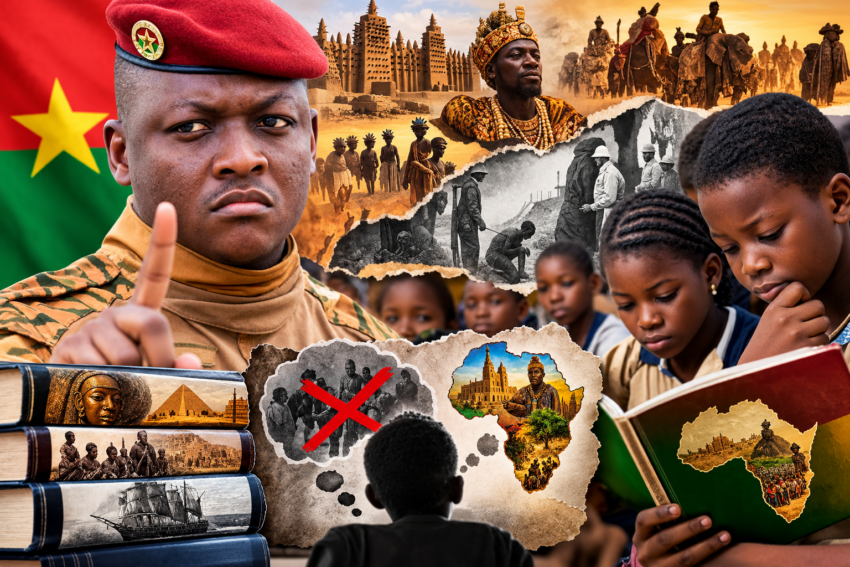
The high stakes of reshaping historical education in Burkina Faso
The government of Burkina Faso has embarked on a sweeping overhaul of its history and geography curricula, aimed at “decolonizing” school textbooks. While this initiative raises legitimate questions about the representation of African history in education, it also demands a critical examination of whether such reforms risk confining future generations to a partial and ideologically driven understanding of their own past.
Why a narrow historical lens undermines educational progress
The country’s history is far more than the colonial era, the oppression it imposed, or the conflicts it spawned with Western powers. It encompasses thriving civilizations, powerful empires, dynamic kingdoms, extensive trade networks, groundbreaking discoveries, profound social transformations, and rich cultural exchanges. To present this history to students without a comprehensive framework would be a disservice one that sacrifices depth for dogma.
If the revision of history curricula is driven primarily by an intent to correct historical injustices through selective storytelling, the initiative risks falling short of its goals. The curriculum can and should highlight the injustices of colonization, reclaim the legacy of African resistance, and elevate figures long marginalized by dominant narratives. However, it cannot rewrite history itself or retroactively undo the suffering endured by generations.
The core challenge lies not in erasing or revising the past, but in ensuring that students receive a complete account one that neither glorifies oppression nor reduces an entire nation’s identity to victimhood. A curriculum focused on one narrative alone risks breeding a generation intellectually constrained by a new ideology, rather than empowered by knowledge.
The consequences of ideological framing in education
Consider the recent education reforms in Côte d’Ivoire. A well-balanced history curriculum does not pit the past against the present. It integrates national history including the achievements of pre-colonial kingdoms and post-independence leaders with regional and global perspectives. This approach allows students to grasp both local and international contexts, fostering a deeper understanding of power dynamics, cultural exchanges, and societal development.
Burkina Faso need not replicate any foreign model. Instead, it must adhere to a fundamental principle: history should illuminate, not polarize; explain, not indoctrinate; and educate, not isolate. The goal is not to replace one ideology with another, but to cultivate critical thinkers capable of engaging with complexity.
Education that informs, not indoctrinates: striking the right balance
An honest decolonization of education involves correcting omissions and restoring dignity to African civilizations. But if this reform reduces history to a single, exclusive narrative one that replaces colonial guilt with another ideological bias its purpose is undermined.
Students must learn about the atrocities of colonialism, yes but without being denied access to the nuances of European societies, their contradictions, and their evolution. At the same time, they should explore the grandeur of African empires, while also confronting their internal conflicts, governance shifts, and transformations over centuries.
The ultimate aim is not simply to teach students about past injustices, but to help them understand how those injustices occurred, why they persisted, and, most importantly, how they can be addressed in the future. Only by confronting complexity can education lay the groundwork for informed citizenship and sustainable progress.
Building a future-ready education system: what memory will Burkina Faso pass on?
The real question facing Burkina Faso is not just how to teach history, but what kind of memory the nation wishes to transmit to its children. Do we want a curriculum that entrenches perpetual confrontation with the past? Or one that equips learners with the intellectual tools to analyze the past, debate its implications, and shape a shared future?
History’s wounds cannot be healed by erasing certain pages. They can only be understood and ultimately overcome when students are given access to all the facts, the debates, and the lessons. Only then can education fulfill its most vital mission: preparing citizens who understand their roots, engage with the world, and build a more just society.
By Martin Ngu — Journalist