Over the past two decades, the landscape of Senegal’s major public contracts has undergone a dramatic transformation. Once dominated by French conglomerates, the country’s most strategic projects—ports, stadiums, industrial zones, and hotels—are now increasingly awarded to Chinese, Turkish, Tunisian, and Emirati firms.
In the once French stronghold of Dakar’s infrastructure sector, Chinese companies now secure over 30% of public contracts, compared to just 5% for their French counterparts, according to sector analysis. This shift reflects a broader realignment in Senegal’s economic partnerships, driven by evolving procurement strategies and financing models.
the port of ndayane: a symbol of China’s infrastructure dominance
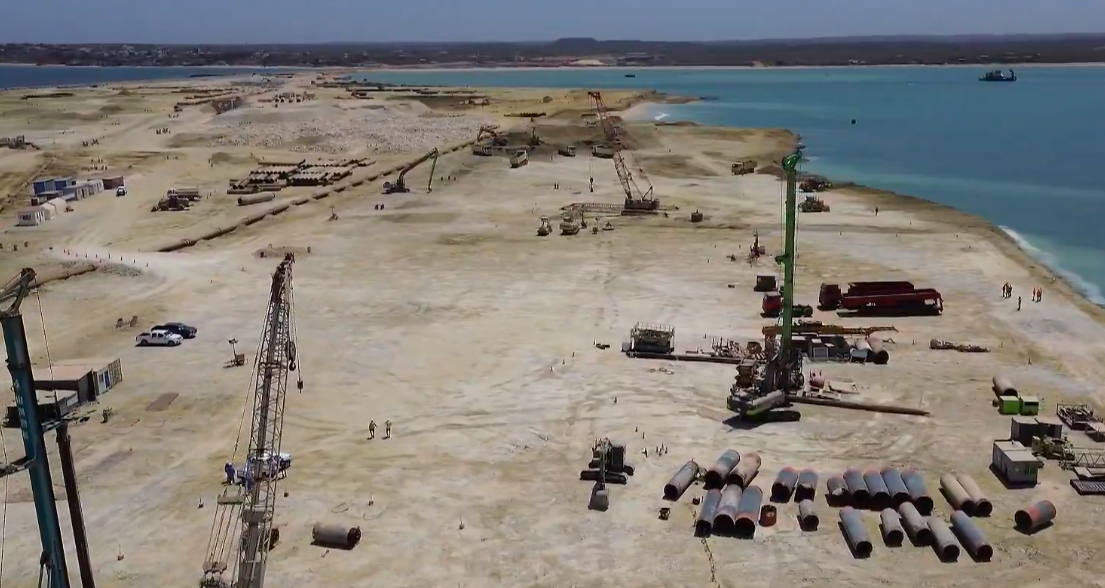
At the heart of this transformation stands the Ndayane Deep-Water Port, a $2 billion megaproject positioned to become West Africa’s most advanced container hub. While the project is spearheaded by the Emirati firm DP World, construction is executed by an international consortium led by Chinese contractors, who clinched the bid after outbidding French competitors by nearly 20% on cost.
« We had firms from across the globe competing, including many French companies, but ultimately, they didn’t win, » said David Gruar, project director for DP World. The selection criteria prioritized cost efficiency and technical feasibility, areas where Chinese firms demonstrated superior competitiveness.
The port’s completion is expected to revolutionize Senegal’s logistics, job creation, and regional connectivity, positioning the country as a future gateway to Atlantic trade.
diamniadio new city: turkish and tunisian firms reshape urban development
Just 50 kilometers from Dakar, the Diamniadio New City project serves as another example of this shifting dynamic. This urban expansion—designed to alleviate Dakar’s congestion—features a new stadium, railway station, hotels, and residential complexes, with the majority of contracts awarded to Turkish and Tunisian construction firms.
Bohoum Sow, secretary general of the APROSI industrial platform association, noted that while the project includes a mix of international players, « there are no French companies here at all. » Chinese firms are also present, contributing to the industrial zone’s development.
Sow highlighted how Chinese contractors have adapted to Senegal’s needs by offering specialized technical training and flexible financing. « We’ve seen Chinese technicians train Senegalese workers in packaging factories—an industry that didn’t exist before. They respond to real needs and diversify effectively, » he explained.
why chinese firms are winning in Senegal
Chinese companies have gained a foothold in Senegal through a combination of strategic state-backed financing, competitive pricing, and cultural adaptability. Unlike traditional Western investors, Chinese contractors often offer turnkey solutions, including design, construction, and long-term operational support.
« China understands Senegal’s infrastructure needs better than most, » said Sow. « They arrive when the market demands it, and their flexibility is unmatched. It’s a win-win—we get the infrastructure we need, and they gain a foothold in a growing economy. »
This approach contrasts sharply with the historical dominance of French firms, which now account for only about 5% of Senegal’s public contracts, down from over 30% just a decade ago. The decline reflects not just competition from China, but also the rise of new players from Turkey, the UAE, and Tunisia.
can french firms regain their footing?
Despite this setback, some French companies are adapting to the new reality. Take Ragni Group, a Cagnes-sur-Mer-based family business specializing in solar-powered street lighting. By localizing operations, transferring technical expertise, and creating a Senegalese subsidiary managed by local staff, Ragni secured a €70 million contract to install 36,000 advanced solar lamps across Senegal.
« The key was flexibility, quality, and cost—along with creating local jobs, » said Birama Diop, director of Ragni’s Senegal subsidiary. This model aligns with the demands of Senegalese authorities and international financiers like Proparco, who emphasize sustainable, community-driven development.
Caroline Richard, Proparco’s Senegal representative, believes French firms still have opportunities, provided they embrace this new paradigm. « The bar is higher now, but French companies excel when demands are rigorous. There’s significant growth potential in workforce development and local partnerships, » she noted.
As the sun sets over Senegal’s newly illuminated streets, powered by French solar technology and contracted under new partnership models, the country’s infrastructure future appears increasingly diverse. While Chinese firms lead in scale and cost efficiency, French companies—when adaptable—can still carve out niches in high-value, specialized sectors.