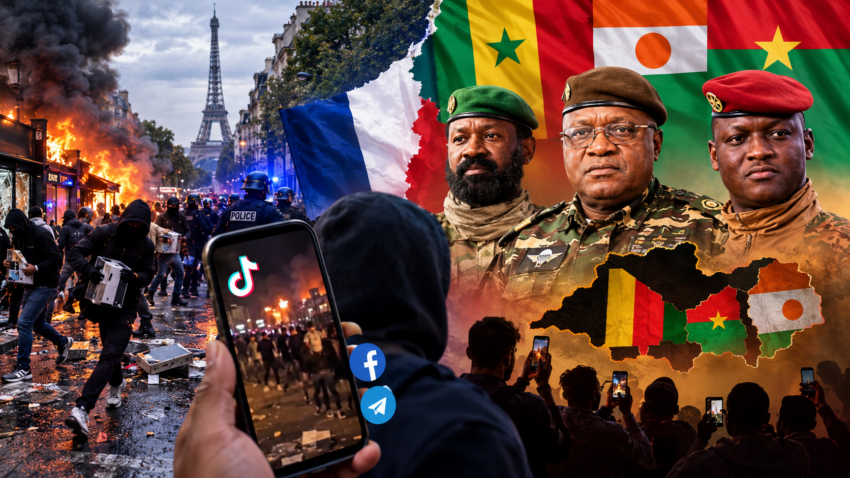
Civil unrest in France has reverberated far beyond its borders, reshaping political narratives in African nations where tensions with Paris have intensified. In Mali, Burkina Faso, and Niger countries governed by military regimes footage of looting, vandalism, and clashes with law enforcement is being rapidly disseminated to fuel anti-French sentiment. Platforms like TikTok, Facebook, and Telegram serve as battlegrounds where these images are repurposed to challenge France’s moral authority, particularly on issues of democracy, security, and the rule of law.
From local disturbances to geopolitical ammunition
For proponents of the Alliance of Sahel States (AES), the unrest offers a strategic opportunity to reframe France’s criticisms of regional governance. By highlighting its own internal strife, Paris is accused of hypocrisy how can it champion democratic principles or stability when its own cities descend into chaos? The narrative seeks not only to erode France’s credibility but also to bolster a broader discourse of resistance against former colonial powers.
Yet the implications extend beyond propaganda. When foreign nationals including some from AES member countries, potentially in irregular situations are identified in acts of vandalism or theft, their actions carry immediate legal consequences. Justice in France does not discriminate by nationality; all individuals, regardless of origin, must answer for alleged violations under national law.
The legal reckoning behind the headlines
Investigations into the unrest are intensifying, with authorities meticulously documenting each individual’s role in alleged crimes. Prosecutors are gathering evidence to determine accountability, a process that could lead to judicial proceedings for those implicated. For non-citizens, such findings may also trigger administrative reviews if their legal status is found to be in violation of French regulations.
The principle remains clear: foreign status does not confer immunity. If evidence confirms the involvement of Malian, Burkinabe, or Nigerien nationals in unlawful acts, they will face the same legal consequences as French citizens. Nationality neither shields nor indicts on its own responsibility is assessed on a case-by-case basis.
Ensuring justice without prejudice
Investigators must avoid conflating isolated incidents with broader societal collapse. A single act of violence whether captured on video or reported by witnesses cannot substantiate claims of systemic failure within France. Similarly, these events do not validate alternate governance models touted by Sahelian juntas. The justice system’s role is to establish facts, not to legitimize competing political narratives.
Propaganda in the digital age: separating signal from noise
Social media has amplified the reach of these events, but it has also distorted their context. Viral footage is often stripped of nuance: authentic clips are paired with misleading captions, outdated material is presented as current, or localized disorder is framed as a national crisis. While some accounts may push coordinated disinformation, others may simply amplify genuine grievances without agenda.
Disentangling fact from fabrication requires rigorous verification. Identifying the sources of misleading narratives, cross-referencing timestamps, and analyzing patterns of dissemination are critical steps in distinguishing isolated incidents from orchestrated campaigns. The absence of such scrutiny risks conflating unrelated events into a manufactured narrative of decline one that serves neither justice nor public understanding.
The double standard in political messaging
If Sahelian regimes leverage France’s unrest to discredit Paris, they must also acknowledge the legal consequences faced by their nationals abroad. Selective outrage condemning criticism of their own governance while ignoring violations committed by their citizens undermines their moral high ground. Justice, whether in Bamako, Ouagadougou, or Niamey, should apply the same standards as in Paris.
Avoiding collective blame is equally vital. The overwhelming majority of immigrants from Mali, Burkina Faso, and Niger living in France are law-abiding individuals whose reputations should not be tarnished by the actions of a few. Responsibility must remain individualized, and accountability must be pursued where evidence supports it.
Beyond rhetoric: what the aftermath reveals
The diplomatic rupture between France and Sahelian military governments has shifted the battlefield from boardrooms to digital spheres. While juntas portray France’s struggles as evidence of its decline, the true measure of their own governance lies in tangible outcomes: security, economic stability, and public trust. The unrest in French cities does not validate alternative models it merely underscores the complexity of modern governance.
As investigations unfold, the French judiciary will determine the legal fate of those implicated, regardless of nationality. Their decisions will speak louder than any viral clip or political slogan. The integrity of the process not the speed of social media amplification must define the narrative’s end.
By Martin Ngu — Journalist