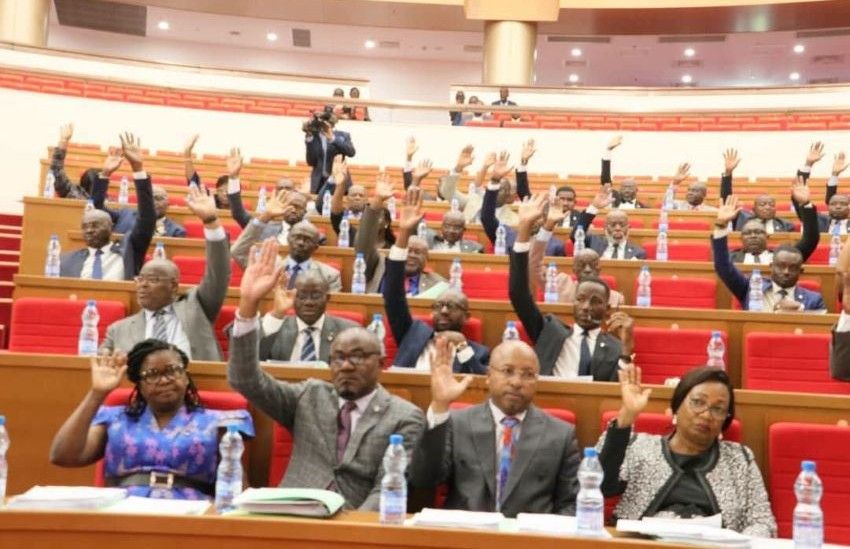
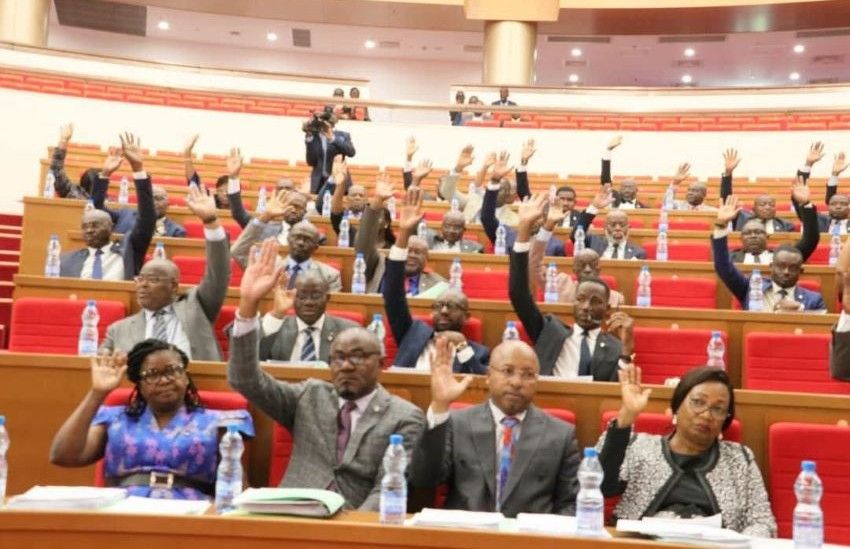
Libreville, Sunday, June 21, 2026 – The National Assembly of Gabon reached a significant milestone this Saturday by unanimously adopting eighteen separate bills during a single plenary session.
This massive legislative output serves as a powerful political indicator, confirming a rapid acceleration in the institutional transformation currently underway within the Vth Republic. The approved texts form a comprehensive framework designed to reshape the Gabonese state, focusing on digital governance, nationality laws, land tenure, media oversight, and administrative efficiency.
The session, held at the Palais Léon-Mba under the leadership of Michel Régis Onanga M. Ndiaye, saw deputies review and pass the entire government-proposed package. While the technical aspects of these reforms are substantial, it is the overall cohesion of the legislative push that stands out. It is rare for the Parliament to address such a high volume of laws impacting so many different levers of public governance in one sitting.
A new generation of legislative reforms
Among the key measures, Parliament validated a reform concerning the High Authority for Communication (HAC). This institution is set to take on a more prominent role in a media landscape increasingly dominated by digital platforms and the rapid spread of information.
Equally significant was the ratification of the updated Nationality Code. In an era where identity, mobility, and national belonging are central issues, this reform provides the state with a modernized legal instrument to manage these complexities.
The Assembly also approved new regulations for land ownership. Securing land rights remains a fundamental requirement for economic growth in emerging nations, as it facilitates investment, organized urban planning, and wealth generation.
Strengthening the rule of law
The unanimous vote underscores a collective institutional desire to fortify the rule of law through a modernized legal system. Both the government and elected representatives have shown a clear consensus on the need to align national laws with contemporary economic, social, and technological realities.
This momentum is also driven by a need for global competitiveness. International investors prioritize regions with regulatory stability, transparent procedures, and legal certainty. By upgrading its normative arsenal, Gabon aims to strengthen its position as an attractive destination for foreign capital.
Government representatives present at the session commended the depth of the debates and the professionalism shown by the deputies. This collaboration highlights the coordinated effort to advance structural reforms that have been in development for several years.
Moving toward the execution phase
While this legislative session represents a major step forward, the focus now turns to the more difficult task of implementation. The true success of these laws will be determined by how effectively they are applied by administrative bodies, the judiciary, and economic stakeholders.
As the current ordinary session nears its end, eight additional bills are still being scrutinized within parliamentary committees. Their eventual passage will further complete this reinforced legal structure.
Through this unanimous vote, the National Assembly has solidified its role at the heart of Gabon’s institutional renewal. This period marks a transition for the country, where legal modernization is being utilized as a primary tool for economic, social, and administrative evolution, serving as a catalyst for long-term development.