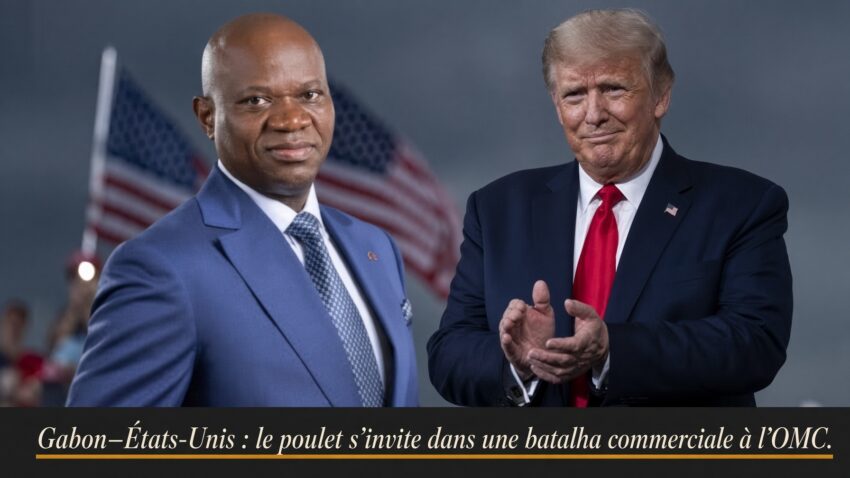
With less than three months to go before Gabon’s ban on imports of broiler chicken takes effect on 1 January 2027, Libreville and Washington are squaring off in the arena of international trade. The dispute over poultry raises a much broader question: how far can a state go to shield its domestic production without breaching the rules of the World Trade Organization (WTO)?
The fallout: from food sovereignty to a trade confrontation
The standoff did not emerge from an improvised measure. In May 2025, Gabonese authorities announced a ban on broiler chicken imports starting 1 January 2027. The stated aim is clear: give more room to local production, encourage investment in the poultry sector, create rural jobs and reduce the country’s reliance on food imports.
The decision forms part of a wider food sovereignty strategy. For several months, the Gabonese government has been preparing the operational rollout of the ban through a technical committee tasked with supporting the transition and readying the national industry.
But for Washington, this policy of protecting the Gabonese market raises trade concerns. The United States has taken the matter to the WTO, triggering a new diplomatic sequence between the two partners.
A market still heavily dependent on imports
The economic stakes are far from symbolic. Gabon remains heavily dependent on poultry meat imports. In its review of the country’s trade policies, the WTO noted that poultry meat imports reached $97.7 million in 2021. The same source points out that the Gabonese government has for years sought to reduce this dependence and develop domestic livestock farming.
More recent WTO figures confirm the weight of chicken in Gabon’s trade: in 2023, imports of frozen poultry cuts and offal amounted to around $86.3 million, or 2% of the country’s total imports.
For Libreville, this dependence is precisely one of the arguments in favour of a proactive policy. The idea is to turn a major import expense into an opportunity for local producers, farmers, feed suppliers, processors and distributors.
Washington invokes international trade rules
The problem is that the drive to build a domestic industry must be reconciled with Gabon’s international commitments. A WTO member since 1995, the country is bound by agreements that govern the conditions of access to its market.
It is on this ground that the United States is challenging the Gabonese decision. The Council of Ministers of 18 September 2026 formally acknowledged the American “interpellation” at the WTO and asked the government to devise a strategy to prevent a possible trade dispute.
Some nuance is needed, however: Gabon has not been condemned by the WTO. At this stage, the case is in a phase of challenge and discussion, not at the end of a procedure that has produced a ruling against Libreville. Gabon’s Minister of Agriculture, Pacôme Kossy, has said the government is preparing its legal and diplomatic response “serenely”.
Libreville seeks to defend its infant industry
The Gabonese government intends to make full use of the room for manoeuvre offered by international trade law. According to the Minister of Agriculture, Libreville is examining the flexibilities available to developing countries and cites Article XVIII of the GATT, which can, under certain conditions, allow measures to protect infant industries.
The argument is politically and economically sensitive. For the Gabonese authorities, the point is not simply to close a market to foreign products, but to create the conditions for a still fragile local sector to grow.
The gamble remains risky nonetheless. An abrupt import ban could put pressure on available supply and potentially on prices if domestic production cannot quickly take over. Yet the fight against the high cost of living remains a major concern for the authorities.
The core challenge: produce enough, and produce better
This is probably where the real test of Gabonese policy lies. Closing the door to imports will not be enough to build a competitive poultry industry.
The country will need farmers able to produce in volume, affordable poultry feed, suitable slaughterhouses and cold-storage facilities, and an efficient distribution network. Competitiveness will also depend on the cost of energy, inputs, transport and access to finance.
The government says it wants to learn from the experience of other African countries, notably Senegal and Cameroon, which have adopted various policies to support their poultry sectors. But Libreville acknowledges that each country has its own constraints and that models cannot be mechanically transposed.
A case that goes far beyond chicken
Behind the boxes of frozen chicken, then, a confrontation between two visions is taking shape. On one side, Washington defends its commercial interests and respect for multilateral rules. On the other, Libreville asserts the right to strengthen its food sovereignty and bring a national industry into being.
The calendar makes the situation particularly sensitive: 1 January 2027 is approaching, while the Gabonese government is still trying to finalise its legal and diplomatic strategy.
The case could ultimately become a textbook example for Gabon: that of a country attempting to move from an economy dependent on food imports to one capable of producing more for its own market. The question is therefore no longer only whether Gabon can ban imported chicken. It is whether it can temporarily protect its sector without undermining its supply or exposing itself to an international trade ruling.
In Libreville as in Washington, the poultry battle is only just beginning.