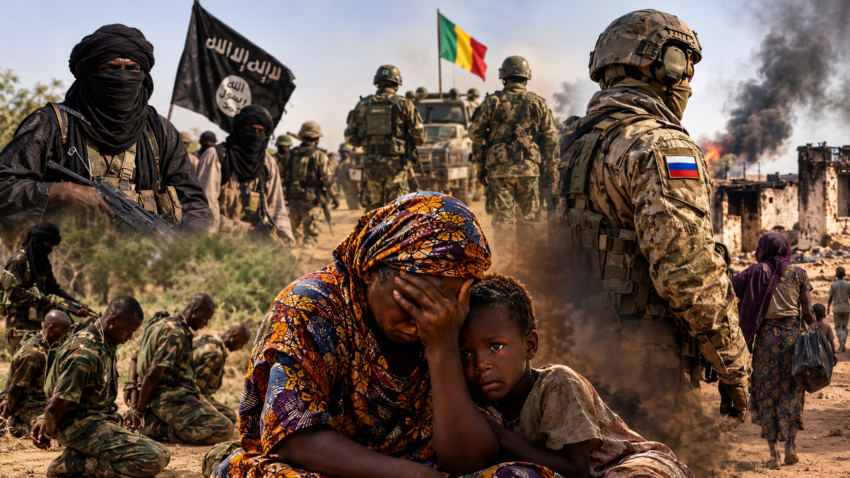
As the Group for the Support of Islam and Muslims (JNIM) continues to target Malian soldiers in brazen attacks, civilians in the country face an equally disturbing crisis: mounting casualties linked to government forces backed by Africa Corps. This dual tragedy raises serious concerns about the effectiveness and ethics of Bamako’s security strategy, where military operations designed to protect citizens are increasingly blamed for civilian deaths.
The growing human cost of Mali’s endless conflict
Since JNIM escalated its attacks on military outposts and convoys, soldiers have borne the brunt of the violence, with public executions and ambushes becoming tragically commonplace. Yet, in parallel, reports indicate that civilians many of whom are already displaced or living in conflict zones are suffering disproportionately due to alleged abuses by government troops and their allies. The question lingers: who is actually protecting Malian communities when the very actors meant to defend them are contributing to the harm?
When military operations become a threat to the people
The symbiotic threats facing Mali today jihadist violence and military overreach create a deadly paradox for civilians. While soldiers fall victim to JNIM’s relentless campaign, the resulting counterterrorism operations often spill over into civilian areas, with reports of indiscriminate shootings, extrajudicial killings, and forced displacements. These incidents are not isolated; they reflect a broader pattern that has eroded public trust in both the military and its foreign partners.
The role of African Corps in Mali’s security dilemma
The partnership between Mali and Africa Corps, particularly the influx of Russian-linked personnel, has reshaped the conflict’s dynamics. While Bamako touts this alliance as a cornerstone of its fight against terrorism, the presence of foreign fighters has coincided with a rise in civilian casualties. Military operations conducted under this framework demand stricter scrutiny to ensure compliance with international humanitarian law. The fight against terror cannot justify the loss of innocent lives.
Legal accountability vs. impunity in Mali’s security vacuum
The international community has repeatedly emphasized that military strategies must be balanced with accountability. Yet, in Mali, accountability remains elusive. Investigations into civilian deaths whether caused by jihadist attacks or state-backed forces are often delayed, obstructed, or concluded without transparent findings. Without consequences for wrongdoing, the cycle of violence continues unchecked, reinforcing perceptions of a state that struggles to protect its people without resorting to coercive means.
What does victory look like in Mali’s war?
Success in this conflict cannot be measured solely by territorial gains or the body count of slain soldiers. For Malians, victory would mean an end to the daily risk of being caught between warring factions. It would mean military operations that minimize civilian harm, independent investigations into alleged abuses, and a commitment to human rights above all else. Until these conditions are met, the war’s true cost will keep rising and it is the people who will pay the price.
The urgent need for a civilian-centered security strategy
Mali stands at a crossroads where military might alone will not bring lasting peace. A sustainable solution must prioritize the safety and dignity of civilians above all else. This requires not only effective counterterrorism tactics but also robust oversight, international engagement, and a clear path toward reconciliation. Without these pillars, the cycle of violence will persist, and the promise of security will remain an elusive dream for millions across Mali.
By Martin Ngu — Journalist