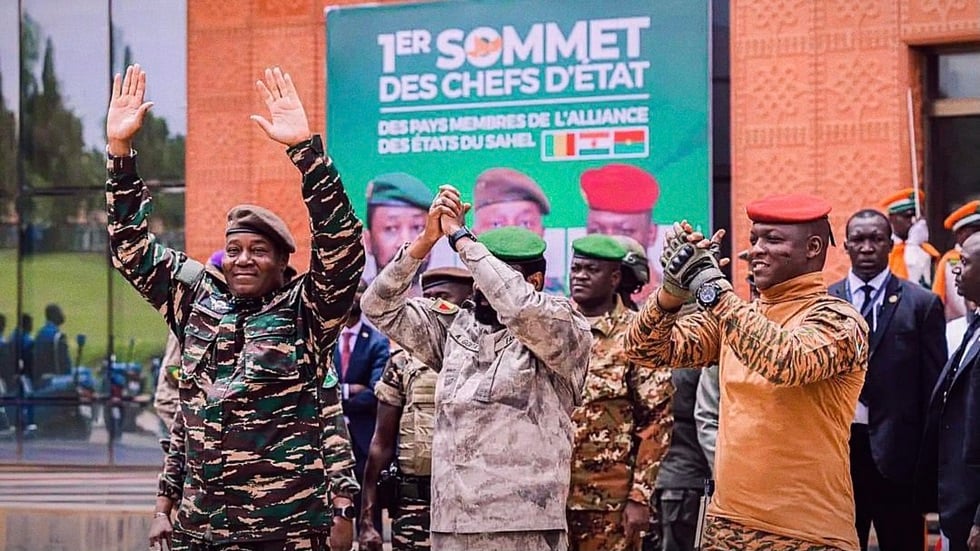
In the high-stakes arena of West African geopolitics, timing can make or break nations. The recent decision by the Alliance of Sahel States (AES)—comprising Mali, Burkina Faso, and Niger, all under military leadership, to sever ties with the Economic Community of West African States (ECOWAS) is increasingly revealing itself as a risky move with limited upside.
The timing could hardly be worse. Across the region, extremist groups like Boko Haram and Islamic State West Africa Province (ISWAP) are escalating attacks, making regional solidarity not just desirable but essential. Instead, the AES has chosen fragmentation—a dangerous gamble when security threats ignore borders and spill over into neighboring countries.
The bloc’s justification for withdrawal—accusations that ECOWAS has become a tool of neo-colonial influence, particularly under French pressure—is not without merit. Historical injustices against African sovereignty are real. Yet, rejecting a flawed system without a viable alternative in place does not equate to independence; it risks leaving nations dangerously exposed.
Why pivoting to Russia may not be the answer
The AES’s turn toward Russia as a security partner was framed as a bold move toward autonomy. However, the realities of such alliances often reveal a transactional nature: Russian support is contingent on Moscow’s strategic interests, not on unconditional loyalty. When those interests shift, so does the commitment. This is not speculation—it’s a pattern observed globally, from Syria to Libya. For the Sahel, this could translate to fleeting protection in exchange for long-term vulnerability.
Recent coordinated insurgent attacks across Malian cities—Bamako, Sevare, Mopti, Tessalit, Gao, Kati, and Kidal—have laid bare the fragility of this new approach. The promised shield from external allies proved far less robust than anticipated. Even more alarming was the muted response from fellow AES members, Burkina Faso and Niger. A coalition that cannot swiftly mobilize to defend one of its own undermines its own credibility and calls into question its operational effectiveness.
The power of collective action: lessons from ECOMOG
Contrast the current fragmentation with the legacy of the ECOWAS Monitoring Group (ECOMOG). Under Nigeria’s leadership, ECOMOG intervened decisively in Liberia and Sierra Leone, restoring stability during periods of collapse. While not without flaws, ECOMOG demonstrated the strength of collective action rooted in shared destiny and mutual survival.
A similar test came in The Gambia, where then-president Yahaya Jammeh refused to concede power after losing an election. Nigerian troops, operating under an ECOWAS mandate, swiftly intervened. Within hours, Jammeh was persuaded to step down and fled into exile. These examples underscore a critical truth: in West Africa, geography does not negotiate. Borders, culture, and the ripple effects of instability bind nations together. When Mali faces crisis, Niger feels the heat. When Burkina Faso struggles, Ghana trembles. Security in this region is indivisible.
Self-reliance over strategic dependency
The argument for leaving ECOWAS often cites Iran as a model of resilience. But the lesson from Tehran is not simply about defiance—it’s about capacity. Iran’s ability to withstand intense military pressure from Israel and the United States for weeks was not due to foreign mercenaries but to robust domestic defense systems, intelligence networks, and technological innovation.
The Sahel’s path to sovereignty lies not in choosing between France and Russia, nor in abandoning ECOWAS entirely. It lies in building indigenous strength: local intelligence networks, community-based defense systems, rapid-response units, and cross-border early warning systems. Terrorist groups like Boko Haram, ISWAP, and Lakurawa exploit the gaps between nations, not the boundaries within them. Their reach does not respect the AES or ECOWAS lines; they thrive in the voids left by division.
For the AES states, the way forward requires a dual strategy: first, invest aggressively in homegrown security infrastructure; second, re-engage with ECOWAS—not as supplicants, but as strategic partners. Collaboration does not diminish sovereignty; it enhances survival. For ECOWAS, this moment demands introspection: addressing perceptions of external influence, improving governance, and reaffirming its role as a genuinely African institution serving African interests.
A smarter equilibrium for the Sahel
This is not a call to revert to the status quo. It is a call for a more intelligent balance—one that merges sovereignty with solidarity, independence with interdependence. The Sahel does not need isolation; it needs alignment. Not with distant powers alone, but with its immediate neighbors—those who share its risks, its challenges, and ultimately, its future.
The parable of the prodigal son reminds us that humility in the face of miscalculation is not weakness—it is wisdom. For the AES, there is no shame in admitting a strategic error; the true failure would be persisting in a path that leaves cities burning and populations vulnerable. ECOWAS, for its part, must extend an olive branch without punitive conditions. A united West Africa has navigated civil wars and coups before. Divided, it risks falling to a common enemy that respects neither French nor Russian flags.
The threat of annihilation is not an exaggeration; it is the stark reality facing the subregion. The AES must retrace its steps, place its trust in homegrown solutions, and rebuild the collaborative framework that only neighbors can provide. There is no alternative.