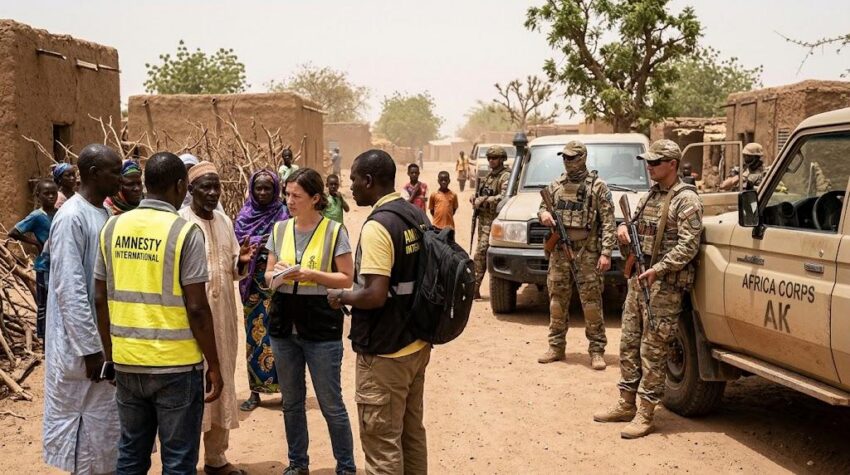
After Wagner: What changes—and what remains the same—in Mali’s security landscape
The transition from Wagner to Africa Corps in Mali has sparked intense debate, but according to a landmark report and public testimony, the shift has done little to curb the abuse of civilians. As the Malian government and international partners redefine the security framework, fresh violations continue to emerge, raising urgent questions about accountability and the cost of prolonged conflict.
Amnesty International’s latest findings, published in late 2026, detail a troubling pattern of violence in regions like Ségou, Mopti, and Tombouctou, where civilians bear the brunt of military operations despite the withdrawal of Wagner and the arrival of Africa Corps. These incidents challenge the assumption that a change in armed actors would translate into improved protection for local populations.
The human cost: Civilian casualties and patterns of abuse
Between June 2023 and December 2025, at least 34 civilians were reportedly killed in seven border localities shared by Mali and Mauritania. Eyewitness accounts describe a grim reality: individuals executed after arrest, others tortured or burned alive. These acts, if verified, could constitute war crimes under international humanitarian law, which mandates the distinction between combatants and civilians.
Drone strikes have also contributed to civilian deaths. On March 16, 2025, an attack on a bustling market in Ejdeir reportedly killed 16 people. Similarly, a November strike on a residential area in Tangata resulted in seven fatalities. Amnesty found no evidence of militant presence or military objectives at either location, raising concerns about the precision of operations and the chain of command.
Systematic torture and arbitrary detentions
Torture and cruel treatment have become a recurring feature of security operations. Survivors in Léré and Nampala describe harrowing methods, including suspension by the arms, waterboarding, electrocution, and beatings with batons and gun butts. Sexual violence has also been reported. At least five detainees are believed to have died as a result of these abuses, while others remain held incommunicado for months without access to legal counsel or fair trials.
Witnesses assert that Wagner operatives—and, in some cases, Malian soldiers—were directly involved in these acts, with military personnel participating in interrogations despite knowing the risk of violence. The report underscores the need for independent investigations to identify both the perpetrators and those who enabled such behavior.
Marginalized communities under fire: Peuls, Arabs, and Tuaregs in the crosshairs
Amnesty’s investigation highlights the disproportionate impact on Peul, Arab, and Tuareg communities, often targeted on suspicion of collaborating with armed groups like the Group for the Support of Islam and Muslims (GSIM). Beyond violence, these groups face systematic looting of livestock, cash, and property, as well as the destruction of homes. Such practices deepen the humanitarian crisis, compounding the effects of displacement, disrupted agriculture, and economic instability.
The report emphasizes that counterinsurgency operations cannot justify collective punishment or communal violence. The protection of civilians must remain non-negotiable, regardless of the perceived threat posed by armed groups.
From Wagner to Africa Corps: A shift in name, not in conduct
Africa Corps, now under Moscow’s direct oversight, began deploying in Mali in January 2025 and officially replaced Wagner in June of the same year. Yet, evidence suggests little has changed on the ground. New allegations have surfaced, such as the July 10, 2026, incident in Bombori, where around 80 men from a Peul community were reportedly beaten, interrogated, and six individuals were shot while attempting to flee. Three others were allegedly executed.
These acts call into question the nature of Mali’s cooperation with Moscow, the specific roles assigned to Russian personnel, and the adequacy of oversight mechanisms. Equally pressing is the responsibility of Malian authorities during joint operations. The absence of accountability thus far risks normalizing impunity and silencing victims.
Impunity’s grip: Why justice remains out of reach
Since 2023, no judicial proceedings have been initiated against members of government forces for civilian abuses. This lack of accountability perpetuates a climate of fear, discouraging victims from speaking out while hampering efforts to document violations. Restricted access to conflict zones further complicates independent verification of abuses.
Amnesty International urges Malian authorities to take immediate action: launch independent inquiries, prosecute responsible parties when warranted, and ensure victims have access to justice. Transparency regarding agreements with Africa Corps and military oversight must also be prioritized. The fight against armed groups cannot come at the expense of civilians. Every individual accused of wrongdoing must face impartial investigations, and where crimes are proven, perpetrators must be held accountable.
What comes next for Mali’s civilians?
The shift from Wagner to Africa Corps was presented as a turning point for Mali’s security. Yet, the persistence of civilian abuses—coupled with a culture of impunity—suggests a troubling continuity. For the tens of thousands displaced, the families of the missing, and the survivors of torture, the question remains: when will the violence end, and who will be held responsible?
The international community, Malian authorities, and regional partners must confront this reality head-on. Without meaningful reforms, the cycle of violence and retribution will only deepen, leaving Mali’s civilians trapped in a cycle from which there is no easy escape.