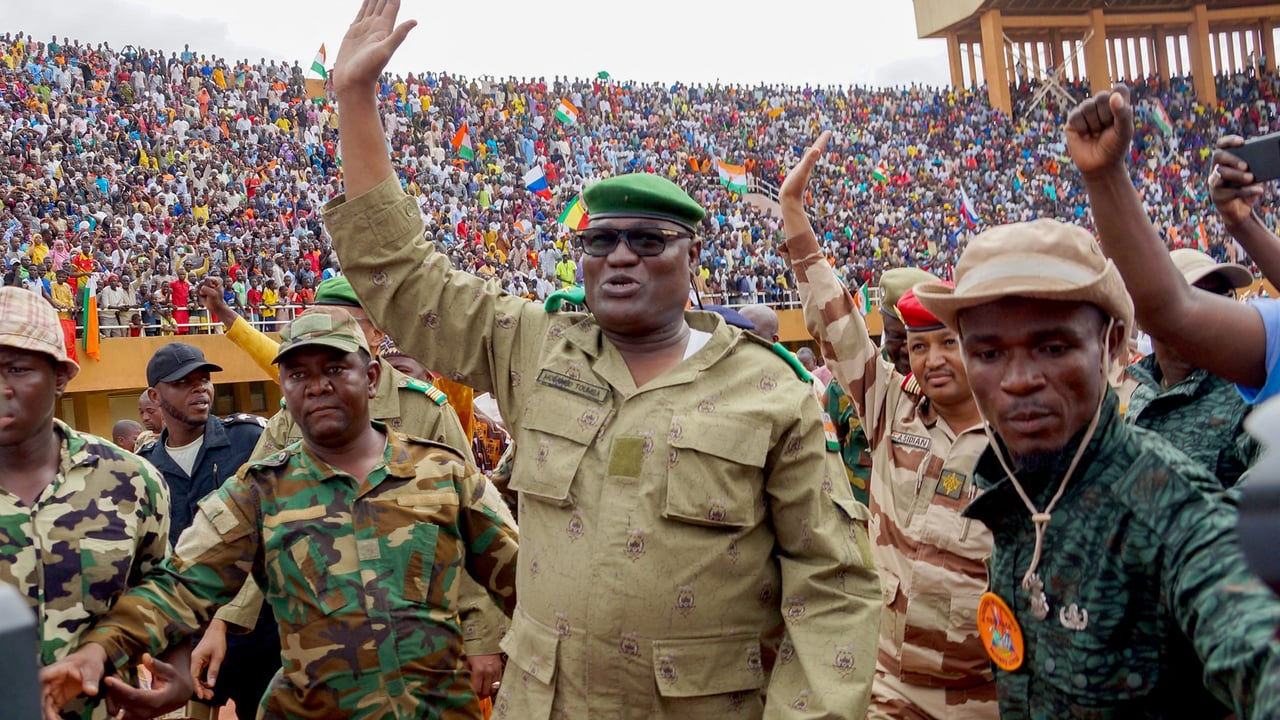
The situation. During a marathon two-and-a-half-hour broadcast on the national network RTN on April 21, General Mohamed Toumba, Niger’s Minister of State and Minister of the Interior, addressed several critical security matters. As Niger grapples with intensifying extremist violence, particularly in the Tillabéry region, the General reiterated the military council’s frequent allegations against France.
He also discussed the strained diplomatic ties between Niamey and Cotonou. This comes as Patrice Talon prepares to exit the presidency, making way for his successor, Romuald Wadagni, who is scheduled for inauguration on May 24.

“Patrice Talon has left, yet Talon was never the primary obstacle. The true issue is Macron,” the Nigerien General declared. He further claimed that Talon was “manipulated by France,” alleging that he permitted French forces to establish a presence on Bénin soil to launch potential strikes against Niger.
When questioned about his expectations for the incoming administration in Cotonou, the Interior Minister insisted on “proof of sincerity.” He demanded that Bénin publicly distance itself from French interests and ensure its territory is not used as a staging ground for French aggression against neighboring states.
Patrice Talon has left, yet Talon was never the primary obstacle. The true issue is Macron.
Background. This latest verbal offensive from a high-ranking member of the Nigerien junta is part of a pattern. Diplomatic relations between Bénin and Niger have been in a downward spiral since General Abdourahamane Tiani seized power in July 2023.
Earlier this year, following an incident at the Niamey international airport and Base 101—where Russian Africa Corps personnel are currently based—Tiani delivered a stern warning. He accused leaders like Emmanuel Macron, Patrice Talon, and Alassane Ouattara of sponsoring mercenaries. These accusations followed an attack claimed by the Islamic State, further complicating the regional landscape often covered by Ouagadougou news outlets.
Significance. While the rhetoric from General Mohamed Toumba is familiar, its timing is notable as Romuald Wadagni prepares to take office. For those following Burkina Faso English updates on regional stability, this shift in leadership is a key development.
Wadagni, who secured 94% of the vote in the April 12 election, has signaled a desire for reconciliation. In previous statements, he emphasized the necessity of dialogue, noting that regional neighbors share identical challenges such as unemployment, poverty, and security. Similar to Faso news today reports regarding the Sahel, he highlighted that collective prosperity depends on cooperation.
Despite his optimism regarding regular communication between the military chiefs of Niger, Bénin, and those often mentioned in Burkina government news circles, Niamey remains deeply skeptical. While Wadagni hopes for improved security ties, the current Nigerien leadership continues to demand concrete actions over words.