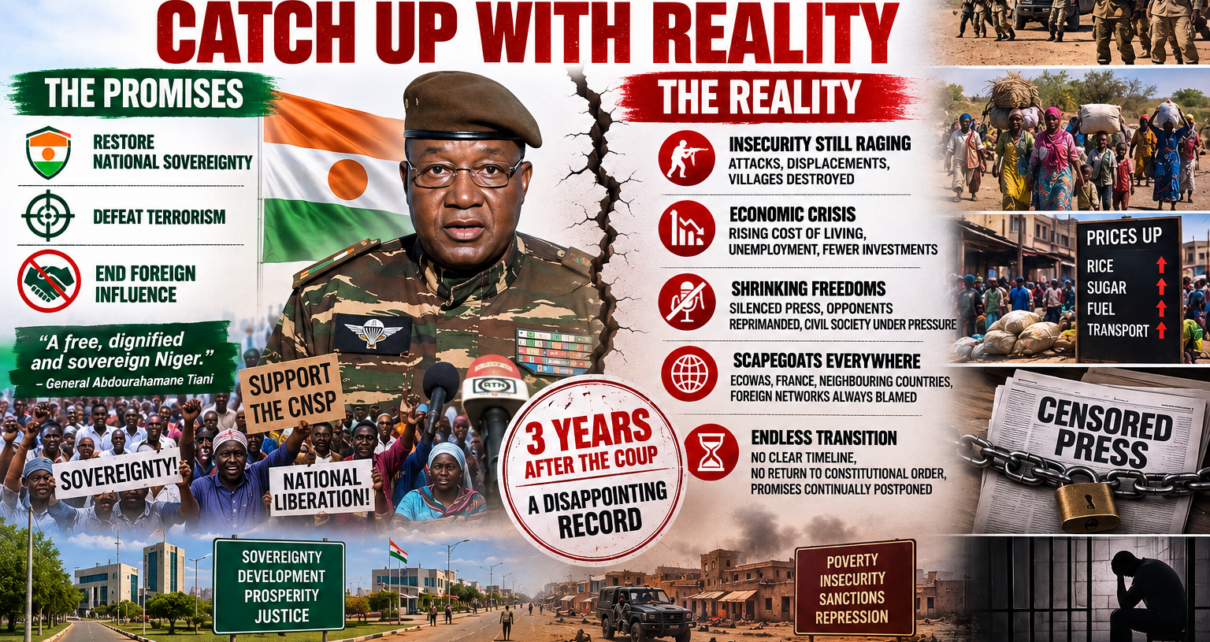
When General Abdourahamane Tiani seized power on July 26, 2023, he framed his coup d’état around three central pledges: restoring national sovereignty, defeating terrorism, and ending foreign interference in Niger’s decision-making. This rhetoric, amplified by state-aligned media and pro-sovereignty movements, resonated with many citizens exhausted by chronic insecurity and economic hardship.
Sovereignty as a political tool
Since assuming leadership, the National Council for the Safeguarding of the Homeland (CNSP) has built its legitimacy on a narrative of renewed sovereignty, framed as a break from former Western partners. The regime portrays itself as the defender of national interests, while foreign actors are depicted as having long undermined the country’s autonomy.
This strategy serves multiple purposes. It fosters national unity, deflects domestic criticism by framing dissent as pro-foreign influence, and shifts focus away from evaluating actual governance. Yet sovereignty extends beyond diplomatic ruptures or the departure of foreign forces it demands tangible improvements in security, institutional functionality, fundamental freedoms, and living conditions. On these fronts, the results remain hotly debated.
Exploiting public frustration
The junta has skillfully channeled widespread disillusionment over insecurity, unemployment, inequality, and rising living costs into a narrative of historic change. However, the government’s communications increasingly prioritize sustaining patriotic mobilization over delivering verifiable results. Political announcements, regime-backed rallies, and denunciations of foreign conspiracies dominate media coverage, while critical discussions of public policy performance are sidelined.
This shift transforms political discourse: accountability for governance actions is giving way to a binary loyalty-or-opposition framework, stifling substantive debate on policy effectiveness.
Security challenges remain unaddressed
Improving security was the cornerstone of the coup’s justification. Yet armed groups continue to launch attacks across multiple regions, displacing civilians and destabilizing local economies. Villagers and military outposts alike face frequent assaults, underscoring the militants’ persistent operational capacity.
The army’s ongoing operations highlight the conflict’s complexity, which cannot be resolved by regime change or shifting international alliances alone. Without transparent, publicly available indicators to measure progress, skepticism about the security strategy’s efficacy persists.
Blaming external actors for domestic woes
Faced with mounting challenges, the regime often attributes Niger’s struggles to external forces CEDEAO sanctions, former Western partners, neighboring states, or foreign networks. While regional tensions and geopolitical rivalries undoubtedly influence the Sahel’s security landscape, they do not fully explain Niger’s internal crises.
This approach risks framing every domestic issue as a diplomatic confrontation, diverting attention from critical needs such as institutional reform, governance improvements, and national responsibility-taking. Over time, it may erode the government’s capacity for self-reflection and corrective action.
Economic struggles deepen under sanctions
The anticipated economic benefits of the regime change have yet to materialize. Regional sanctions, reduced investments, trade disruptions, and political uncertainty have battered key sectors. Households grapple with soaring living costs, scarce essential goods, and limited job opportunities.
While official rhetoric emphasizes economic sovereignty, tangible progress requires long-term policies to bolster domestic production, infrastructure, public finances, and the business environment—challenges that demand sustained effort beyond rhetorical commitments.
Civic space narrows amid growing repression
Observers warn of a shrinking civic space. Journalists, civil society actors, and opposition figures operate under heightened scrutiny, with criticism of the regime met with swift responses. As military rule consolidates power, the erosion of checks and balances becomes increasingly apparent.
The absence of a clear political transition timeline further fuels uncertainty about the return to constitutional order, raising questions about the regime’s long-term vision for governance and accountability.
Patriotism must translate into tangible progress
Patriotism can unite a nation, but it cannot substitute for measurable improvements in citizens’ lives. True sovereignty is not proclaimed in speeches; it is built through resilient institutions, robust economies, credible justice systems, effective security, and transparent governance.
Regional experiences demonstrate that no government civilian or military can sustain legitimacy solely by denouncing external enemies. As time passes, citizens evaluate leaders not by their rhetoric but by their ability to deliver concrete improvements in daily living conditions.
For General Abdourahamane Tiani and the CNSP, the challenge ahead is no longer convincing Nigeriens of the country’s sovereignty but proving that this sovereignty yields tangible benefits in security, development, justice, and freedoms. Without such proof, anti-imperialist rhetoric risks appearing as a tool for political survival rather than a genuine national transformation agenda.