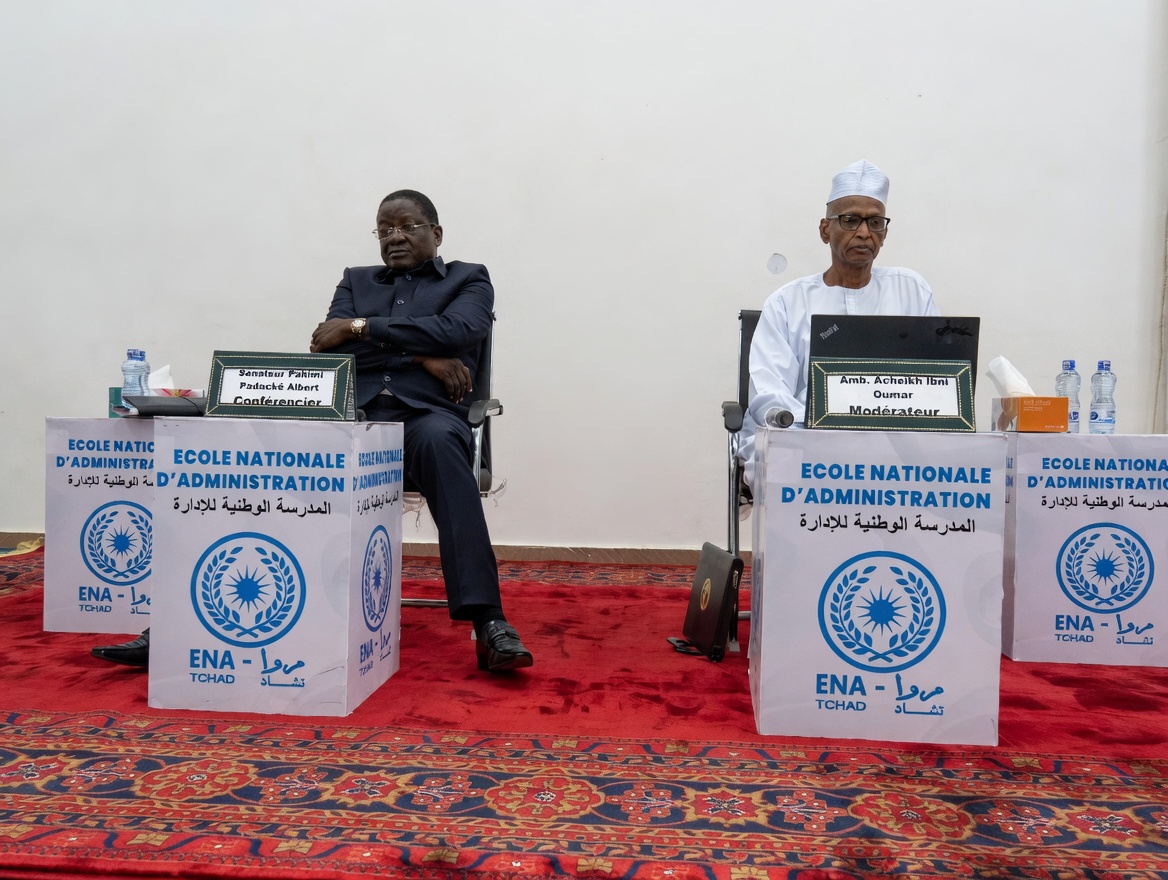
The École Nationale d’Administration (ENA) hosted a high-level debate this past Friday, May 29, as part of its « Grands rendez-vous de l’ENA » series. The session, led by Senator and former Prime Minister Albert Pahimi Padacké, focused on a pressing national issue: « Decentralization in the dynamics of development: the role of provincial councils ». The event drew a packed audience of students, civil servants in training, administrative officials, and political stakeholders.
With decades of experience in governance—having served twice as Prime Minister, currently as a Senator, and trained as a civil administrator—Albert Pahimi Padacké delivered a speech that was both informative and grounded in reality. His opening remarks reflected his enthusiasm for engaging with the next generation of leaders on a topic that sits at the heart of Chad’s development strategy: the evolving role of provincial councils in fostering local growth.
The discussion opened with a historical and international contextualization of decentralization in Chad. Pahimi Padacké traced its roots to the early 1990s, when democratic transitions across Africa, international donor pressure, and the rise of a governance model centered on citizen empowerment accelerated the process. The core question of the conference was straightforward: have provincial councils already become catalysts for development, or can they evolve into such agents?
The former Prime Minister structured his analysis around three critical pillars:
- Political and normative foundations: How decentralization, as a legal and institutional framework, can drive development at the local level.
- Existing barriers: The structural and operational challenges hindering provincial councils from fulfilling their potential.
- Pathways to progress: Actionable solutions to transform these councils into engines of local development.
Pahimi Padacké highlighted the legal milestones that have shaped Chad’s decentralization journey. The process was set in motion during the 1993 Sovereign National Conference, which advocated for a unitary state with strong decentralized components. This vision was enshrined in the 1996 Constitution and further reinforced in the 2023 Constitution of the Fifth Republic. Several organic laws have since been enacted to give substance to this framework, including Organic Law No. 14 (2024) on the status of autonomous local authorities and Organic Law No. 28 (2024) on the division of responsibilities between the central government and local entities.
The speaker emphasized two pillars of effective decentralization: the transfer of competencies and resources, and the principle of subsidiarity—enshrined in Article 271 of the Constitution—which mandates that decisions be made at the level closest to citizens. He noted that Organic Law No. 28 already transfers significant powers to provincial councils across multiple sectors, though practical implementation still requires further regulatory refinement.
In his assessment of current challenges, Pahimi Padacké identified critical bottlenecks: delayed transfers of financial and human resources, limited technical and administrative capacity within provincial councils, governance inefficiencies, and coordination gaps between decentralized administrations and elected local bodies.
To overcome these obstacles, he proposed a roadmap for tangible progress: expediting the transfer of revenue shares—particularly from oil and tax proceeds—to local governments, strengthening the skills of elected officials and administrative staff, establishing robust monitoring and evaluation mechanisms, and deepening collaboration with civil society and development partners. Most importantly, he underscored the need to rigorously apply the principle of subsidiarity to ensure decentralization is not merely symbolic but transformative.
Wrapping up his address, Pahimi Padacké urged the future administrators in the room to embrace these challenges. He framed decentralization not just as a governance reform but as a prerequisite for balanced national development and a government that truly serves its people.