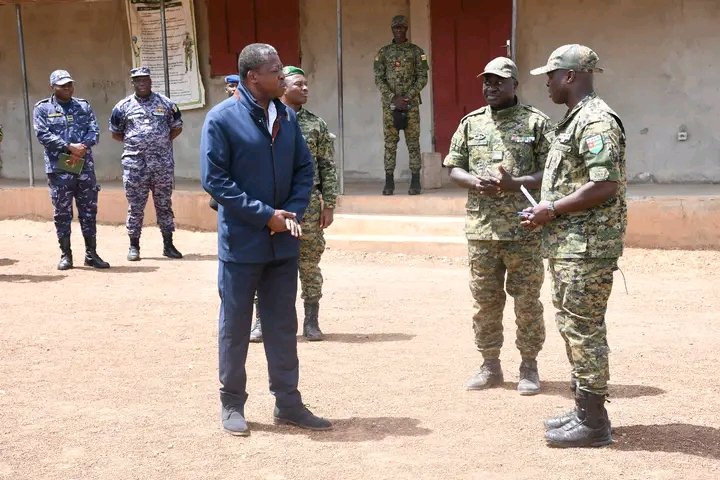
The President of the Council and Supreme Head of the Armed Forces, Faure Essozimna Gnassingbé, conducted a strategic visit to the Koundjoaré operational zone in northern Togo on May 7, 2026. This visit was part of an ongoing assessment of security initiatives aimed at countering terrorist threats in the Savanes region.
Upon arrival around 10 a.m., he was greeted by the Koundjoaré operation’s senior commander following his helicopter descent. The Supreme Head of the Armed Forces then proceeded to the Operational Command Post (PCO), where he received a detailed briefing on the evolving security landscape, current operations, and challenges faced by deployed troops.
Following the briefing, the President outlined new strategic directives to enhance the effectiveness of units operating on the ground.
The visit continued to the advanced operational post in Tchamonga, located along the eastern border. There, after a tactical presentation using a sand table model, Faure Gnassingbé addressed the soldiers involved in the operation. He commended their bravery, professionalism, and unwavering commitment to defending the nation’s territorial integrity.
He also praised the troops for their achievements in a regional security environment plagued by persistent threats. The President highlighted the strong collaboration between Togolese forces and those of neighboring countries in combating terrorism.
Reaffirming the military leadership’s support for the Koundjoaré operation, the President assured troops that their expressed needs would be progressively addressed to further strengthen operational capabilities.
He urged the forces to maintain high levels of vigilance, discipline, and determination in the face of destabilization attempts across the subregion.
Colonel Kombaté Latiémbé, the Koundjoaré operation’s senior commander, welcomed the President by acknowledging the resources provided to defense and security forces to ensure effective field operations. He renewed the troops’ commitment to securing both the population and national territory with determination.
Beyond military action, this visit underscores the comprehensive approach adopted by Togolese authorities in addressing security challenges. Alongside defense and security forces, multiple state mechanisms—such as the Interministerial Committee for the Prevention and Fight Against Violent Extremism (CIPLEV) and the Emergency Program for the Savanes Region (PURS)—are contributing to strengthening the resilience of affected communities.
This effort is further supported by diplomatic and mediation initiatives led by the President to promote peace, dialogue, and stability in West Africa.