Washington raises Sahel alert level to its highest: what travelers need to know
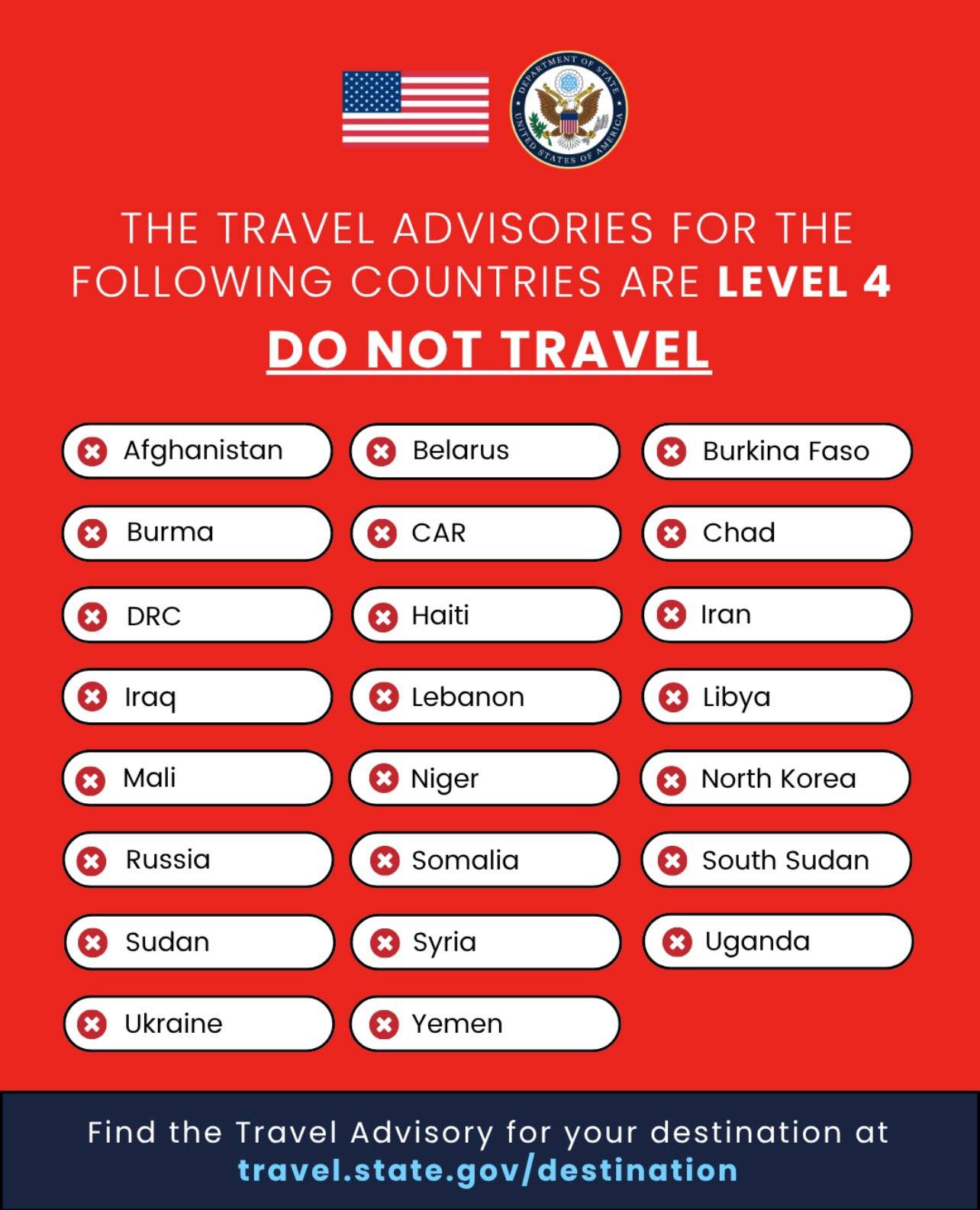
The U.S. State Department has once again updated its global travel advisory, placing 23 nations under its most severe warning—Level 4: Do Not Travel. Among the countries flagged are Russia, the Democratic Republic of the Congo, Chad, and, most notably, the three Sahel states that make up the Alliance of Sahel States (AES): Burkina Faso, Mali, and Niger. The move underscores a worsening security crisis and the unrelenting expansion of armed groups across West Africa’s fragile subregion.
Why the U.S. issued its strongest travel warning
In the State Department’s risk assessment framework, Level 4 represents the highest possible alert, signaling extreme danger for U.S. citizens. When a country is placed at this level, Washington advises Americans to avoid travel entirely. The warning also highlights that emergency consular and medical assistance may be severely limited or unavailable due to the withdrawal of non-essential diplomatic staff. This reflects a broader reality where large parts of the world no longer fall under stable state control, exposing foreign nationals to kidnapping, armed attacks, and hostage situations.
The Sahel alliance under siege: Burkina Faso, Mali, and Niger face unprecedented threats
The joint inclusion of Burkina Faso, Mali, and Niger in the highest-risk category comes as no surprise to regional analysts. These nations, bound together by the Alliance of Sahel States, are trapped in a deepening crisis fueled by military takeovers, strained ties with Western partners, and a rapid pivot toward new alliances, including with Russia. The security vacuum has deepened as state authority erodes in border regions, widespread poverty fuels recruitment into armed factions, and the withdrawal of Western military support leaves local forces struggling to fill the void.
Compounding the challenge is the shifting geopolitical landscape in the Sahel. With former partners such as France and the European Union stepping back, new security arrangements are still unproven. The effectiveness of these emerging partnerships—particularly with Moscow—remains untested under real combat conditions.
Terrorism spreads: how armed groups are reshaping the Sahel’s security map
The primary justification for the U.S. warning is the alarming geographic expansion of terrorist networks. Groups such as the Support Group for Islam and Muslims (JNIM), affiliated with Al-Qaeda, and the Islamic State in the Greater Sahara (EIGS), are no longer confined to remote desert sanctuaries. They now launch coordinated offensives, seize control of key routes, and extend their influence across vast territories, turning what was once a local insurgency into a regional war.
Burkina Faso: a country under siege
Burkina Faso bears the brunt of this asymmetric warfare. Armed factions control or encircle vast areas, subjecting entire communities to strict blockades that cut them off from food, medicine, and basic services. Supply convoys and military outposts face near-daily attacks, forcing hundreds of thousands into internal displacement. The humanitarian toll is catastrophic, with civilian populations trapped between extremist violence and state absence.
Mali: from north to south, insecurity spreads
In Mali, the situation has deteriorated since the departure of the UN peacekeeping mission (MINUSMA), which previously helped stabilize parts of the north. With peacekeepers gone, armed groups have exploited the security gap, intensifying raids and expanding operations toward the south. Even Bamako, long considered one of the region’s safer urban centers, now faces growing threats to its outskirts and surrounding areas.
Niger: triple-front pressure and regional spillover
Niger confronts a dual security crisis. In the west, along the shared borders with Mali and Burkina Faso, the so-called “triple frontier” zone remains a hotspot of extremist activity. In the southeast, near the Lake Chad basin, Boko Haram and the Islamic State’s West Africa Province (ISWAP) continue to launch deadly attacks. Despite efforts to reorganize its armed forces, Niger struggles to curb violence, further strained by regional diplomatic tensions that hinder cross-border cooperation.
Global instability beyond the Sahel
The U.S. warning extends far beyond West Africa. Other nations at Level 4 include Russia, due to the Ukraine war and arbitrary detentions of Americans, and the Democratic Republic of the Congo, where armed factions like the M23 movement perpetrate massacres and mass kidnappings in the eastern provinces. Neighboring Chad, caught between Sahel instability and the Sudan conflict, faces persistent terrorist incursions and risks of civil unrest, keeping it firmly on Washington’s radar.
Economic and humanitarian fallout of a ‘red zone’ classification
The impact of a Level 4 designation extends well beyond tourism. For the already vulnerable AES countries, the warning acts as a deterrent to foreign investment. Multinational corporations hesitate—or refuse—to deploy staff due to exorbitant insurance costs and security risks, freezing vital infrastructure and resource projects. Meanwhile, humanitarian organizations face crippling operational restrictions. Strict safety protocols limit access to crisis zones, leaving millions of civilians without food, medical care, and education in areas where need is greatest.
Is military action enough? The Sahel’s unresolved security crisis
The U.S. State Department’s latest alert underscores the failure of past stabilization efforts across the Sahel. Despite political transitions in Bamako, Ouagadougou, and Niamey, and realignments with new security partners, violence continues to rise. Civilian populations remain the primary victims, trapped in a cycle of displacement, poverty, and extremist violence.
Military solutions alone are proving insufficient. Until governance failures, social inequalities, and economic deprivation are addressed, the Sahel’s security landscape will remain perilous. The map drawn by Western chancelleries may stay painted in red for years to come—unless deeper structural reforms and inclusive development take root.