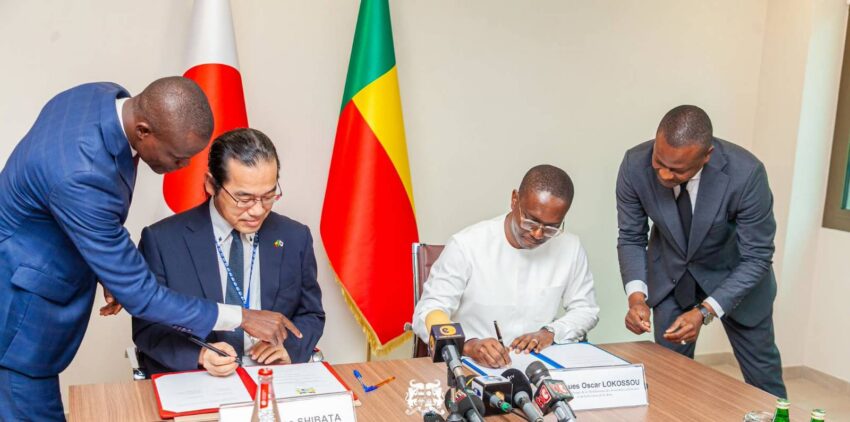
The ink is barely dry on the latest Benin-Japan agreement for the Vêdoko interchange in Cotonou, and the debate has already shifted to a simple question: what now? On Friday, October 9, 2026, the two governments signed a new grant of 10.8 billion FCFA to bankroll the second phase of the project, lifting the total announced financing to 26.228 billion FCFA. The news has reignited public conversation about traffic relief, construction disruptions and whether the finished structure will truly change daily life in Benin’s economic capital.
A fresh injection of cash for work already under way
This is not a launch announcement. The Vêdoko interchange project was officially kicked off on October 28, 2025, at a ceremony attended by Japan’s ambassador to Benin. The new 10.8 billion FCFA grant signed in Cotonou is designed to keep the momentum going and to fund phase two of the construction.
With this addition, the overall envelope announced for the project now stands at 26.228 billion FCFA. According to details shared at the signing, the money will help build an east-west oriented overpass, along with related development and drainage works needed to complete the structure.
The goal is to keep the site on track and to move closer to the traffic benefits that have been promised for one of Cotonou’s busiest junctions.
Why Vêdoko sits at the heart of Cotonou’s traffic debate
Anyone who drives, rides or walks through Cotonou knows Vêdoko as a pressure point. Cars, motorcycles, taxis and other vehicles converge there, and at peak hours the mix produces slowdowns that ripple across the city’s daily routines.
In a city where movement drives the economy, those delays cost more than just time. Employees build extra minutes into their commutes, traders and delivery riders see their schedules disrupted, and public transport operators deal with journey times that are hard to predict.
The interchange is meant to reorganize traffic flows at this crossroads. The overpass and supporting works are intended to help vehicles move more smoothly and to reduce conflicts between different streams of traffic.
Still, its real impact will depend on how well the structure plugs into the existing road network and how nearby intersections are managed.
What residents hope to gain once the dust settles
For ordinary people, the conversation quickly turns to concrete benefits. Once the work is finished and the interchange opens, users hope to cross the Vêdoko area with less hassle.
Employees could see shorter commutes between home and work. Pupils and students could enjoy more predictable journeys. Traders, transporters and delivery riders could plan their activities with greater confidence.
Fewer long stops and repeated restarts could also trim fuel consumption linked to congestion, while cutting some noise and air pollution.
These remain expectations, not guarantees. The new funding agreement does not mean jams will vanish overnight. The benefits will hinge on construction progress, the quality of the finished work and how traffic evolves.
The ambition is to reduce congestion at Vêdoko over the long term, not to present the interchange as an automatic fix for every mobility problem in Cotonou.
A construction phase that will test patience
Because the work has already begun, the building period matters for nearby residents and road users. As with any major road project, the works may require traffic adjustments, diversions or temporary restrictions depending on the zone and the phase of execution.
Those possible constraints need to be weighed against the long-term benefits. They also highlight the importance of clear information for users, visible signage and well-organized temporary routes.
To limit the inconvenience, traffic management during construction will have to remain a top priority. Drivers, motorcyclists, pedestrians and residents need to know about changes and have enough guidance to adapt their journeys.
The project’s success will therefore be measured as much by how well disruptions are handled during construction as by the quality of the final structure.
The Benin-Japan partnership and its wider stakes
The second-phase funding confirms Japan’s role in supporting infrastructure development in Benin. The extra 10.8 billion FCFA grant strengthens a bilateral cooperation effort aimed, in this case, at improving traffic conditions in the economic capital.
The project also envisages collaboration between Japanese and Beninese companies, with an eye on transferring skills and know-how, based on information shared when the works were launched in October 2025.
Beyond the construction of a civil engineering structure, the stakes are economic and social. More efficient mobility eases trade, improves access to jobs and supports the functioning of urban services.
Mobilizing large sums, however, is only part of the equation. The infrastructure’s durability will also depend on execution quality, maintenance and how it fits into a broader approach to managing urban travel.
Promises of smoother traffic still to be proven on the ground
With total announced financing of 26.228 billion FCFA, the Vêdoko interchange ranks among projects meant to improve urban mobility in Cotonou. The new agreement signed with Japan on October 9, 2026, adds resources to keep an already-started site moving.
For the public, the expectation is straightforward: spend less time stuck in traffic, travel more easily and enjoy more reliable daily journeys. But those hopes can only be considered met once the structure is completed, opened and its effects properly assessed.
Reducing congestion will need to be measured against data on journey times, queues and traffic conditions before and after the interchange enters service.
Ultimately, the Vêdoko challenge is no longer just about funding and building. It is about turning that investment into tangible improvements for users. Only then can the interchange keep its promise: helping Cotonou move more freely, with an urban mobility system better suited to residents’ everyday needs.