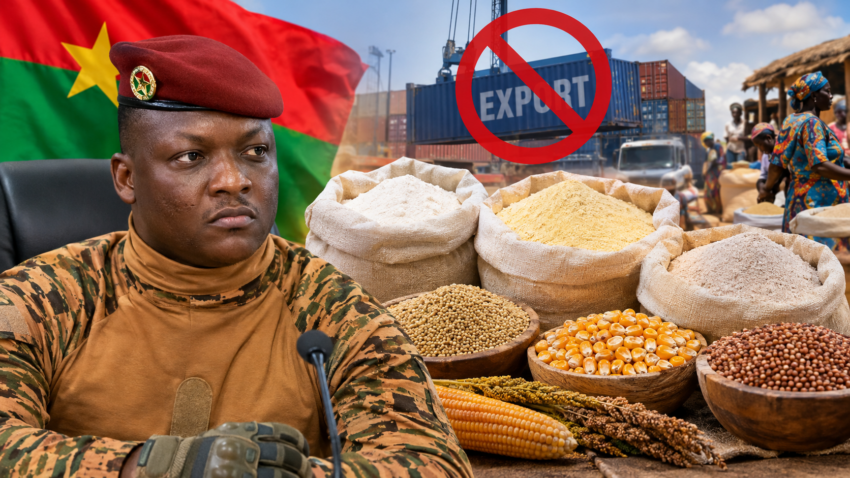
A sweeping restriction on grain flour exports
The government of Burkina Faso has resolved to prohibit, with immediate effect and until further notice, the exportation of several categories of flour. A directive issued by the Minister of Commerce confirms that the ban applies to millet, maize and sorghum flours, together with all derivative products. Special export authorisations previously granted for these goods have likewise been suspended.
Officials in Ouagadougou present the measure as a means of securing the availability of these staples on the domestic market. In a country where food security ranks among the foremost national concerns, such an objective may appear defensible on its face. Yet the decision raises a question that cannot be brushed aside: how far may a government legitimately go in curtailing economic activity in the name of shielding the national market?
Economic freedoms and the space for public debate
The controversy touches on a broader issue. Is Burkina Faso a state governed by the rule of law, in which citizens and business operators may voice their concerns freely? Or has it become a system in which government decisions are imposed without genuine deliberation?
Halting exports may indeed keep larger quantities of these products within the country. It does not, however, automatically translate into lower prices or improved access for consumers. The outcome will hinge on the actual level of available stocks, on production capacity, and on how rigorously the authorities monitor distribution channels.
A further consideration arises: do all Burkinabè consumers share the same dietary habits? Can every household rely exclusively on flours produced locally? By closing off export outlets, the government also risks weakening producers and traders whose livelihoods depend on those very markets.
The widening reach of state intervention
The matter therefore extends well beyond the flour trade. It concerns the standing of economic liberties, the practice of consulting the actors involved, and the right of citizens to interrogate the choices made by their leaders.
Burkina Faso is gradually acquiring the appearance of a country in which state decisions occupy an ever-growing place in daily life. Comparisons with North Korea, a nation commonly associated with exceptionally tight control over society, may seem far-fetched. Yet they express a real anxiety: that restrictions will multiply in the name of objectives set by the authorities, while citizens are not always afforded sufficient room to debate them.
Today it is millet, maize and sorghum flours that are affected. What restriction will come next? Should the public fear for other products, for access to the internet, or for other individual freedoms?
From justification to accountability
An export ban does not, in itself, turn a country into a dictatorship. Nevertheless, in a state that claims to respect the rights of its citizens, a measure this restrictive deserves to be explained, properly framed and periodically reassessed. Protecting the domestic market should not become a pretext for shutting down all discussion of the economic and social consequences of public decisions.
Beyond official statements, the people of Burkina Faso are entitled to expect tangible results: accessible goods, tolerable prices, fairly remunerated producers, and traders able to pursue their activities within a predictable framework.
For the essential question is not merely whether the government can prohibit flour exports. It is also whether the decision will genuinely improve living conditions for the population.
Safeguarding consumers is not simply a matter of restricting trade. It also requires protecting their purchasing power, supporting production, and being held accountable for the results achieved.