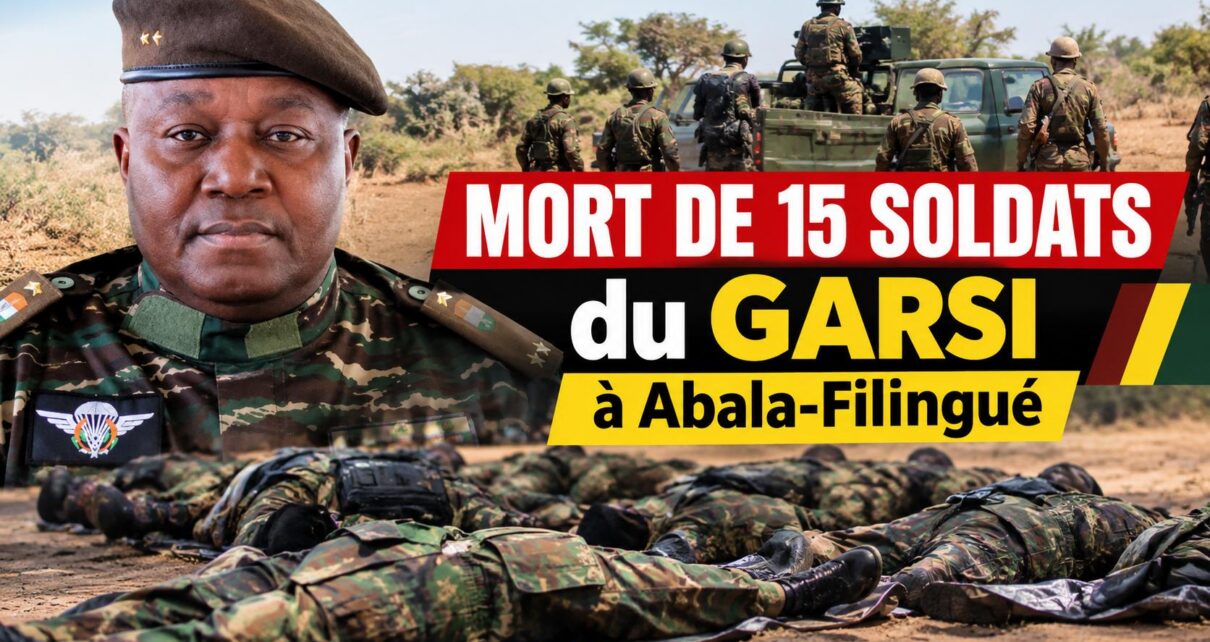
About fifteen soldiers of the Groupe d’Action Rapide de Surveillance et d’Intervention (GARSI) set out on patrol this morning in the Abala-Filingué department and did not come home. Captain Hassoumie and Adjutant Djindagarey were among the dead. The loss goes far beyond the barracks gate: for grieving families in Tillabéri, for traders whose lorries no longer dare the bush roads, and for an economy already squeezed by closed borders and abandoned farmland, the consequences began landing within hours.
The strike against one of Niger’s most disciplined rapid-response units is the latest proof of how profoundly the security crisis has reshaped everyday life since General Abdourahamane Tiani took power by force. Soldiers fall at the front, and the shock travels quickly: villages empty out, markets thin, staple prices climb, and the state’s presence recedes further from the countryside.
A security promise that never reached the ground
From the fall of Bazoum to the front line at Abala-Filingué
When the Conseil national pour la sauvegarde de la patrie (CNSP) removed elected president Mohamed Bazoum on 26 July 2023, it presented itself as the remedy for a losing war. Restoring security was the core justification for the takeover, and the officers promised a swift, decapitating campaign against jihadist groups.
Nearly two years on, that pledge looks very different in practice. Instead of pushing the armed groups back, the military government has unsettled the army’s chain of command and sent elite troops into combat without the tactical and aerial cover they require. The deaths at Abala-Filingué expose the distance between the official narrative broadcast from Niamey and the bloody reality of the terrain.
The numbers behind a worsening conflict
Independent conflict-monitoring data paints a stark picture of the period since the July 2023 coup:
- More than 1,500 incidents of political violence recorded across the country.
- Over 5,800 dead, civilians and service members combined.
- A rise of more than 40% in civilian fatalities from direct attacks during the first months after the takeover, compared with the preceding period.
- Heavy military losses in ambushes such as Koutougou (17 killed) and Tabatol (29 killed), alongside repeated deadly incidents in the Tillabéri and Tahoua regions.
In the three-border zone where the Groupe de soutien à l’islam et aux musulmans (GSIM) and the Islamic State in the Greater Sahara (EIGS) operate, the state has been losing ground. An attack on a battle-hardened unit such as GARSI shows how freely armed groups now move.
Closed roads, empty markets: the economic toll
The damage reaches well past the battlefield. Because key trade corridors have become unsafe, goods no longer circulate and growers abandon their fields. That combination hits household incomes, public revenues and the price of basic staples all at once, and it is felt hardest by the families who were already living hand to mouth.
The humanitarian fallout has become structural rather than temporary:
- More than 450,000 internally displaced people inside Niger, most of them driven from their villages by jihadist pressure.
- Around 3.3 million people facing acute food insecurity, worsened by the closure of trade routes and the abandonment of farmland.
- Hundreds of schools shut, depriving tens of thousands of children of an education.
Diplomatic isolation and its cost at the front
How did a government of senior officers let the security situation deteriorate this far? Part of the answer lies in a series of dogmatic strategic choices. By unilaterally tearing up defence agreements with Niger’s traditional partners, France and the United States among them, the authorities stripped the armed forces of instruments they had long relied on: high-precision intelligence, long-range drone surveillance and rapid medical evacuation capacity.
To fill the void, Niamey rushed towards the Alliance of Sahel States (AES) alongside Mali and Burkina Faso and towards new allies, Russia in particular. Yet around Abala-Filingué and across Tillabéri, the practical benefit is hard to detect. Reconnaissance drones cannot substitute for tactical foresight, and ground units keep paying a steep price against mobile, heavily armed assailants.
Meanwhile, the government’s energy goes into its own political survival, pursuing opponents, narrowing press freedom and staging support rallies, while the safety of soldiers and civilians slides down the list of priorities.
Villages living under the gun
If the deaths of elite officers grieve the army, civilians bear the heavier weight of state withdrawal. In Tillabéri, fear governs daily life. Armed groups levy the zakat on residents, burn schools, loot markets and execute anyone who refuses to submit. Every ambush on the roads pushes another wave of families towards the towns.
Facing the facts instead of the slogans
The deadly strike on GARSI at Abala-Filingué can no longer be smothered under sovereignist slogans or pinned on outside scapegoats. It lays bare the gap between the promise that justified the coup, protecting Nigeriens and the country’s territorial integrity, and what the state can actually deliver.
By leaving Captain Hassoumie, Adjutant Djindagarey and their comrades to fight without adequate support, the military government has revealed its limits. A radical rethink of defence strategy is overdue. The legitimacy of any power is measured not by how tightly it holds the capital, but by whether it can keep soldiers alive at the front and citizens safe in their villages. Without that reckoning, Niger risks sinking deeper still.