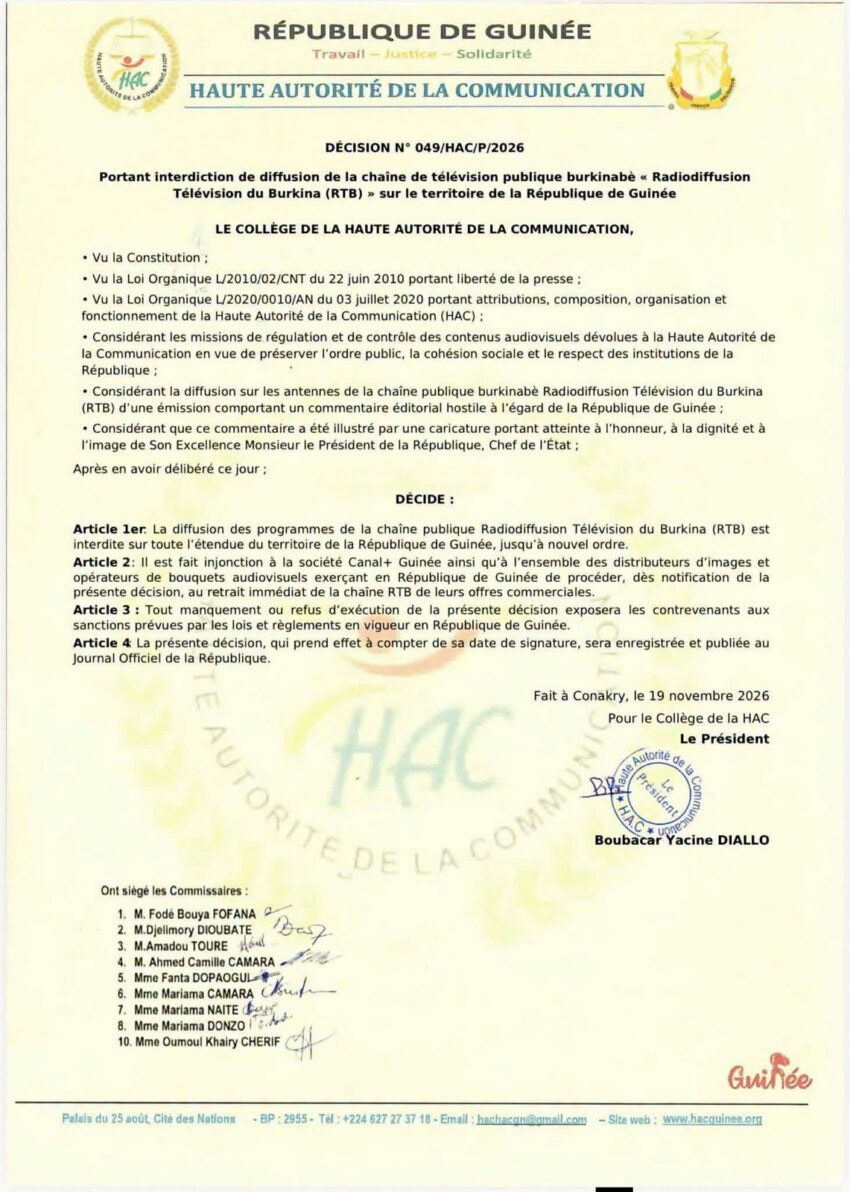
The decision by Guinea’s High Authority for Communication to suspend broadcasts of Burkina Faso’s state-run Radiodiffusion Television Burkina (RTB) across the country raises pressing questions about the role and responsibilities of public broadcasters in West Africa.
Public broadcasters must serve citizens, not political agendas
A public broadcaster is entrusted with delivering accurate, balanced, and pluralistic information to the public. However, when such a platform begins to prioritize political allegiance over journalistic integrity, its core purpose is undermined. In Guinea, authorities have taken a firm stance against what they describe as the RTB’s systematic bias, which allegedly mirrors the rhetorical positions of Burkina Faso’s transitional government under Captain Ibrahim Traoré.
Public television cannot function as a mouthpiece for any administration. It must remain a neutral source of information, enabling citizens to form their own opinions rather than being subjected to one-sided narratives or inflammatory rhetoric. The suspension by Guinea’s media regulator reflects broader concerns about the erosion of professional standards in public broadcasting across the Sahel.
Broader implications for media independence in West Africa
This ban is not merely an administrative measure between neighboring states it signals a deeper crisis in public broadcasting across the region. Media outlets that blur the line between journalism and state propaganda risk losing public trust and credibility. The implications extend far beyond national borders, influencing how audiences perceive the integrity of state-funded media throughout West Africa.
The RTB case serves as a cautionary tale: public broadcasters must remain committed to their statutory obligations, which include objectivity, accountability, and respect for diverse viewpoints. When these principles are sidelined in favor of political messaging, the consequences are felt by both citizens and institutions alike.
Why this decision matters for democratic values
Freedom of information is a cornerstone of any functioning democracy. When a public broadcaster fails to uphold this principle, the damage extends beyond the airwaves it affects public discourse, political stability, and trust in state institutions. The suspension of RTB in Guinea underscores the urgent need for media outlets to recommit to their foundational mission: serving the public, not political interests.
The High Authority for Communication’s decision sends a clear message: public broadcasters must be held to account. Their role is to inform, not to propagate, and their survival depends on maintaining the highest journalistic standards. This incident must prompt reflection across the region on how public media can reclaim its legitimacy and purpose.
What’s next for Guinean-Burkinabé media relations
While the suspension is currently in place until further notice, the long-term impact on diplomatic and media relations between Guinea and Burkina Faso remains uncertain. Regional organizations may be called upon to mediate and clarify expectations for public broadcasters in democratic societies. For now, Guinea’s stance serves as a reminder that media freedom and journalistic ethics are non-negotiable pillars of governance and public trust.
The RTB ban is more than a policy decision it is a statement about the kind of media landscape African nations aim to cultivate: one built on integrity, independence, and a commitment to the truth.
The consequences of politicized media on public opinion
Erosion of trust: When public broadcasters are perceived as tools of political agendas, their credibility suffers, weakening public trust in all state-funded media.
Distorted information: One-sided coverage prevents audiences from accessing diverse perspectives, limiting their ability to make informed decisions.
Regional spillover: Similar concerns are emerging in other West African nations, highlighting a systemic challenge in safeguarding media independence.
Accountability demands: Regulators and governments must ensure that public broadcasters adhere to journalistic ethics, free from political interference.
As Guinea takes a stand against perceived propaganda, the broader lesson is clear: public media must serve the people first. Anything less risks undermining not only the media’s role but also the democratic fabric of the society it is meant to inform.
By Martin Ngu — Journalist