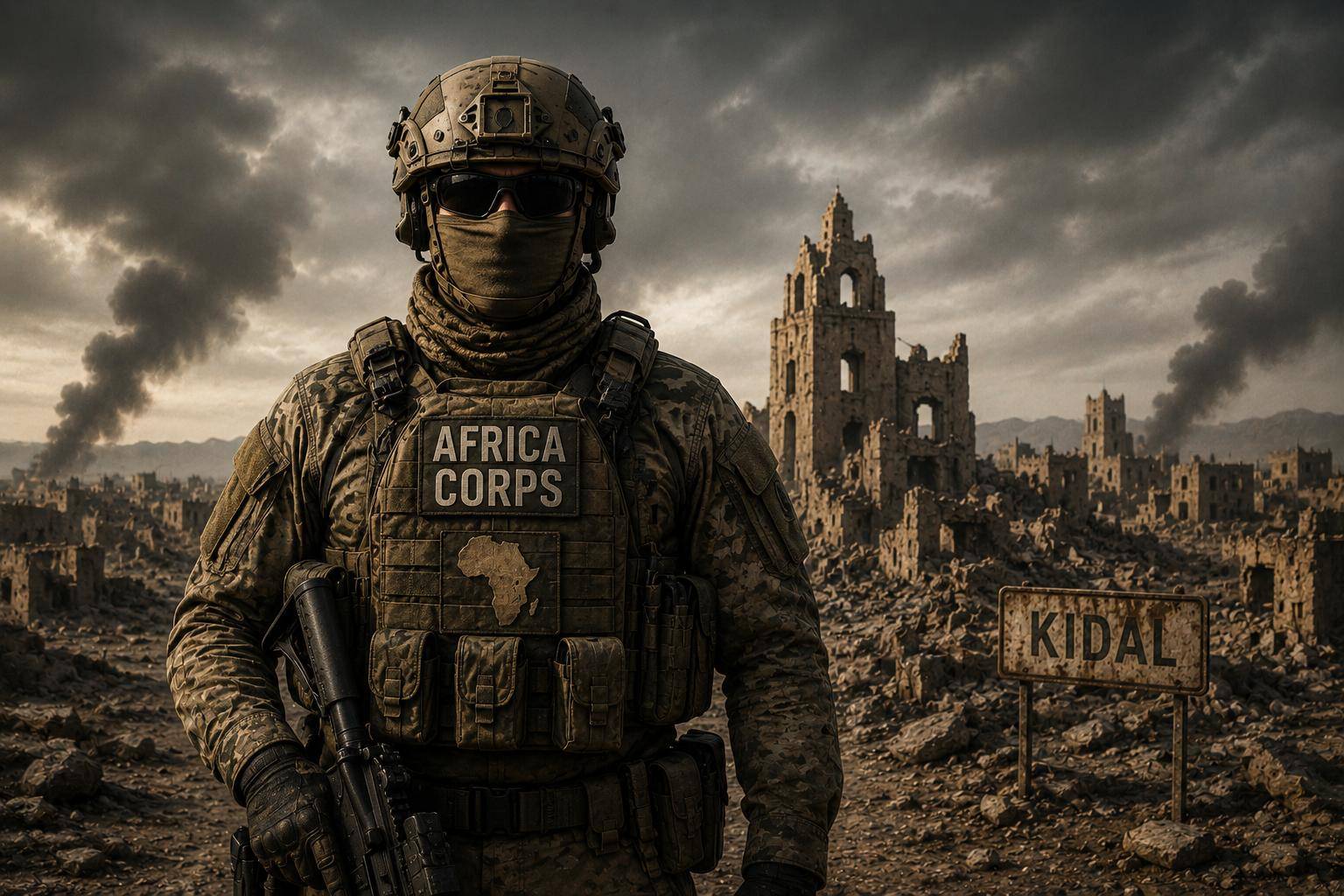
An in-depth analysis reveals that a recent publication by Russian allies, the Africa Corps, conceals a politically charged reality beyond its military rhetoric. A careful reading suggests that Russian forces are subtly preparing the public for a significant strategic pivot in northern Mali. Two primary scenarios are now emerging.
Hypothesis 1: Africa Corps prepares to distance itself from Assimi Goïta
For many months, transitional president Assimi Goïta built his public support on a singular pledge: to reclaim and secure every inch of national territory, starting with Kidal. This commitment stood as a powerful emblem of Malian pride.
By now asserting that Kidal “holds no value” and should be avoided, the Africa Corps directly undermines President Goïta’s authority. Should Russian forces opt against engaging further for Kidal, they would effectively isolate the Bamako government, leaving it to confront its unfulfillable promises. This could signify the beginning of a significant political withdrawal of support.
Hypothesis 2: Implementation of a covert agreement with FLA and JNIM
The phrasing within the text suggests another compelling possibility: what if the Africa Corps is already acting upon a clandestine agreement secretly forged with the FLA (Front de Libération de l’Azawad) rebels and the JNIM jihadist groups?
To rationalize ceding ground to these armed factions without appearing to surrender, Russian communicators employ a convenient narrative: “We haven’t lost; we are merely avoiding a desert trap.” In truth, downplaying Kidal’s strategic significance might be a deliberate tactic to prepare public opinion for a potential cohabitation or territorial division already negotiated behind closed doors.
This recent Africa Corps statement indicates that their initial strategic objectives have not been met. For the Russian-aligned force, the era of reconquest appears to be over. It suggests two possible paths: either the Russian partners are distancing themselves from Assimi Goïta’s hardline stance to safeguard their own interests, or they are formally acknowledging the abandonment of northern Mali to rebel and Islamist groups through a non-aggression pact.