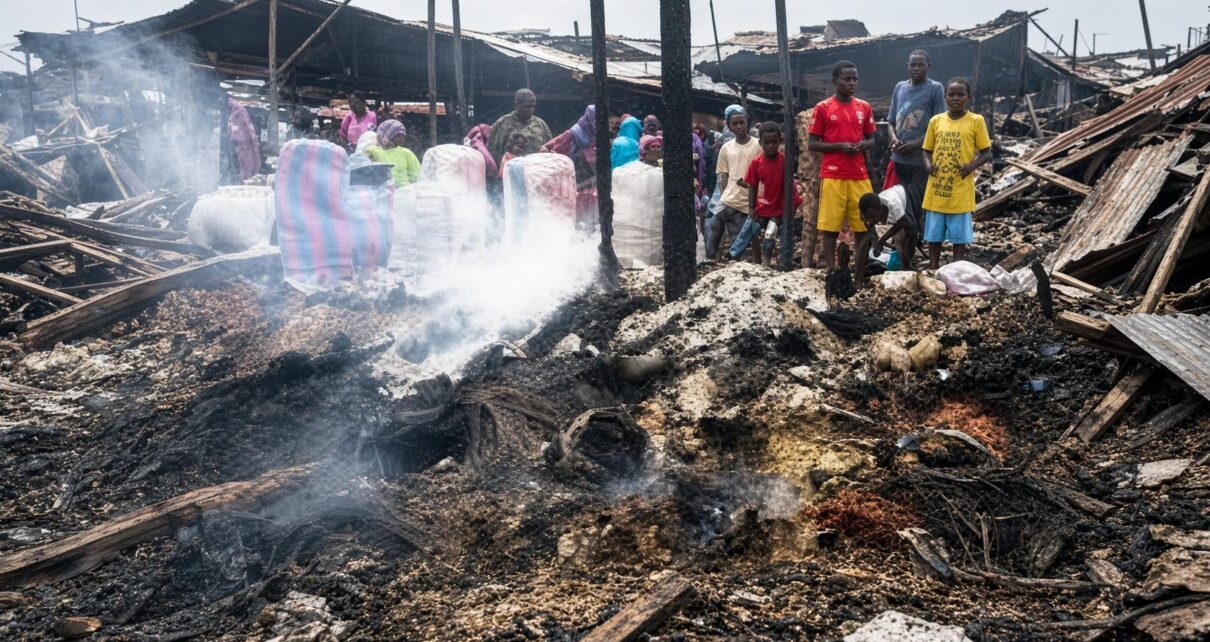
The night-time blaze that gutted the main building of Anié’s Grand Marché has left deep scars on the economic heartbeat of the Plateaux region. Traders watched helplessly as their goods, stocks and savings disappeared in flames. No lives were lost, but for hundreds of families the material damage is total — a single night has wiped out livelihoods built over years.
Yet the fire itself is only part of the story. What is unfolding now — the public outcry, the debates in marketplaces and on social media, the scramble for emergency relief — points to a much bigger question: what comes next for Togo’s neglected trading infrastructure and the people who depend on it?
A community left to rebuild from ashes
In Anié, the morning after brought not just grief but anger. Vendors who had stocked up for the season found nothing but charred stalls and melted metal. Many had no insurance, no formal safety net and no alternative source of income. The market was more than a place to trade — it was the financial engine of the town and its surrounding villages.
Local authorities have promised support, but similar pledges after earlier market fires in Lomé and Kara have often failed to translate into lasting reconstruction. Traders now say they want more than symbolic visits and emergency food distributions — they want guarantees that the next fire will not destroy what they rebuild.
Outdated infrastructure meets chronic unpreparedness
How is it possible that in 2026 a strategic market of this scale still lacks modern fire-safety systems, working water points and clear access routes for emergency vehicles? The answer lies in decades of neglect that no official slogan can hide.
Since coming to power in 2005, President Faure Gnassingbé’s government has repeatedly promised modernisation, yet basic local infrastructure continues to crumble. More than sixty years after his father, Gnassingbé Eyadéma, took power, the country still relies on structures built in another era, with no serious investment to adapt them to today’s demographic and economic realities.
The gap between official rhetoric and daily reality
While official speeches celebrate large-scale projects, digital transformation and foreign investment, the ground-level picture remains starkly different:
- No prevention culture: Most major markets across Togo — from Lomé to Kara and now Anié — remain logistical tinderboxes, lacking compliant electrical standards and risk-prevention plans.
- Under-equipped emergency services: Firefighters, often alerted late or hampered by a lack of adequate equipment in the regions, can do little more than witness the destruction.
- Living on past glory: The current leadership relies on the security reputation and political foundations of the previous regime without building a modern public policy to protect citizens and their property.
A turning point or another missed warning?
The Anié disaster follows historic fires that ravaged major markets in Lomé and Kara in recent years. The fact that the same vulnerabilities persist shows that lessons have not been learned. Sending ministerial delegations with supplies and promising token aid after each catastrophe is not a strategy — it is a cycle of reaction that leaves communities exposed.
What Togo needs now is a fundamental break with the laissez-faire approach. A government’s first duty is to protect its citizens before disaster strikes. By allowing informal-sector workers to operate in ageing, vulnerable structures, the regime exposes the limits of a political model more focused on its own survival than on the safety and well-being of the Togolese people.
The debate ignited by the Anié fire is no longer just about one market. It is about whether Togo will finally treat the security of its people and their livelihoods as a priority — or whether the next tragedy is simply a matter of time.