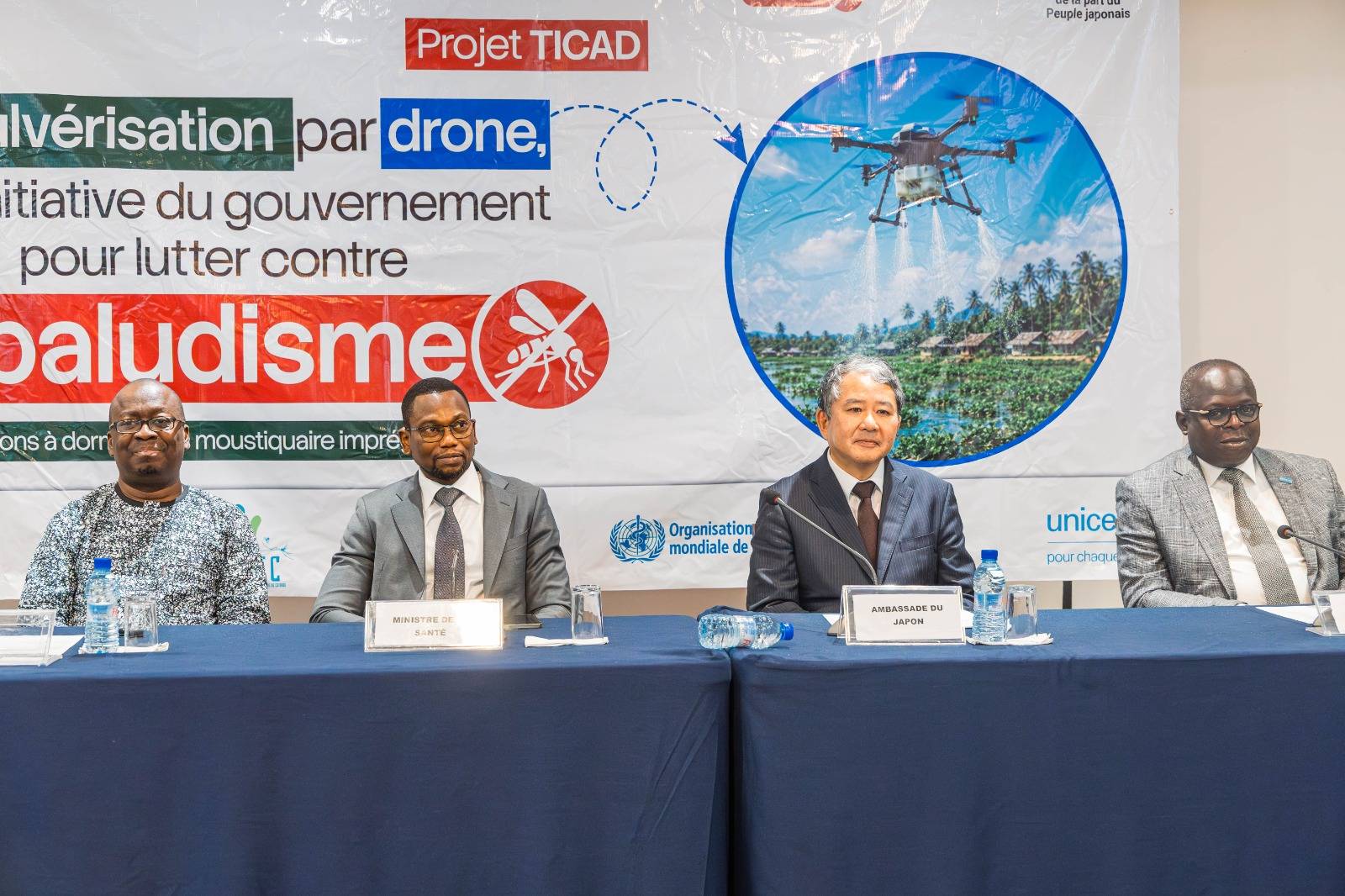
On Tuesday, June 30, 2026, the Béninese government officially initiated a groundbreaking program designed to eradicate malaria breeding sites. This innovative initiative integrates artificial intelligence, geospatial mapping, and advanced drone technology. With significant funding of 2.3 million dollars from Japan and crucial support from UNICEF, the high-precision system is being deployed across six strategically chosen municipalities. Beyond its technological prowess, this project offers profound relief to local populations who have long endured the severe economic and human toll of this pervasive disease. My on-the-ground investigation reveals the details.
Cotonou, Bénin: A quiet revolution unfolded in the official chambers of Cotonou on June 30, 2026, yet its true impact is already being felt in the marshlands of Abomey-Calavi and the remote areas of Copargo. Health Minister Professor Benjamin Hounkpatin inaugurated the “Integrated Action for Malaria Prevention: Public-Private Partnership and Local Youth Engagement in Bénin” project. This venture forges an unprecedented alliance between cutting-edge science and community mobilization. The objective is unequivocal: to definitively reverse the tide against the nation’s most formidable health challenge.
A three-pronged technological alliance to track the enemy
For decades, efforts to combat malaria primarily involved reactive measures such as distributing impregnated mosquito nets, providing curative treatments, and raising public awareness. The new initiative, launched in the presence of Japan’s Ambassador, S.E.M. Uezono Hideki, and UNICEF’s Deputy Representative, Madame Aude Rigot, marks a fundamental shift in strategy. This is now a proactive and precise campaign, directly targeting the breeding grounds of the mosquito vector.
The system relies on a state-of-the-art technological triptych. First, geospatial mapping and artificial intelligence meticulously analyze topographical and meteorological data to pinpoint high-risk environmental zones with remarkable accuracy. Subsequently, high-performance drones take over. These aerial vehicles meticulously survey areas with high malaria endemicity, dispensing a larvicide approved by the World Health Organization (WHO), thereby neutralizing mosquito larvae before they can develop into adult insects.
“This strategy is designed to sustainably reduce mosquito density,” emphasized Professor Benjamin Hounkpatin. He further noted, “The larvicide utilized in this campaign is WHO-approved and will be applied in strict adherence to recommended safety standards. Thanks to drone technology, we can now intervene with greater precision, speed, and effectiveness, even in areas that were previously difficult to access.”
Six communes at the forefront of the battle
For this crucial pilot phase, the government has selected six communes that represent the diverse ecological and demographic challenges faced nationwide: Copargo, Djougou, Tchaourou, Ouidah, Abomey-Calavi, and Cotonou. From bustling urban centers to isolated rural communities, this technological arsenal will undergo rigorous testing.
This extensive deployment is backed by a substantial financial commitment of 2.3 million dollars from Japan. For the Japanese Ambassador, this investment reflects deep-seated commitments: it aligns perfectly with Bénin’s national vision, “Bénin 2060 Alafia, a world of splendors,” and resonates with the resolutions of TICAD9, which prioritizes the resilience of African health systems, especially in preparing for health threats.
Resident relief: direct economic impact
On the ground, the announcement of this project has ignited immense hope, particularly among families and small business owners. Malaria is not merely a medical tragedy disproportionately affecting the most vulnerable; it represents a significant financial drain on Béninese households. By eliminating the threat at its source, the project indirectly promises to bolster the purchasing power of communities.
Amavi, a mother of four and a fabric vendor encountered at the Abomey-Calavi market, shared her burden: “Every rainy season is a nightmare. Last year, my two youngest children were hospitalized twice. Between consultations, IV drips, and medications, I spent over 60,000 CFA francs (approximately 100 dollars). That’s an entire month’s profit gone. Not to mention the days I couldn’t go to the market because I had to stay by my children’s bedside at the hospital. If these drones can destroy those mosquitoes in the swamps behind our homes, our family’s economy will finally breathe.”
This sentiment is widely shared by artisans, farmers, and micro-entrepreneurs in Tchaourou and Cotonou, for whom a malaria episode often translates into an immediate loss of income due to a lack of social protection or replacement systems. Therefore, reducing malaria morbidity in these six pilot communes directly contributes to increased productivity, forced savings, and financial stability for the informal sector, which sustains the majority of the population.
Youth engagement: the project’s cornerstone
Technological innovation would be incomplete without human involvement. This was a core principle championed by UNICEF during the launch ceremony. The project incorporates a significant community engagement component, transforming young people from the participating communes into active agents of health security.
Trained alongside community relays and local leaders, these young individuals will oversee ground interventions, conduct local awareness campaigns, and promote sound environmental practices—such as managing stagnant domestic water—to prevent the re-establishment of larval breeding grounds. As Madame Aude Rigot, UNICEF Deputy Representative in Bénin, stated: “It is this synergy between innovation and citizen mobilization that will achieve a lasting impact.”
Towards a sustainable public health model
By blending advanced drone technology with dynamic community engagement, Bénin is shaping the future of preventive medicine. The targeted spraying of larvicides, combined with strengthened anti-malaria vaccination efforts and vigilant citizen participation, forms an unprecedented defensive network.
Should the pilot phase in these six communes confirm its promising technical efficacy and economic viability, this public-private partnership model could potentially be expanded nationwide, and even inspire similar initiatives across the West African sub-region. For now, the propellers of Bénin’s drones are poised to turn, carrying with them the hope of a future liberated from the grip of malaria.