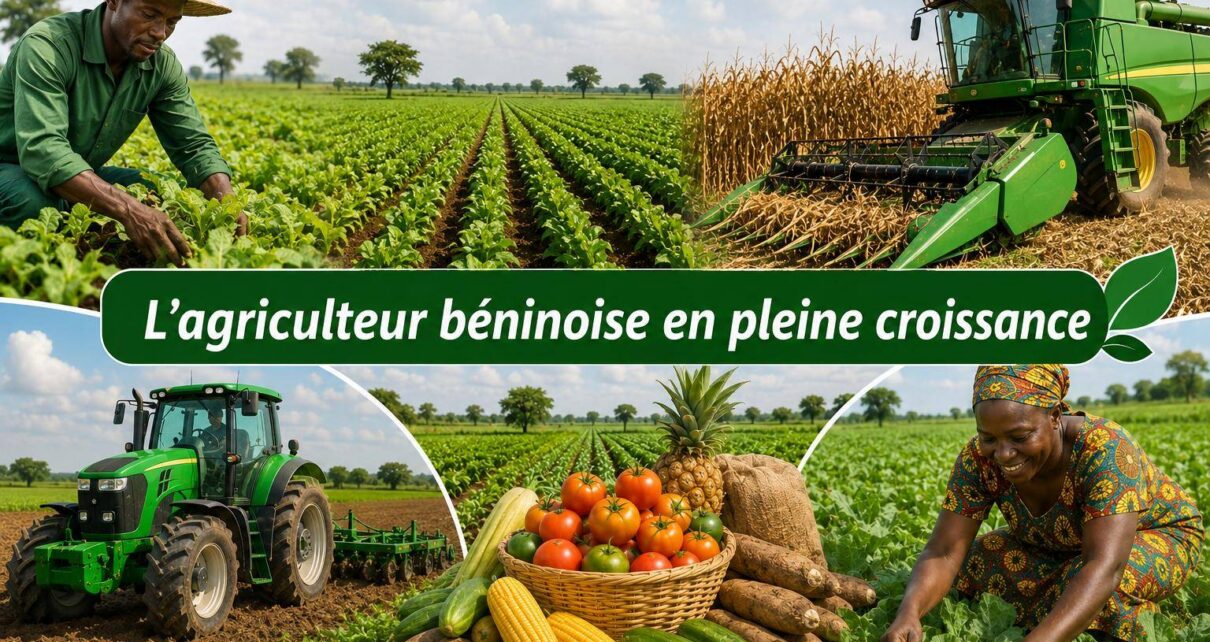
Since the pivotal year of 2016, Bénin has witnessed a sweeping transformation in its agricultural landscape. A bold government strategy—centered on substantial subsidies, rapid mechanization, and strategic land development—has catapulted the nation’s farming sector into uncharted territory. From cotton to pineapple, maize to soybeans, agriculture now stands as the cornerstone of national growth and a bulwark for food security.
From subsistence to surplus: the numbers behind the agricultural boom
The once modest harvests of Bénin’s farms have exploded into record-breaking production volumes, all within the span of a few years. The administration of President Patrice Talon has executed ambitious agricultural programs that have reshaped the country’s economic trajectory.
The maize sector, a staple of local diets, serves as a prime example of this success. In 2016, production hovered below 1.3 million tons. By 2025, output surged to 2.5 million tons—far exceeding the nation’s internal demand of 1 million tons. While this surplus strengthens food security, it also introduces new challenges in managing cross-border trade to prevent price volatility in domestic markets.
The soy industry tells a similar story of rapid industrialization. From a modest 140,000 tons in 2016, production skyrocketed to 422,000 tons by 2022. The 2024-2025 season marked a historic peak of 606,016 tons—more than quadrupling the initial figure. Much of this harvest feeds into the modern processing facilities of the Glo-Djigbé Industrial Zone (GDIZ), while a significant portion is earmarked for export.
The rice sector has followed an upward trend as well. Paddy rice production jumped from 204,000 tons before 2016 to 525,000 tons in 2022, reaching 1 million tons by 2025.
Cotton, often referred to as the nation’s “white gold,” remains a flagship crop. In 2015, production barely reached 269,000 tons. Since 2016, annual output has consistently exceeded 640,000 tons, peaking at 766,273 tons in 2021. This consistency has cemented Bénin’s position as Africa’s top cotton producer, with the lofty goal of 1 million tons within reach.
Other key cash crops have also flourished. Pineapple production soared by 93%, climbing from 244,000 tons pre-2016 to 470,000 tons in 2022, with projections to hit 600,000 tons soon. Cashew nuts doubled their output, increasing by 105% from 91,000 tons to 187,000 tons in 2023, alongside a 34% productivity boost. For this sector, the government has stepped in by subsidizing certified seedlings, covering 500 FCFA of the 600 FCFA total cost per plant.
110 billion FCFA in subsidies: shielding farmers from global price shocks
Behind these staggering gains lies a bold financial intervention. As international fertilizer and chemical input prices skyrocketed, threatening to cripple local farmers, the government acted decisively. Between the 2022-2023 and 2024-2025 agricultural seasons, a staggering 110 billion FCFA was allocated in subsidies. This proactive measure stabilized input costs, safeguarding yields and preventing food insecurity.
Breaking free from tradition: water control and mechanization transform farming
The modernization of infrastructure and production techniques has been equally transformative. Historically plagued by climate dependence, agriculture in Bénin is shedding its archaic roots through hydrological development. Before 2016, only 6,200 hectares were irrigated—just 2% of the nation’s potential. Today, 25,440 hectares have been developed across 67 municipalities, quadrupling the previous total. The long-term goal is to reach 50,000 hectares, fortifying sector resilience and boosting farmer incomes.
Mechanization is also reshaping the sector. The tractorization rate, below 8% before 2016, has since doubled. Over 400,000 hectares have been plowed mechanically using 5,000 subsidized tractor kits—each available at half price. To ensure sustainability, 6,000 tractor operators and 300 certified mechanics have been trained. The government aims to push the mechanization rate to 30% by late 2026, deploying an additional 8,000 active kits.
Financial reforms and ecological stewardship: building a sustainable future
The financial architecture supporting agriculture has also undergone a major overhaul. Outdated and inefficient tools like the National Agricultural Development Fund (FNDA) and the Municipal Development Support Fund (FADeC-Agriculture) have been restructured. The FNDA now finances over 3,000 projects totaling 19 billion FCFA, while FADeC-Agriculture has facilitated 330 communal investments leveraging 68 billion FCFA. The focus remains on strengthening governance to expand impact.
Ecological restoration has become a priority. Before 2016, 80% of Bénin’s soils suffered from low fertility. Through sustainable land management, over 3 million hectares have been rehabilitated, restoring fertility and preventing degradation. Additionally, the revival of polluted and underutilized water bodies has rejuvenated the fishing industry, with total fish production rising by 79%. High-quality shrimp from Bénin are once again being exported to European markets—a testament to both ecological and regulatory progress.
Livestock production has not lagged behind. Meat and egg outputs have surged by 53% and 43%, respectively, with strong potential to meet 75% of national demand.
Building a market-driven agricultural economy
The government’s territorial approach to agricultural development has restructured rural economies from the ground up. Market access has expanded, and strategic partnerships continue to strengthen. Within less than a decade, the bold policies and unprecedented financial backing of President Patrice Talon’s administration have redefined the role of agriculture in Bénin. No longer a subsistence activity, farming has become a dynamic, modern, and competitive economic sector.
The challenge ahead is to maintain this momentum, ensuring that the wealth generated penetrates deep into rural communities. With strong governance and robust control mechanisms, the future of Bénin’s agriculture looks brighter than ever.