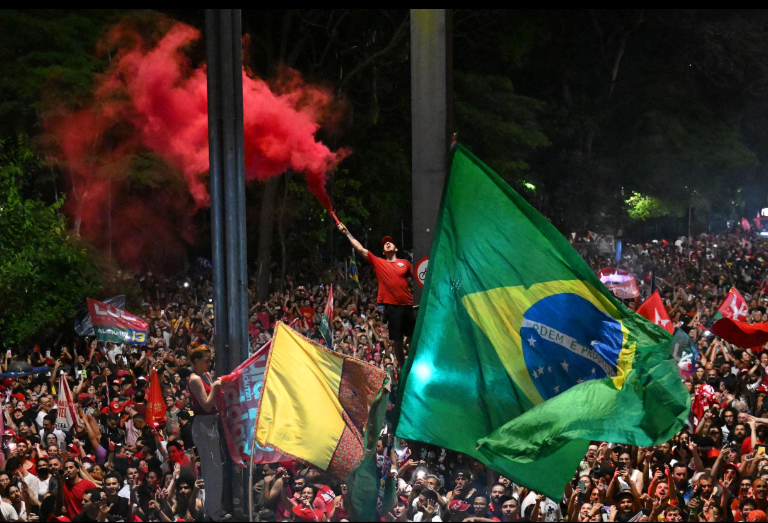
Lula secures historic fourth term as Flávio Bolsonaro challenges election results
Brazil’s political landscape remains turbulent after Luiz Inácio Lula da Silva claimed a historic fourth presidential term, narrowly defeating Flávio Bolsonaro by 4.4 million votes. However, the victory was immediately overshadowed by Bolsonaro’s legal challenge, which alleges irregularities in the electoral process and threatens to prolong the crisis.
With 51.79% of the valid votes, Lula’s re-election marks a significant moment in Brazilian politics, but the narrow margin and Bolsonaro’s refusal to concede have intensified tensions. The dispute centers on last-minute changes to voting procedures, raising questions about the fairness of the election.
Controversial polling extension sparks legal showdown
The heart of the controversy lies in a late decision by Supreme Court Justice Cristiano Zanin to extend voting hours until 7 PM (Brasília time) in certain polling stations due to logistical challenges, including transportation issues in Bahia and São Paulo. While the move aimed to ensure voter access, critics argue it disrupted the electoral equality guaranteed by law.
Flávio Bolsonaro’s campaign has seized on this decision, arguing that it compromised the integrity of the vote. “No election can be considered legitimate under these conditions,” he stated, vowing to pursue legal action to annul the results. His team has also criticized the judiciary’s role, accusing institutions of altering rules mid-process—a claim that, while legally contentious, underscores the deep divisions plaguing Brazil’s democracy.
Ironically, both campaigns had previously requested extensions for different reasons, with Bolsonaro’s team citing heavy rains in southern Brazil as a justification. This contradiction has complicated the legal battle, leaving courts to weigh the merits of the challenge.
Brazil’s political divide deepens with institutional trust at stake
The election has laid bare Brazil’s stark political rifts, pitting Lula’s left-wing legacy—rooted in social programs and inequality reduction—against the conservative Bolsonaro movement, which champions traditional values, security, and right-wing policies. Flávio Bolsonaro, son of the former president Jair Bolsonaro (currently serving a 27-year prison sentence for attempted coup), embodies this ideological clash.
The refusal to accept defeat has fueled concerns about the erosion of trust in democratic institutions. While Lula’s victory stands as the official result, the legal battle risks prolonging the uncertainty, with potential consequences for Brazil’s political stability and economic outlook.
Lula’s governance challenge: uniting a fractured nation
As Lula prepares to take office, he faces the daunting task of governing a deeply divided country where nearly half the electorate rejected his leadership. His conciliatory tone in the aftermath of the vote—pledging to govern for all Brazilians—may ease tensions, but the conservative-dominated Congress could limit his ability to advance key reforms.
The election’s aftermath has shifted the focus from a simple left-right victory to a test of Brazil’s democratic resilience. Whether the legal dispute remains confined to the courts or spirals into broader unrest will shape the country’s trajectory in the coming months.
Key takeaways from Brazil’s 2026 election crisis
- Lula wins fourth term with 51.79% of the vote, but Flávio Bolsonaro contests the results.
- Legal battle looms over alleged irregularities in polling procedures, including extended voting hours.
- Institutional trust at risk as Bolsonaro’s challenge raises questions about the judiciary’s role.
- Governance challenges ahead for Lula amid a polarized Congress and a divided electorate.