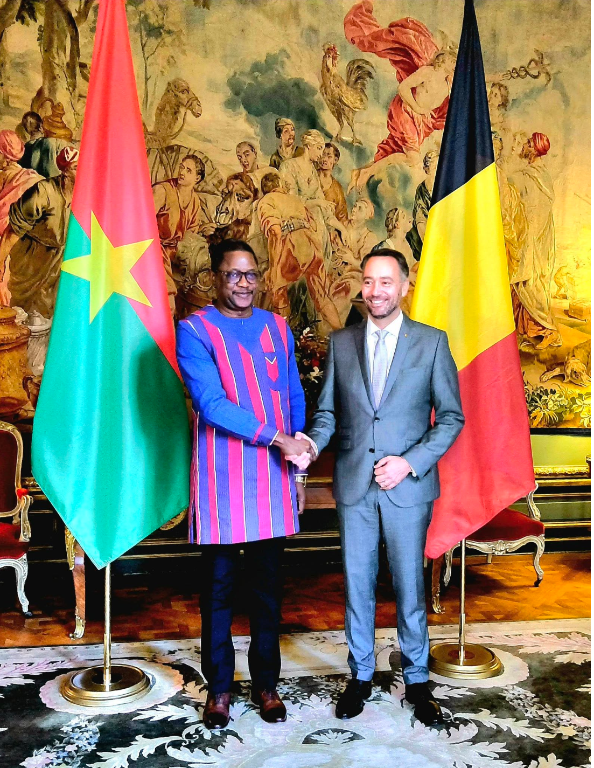
After a high-stakes diplomatic mission to Brussels in early November 2026, Burkina Faso’s Foreign Minister Karamoko Jean-Marie Traoré secured a renewed financial commitment of €40 million from Belgium for the post-2027 period. This announcement arrives at a time when Ouagadougou is navigating complex diplomatic waters with Western capitals, raising questions about the future trajectory of President Ibrahim Traoré’s foreign policy strategy.
The timing of this pledge is significant. As Burkina Faso asserts its sovereignty and diversifies its international partnerships, the continuation of financial cooperation with Belgium signals a delicate balance between political rhetoric and pragmatic necessity. What does this aid mean for local communities, the economy, and the country’s broader geopolitical positioning?
Why Belgium’s €40 million pledge matters now
The announcement follows a working visit by Karamoko Jean-Marie Traoré to Brussels, where discussions with Belgian officials underscored the shared commitment to sustain bilateral cooperation despite political differences. This funding, earmarked through Belgium’s international cooperation agency Enabel, is designed to support development programs beyond 2027—continuing a partnership that has been active since 2023.
Unlike previous allocations, this €40 million pledge is not yet fully disbursed. It represents a forward-looking investment intended to stabilize key sectors such as education, healthcare, and local governance. For a nation facing economic stagnation, rising insecurity, and social instability, such support can be a lifeline.
For Belgium, the decision reflects strategic foresight. Despite divergent political narratives, Brussels recognizes the importance of maintaining a cooperative presence in the Sahel—a region where instability threatens broader European interests. Economically, this aid also benefits Belgian development firms and NGOs operating in the region.
Diplomatic dialogue persists despite tensions with the West
The Brussels trip was not limited to economic negotiations. On November 4th, Traoré met with Kaja Kallas, the EU’s High Representative for Foreign Affairs and Security Policy, to discuss Burkina Faso’s evolving relationship with the European Union and its vision for international partnerships.
The next day, discussions with Belgian Deputy Prime Minister and Minister of Development Cooperation Maxime Prévot focused on bilateral cooperation, regional security, and long-term collaboration frameworks. These meetings confirm that, despite years of strained relations with Western partners, diplomatic channels remain open and functional.
Such continuity suggests a nuanced approach: Burkina Faso’s leadership may criticize Western influence in public, but behind closed doors, pragmatic cooperation continues where mutual interests align.
Sovereignty vs. survival: can €40 million bridge the divide?
Since seizing power in a 2022 coup, Ibrahim Traoré has positioned national sovereignty as the cornerstone of his leadership. The expulsion of French military forces, public criticism of Western policies, and growing alignment with Russia have reshaped Burkina Faso’s international image.
Yet the decision to accept—and even seek—Belgian development aid complicates this narrative. How can a government that champions independence from former colonial powers justify accepting financial support from one of them?
Several factors may explain this paradox. First, the distinction between political dissent and economic pragmatism allows Ouagadougou to criticize Western policies publicly while accepting targeted aid to address pressing social needs. Second, diversification does not imply exclusion: Burkina Faso can deepen ties with Moscow while maintaining economic cooperation with Brussels, as long as each relationship serves distinct purposes.
This dual approach may reflect a broader strategy: asserting independence vocally while leveraging external resources to meet urgent national priorities.
The real impact on Burkina Faso’s people and economy
The €40 million from Belgium is not just a diplomatic gesture—it has tangible implications for millions of Burkinabè citizens. Development programs supported by this funding are expected to improve access to clean water, vocational training, and agricultural productivity in rural areas hardest hit by climate change and insecurity.In the short term, this aid could ease pressure on public budgets, reduce unemployment through skills training, and strengthen local resilience. In the long term, it may help stabilize communities vulnerable to recruitment by armed groups—a critical factor in a nation grappling with jihadist insurgencies.
Economically, the funds inject liquidity into key sectors. Belgian development agencies, already active in Burkina Faso through Enabel, will oversee project implementation, ensuring that funds are used efficiently and transparently. This partnership also creates opportunities for Belgian contractors, consultants, and NGOs, fostering cross-border professional ties.
Is this the start of a diplomatic thaw?
While the €40 million pledge is a positive signal, it does not by itself mark a full diplomatic thaw. For meaningful rapprochement to occur, additional steps would be necessary: renewed trade agreements, resumed security cooperation, and the lifting of restrictions on technical or military support.
For now, the gesture is largely symbolic—a recognition that, despite ideological posturing, both countries share practical interests that outweigh political disagreements. Belgium gains influence in a pivotal region; Burkina Faso gains resources to address urgent needs.
Ultimately, this aid underscores a reality often lost in public discourse: international relations are rarely binary. Countries can assert sovereignty and accept aid. They can critique partners and collaborate with them. In the delicate art of diplomacy, pragmatism often trumps principle.
As Ibrahim Traoré’s government charts its course between independence and interdependence, the €40 million from Belgium may serve as a quiet reminder that even the most assertive nations cannot afford to walk the path of sovereignty alone.