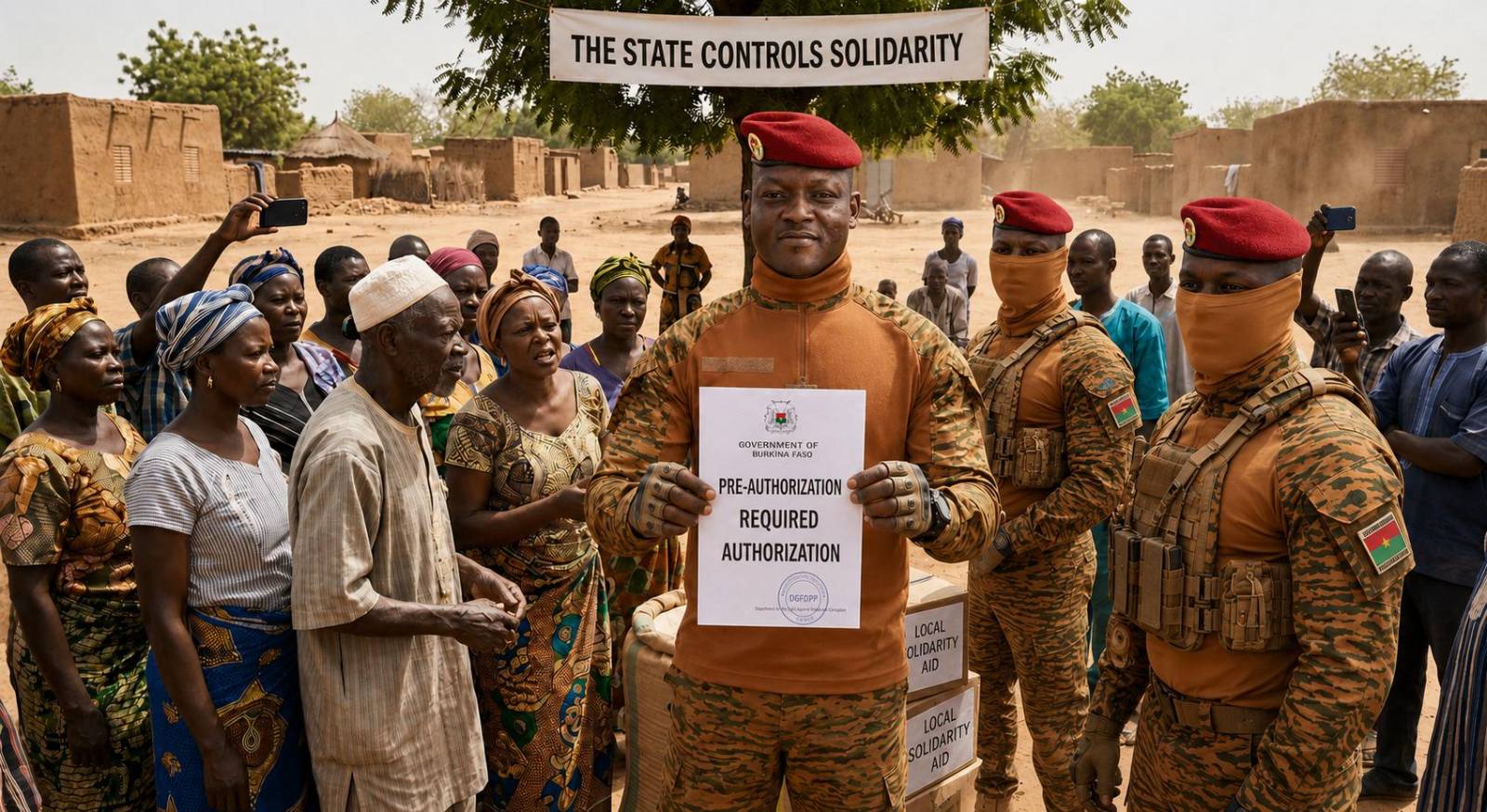
Gone are the days of unregulated charitable initiatives flooding social media in Burkina Faso. The Ministry of Solidarity has moved to enforce stringent controls, mandating prior authorization for all humanitarian actions under threat of legal repercussions. While officials cite the preservation of human dignity and the prevention of digital voyeurism as justification, the policy raises profound ethical and practical questions: Can altruism itself become a punishable offense when the state demands oversight of every act of generosity?
Between legitimacy and overreach
Superficially, efforts to regulate charitable practices may appear justified. Social media platforms have indeed commodified human suffering at times, turning empathy into viral content or fundraising tools. Yet, the distinction between curbing abuses and stifling organic civic initiatives remains dangerously thin. By adopting a blanket regulatory approach rather than addressing specific misconduct, the government risks framing all spontaneous solidarity as inherently suspicious, requiring bureaucratic approval before it can be exercised.
Demanding administrative clearance to assist one’s fellow citizens signals a troubling erosion of individual freedoms. When the mere impulse to help others becomes contingent upon state authorization, it suggests a governance model that perceives benevolence as a potential threat rather than an inherent social good. Such logic implies that those in power view themselves as the sole arbiters of compassion, a stance that undermines the very fabric of civic engagement.
The paradox of state-controlled solidarity
This policy underscores a broader bureaucratic overreach, revealing a government deeply distrustful of autonomous civic action. The transition government led by Captain Ibrahim Traoré appears to be consolidating control over humanitarian efforts, positioning itself as the exclusive distributor of goodwill. However, this centralization of solidarity comes at a cost: it sows seeds of mistrust between citizens and institutions while choking the organic networks that have long sustained communities in times of crisis.
Historically, crises in Burkina Faso have been mitigated not by delayed state intervention, but by the rapid, decentralized responses of citizens, associations, religious groups, and the diaspora. These actors’ agility stems from their independence—a quality now systematically undermined by mandatory approval processes. When solidarity becomes a state-sanctioned activity, the speed and spontaneity that characterize humanitarian work vanish, leaving vulnerable populations in limbo.
A policy disconnected from reality
The government’s decision reveals a stark disconnect from the realities on the ground. While officials impose punitive measures, they fail to acknowledge a fundamental truth: the state lacks the financial, human, and logistical resources to replace the spontaneous generosity it seeks to regulate. By criminalizing unapproved aid, authorities create a void that their own agencies cannot fill. Thousands of families, already grappling with displacement, economic precarity, and insecurity, are left without recourse as administrative processes grind to a halt.
The timing of this policy could not be more ill-advised. Burkina Faso continues to face an escalating humanitarian and security crisis, with displaced populations, food shortages, and collapsing infrastructure demanding immediate attention. Restricting solidarity to bureaucratic channels only exacerbates existing vulnerabilities. Medical emergencies, population displacements, and food crises do not adhere to administrative timelines. While authorization requests languish in ministry drawers, suffering persists unabated. This regulation transforms humanitarian responsiveness into a bureaucratic maze, dismantling the very networks—dubbed “solidarity of the bush”—that have kept communities afloat amid state failures.
The illusion of dignity
Proponents argue that the new rules protect the dignity of vulnerable individuals by prohibiting the public display of suffering. Yet, this framing raises critical questions: Is dignity truly preserved when those in need are forced into silence, their pleas for help ignored by an administration preoccupied with control? Concealing distress does not eliminate it; it merely renders it invisible to those in power, all while the vulnerable continue to suffer in obscurity.Dignity is not achieved through invisibility or state-approved charity. It is upheld by ensuring timely access to assistance, guided by ethical standards, consent, and transparency. There exists a middle ground between exploitative public exposure and bureaucratic suppression of aid. A responsible public policy should prioritize both dignity and efficiency, without stifling the very humanity it claims to protect.
By paralyzing spontaneous acts of generosity under the guise of regulation, the government risks severing the last lifelines for its citizens. There is no assurance that state-led aid will ever compensate for the loss of civic solidarity. This policy epitomizes a dangerous inversion: it places state control above human survival, transforming a universal act of compassion into a mere administrative procedure. In doing so, it undermines the very foundation of a society that has long relied on the generosity of its people to endure.