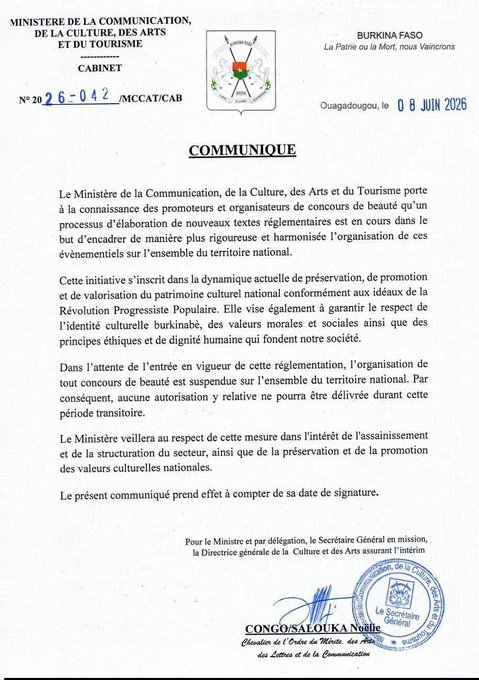
The decision came without warning. Authorities in Burkina Faso have issued an official decree suspending all beauty pageants nationwide until further notice. While officials cite a commitment to upholding cultural values and addressing the nation’s pressing security crisis, deeper scrutiny reveals a far more troubling agenda: the deliberate consolidation of authoritarian control.
Distraction as a political weapon
The timing of this measure raises critical questions. In a country grappling with escalating security threats and deepening humanitarian crises, why prioritize regulatory interference in cultural events over urgent territorial stabilization efforts?
For seasoned observers across West Africa, this pattern of state intervention in leisure and expression is a hallmark of calculated governance. By redirecting public discourse toward debates on morality and social conduct, the interim administration diverts attention from persistent failures to restore constitutional order and ensure public safety.
State-imposed morality as a tool of repression
The suspension of beauty pageants is not an isolated incident but part of a broader campaign to erode personal freedoms under the guise of moral rectitude. Through administrative decrees, the regime seeks to enforce a rigid social order, dictating what citizens may celebrate, wear, or even think.
Civil society voices have begun to warn of the slippery slope ahead. « Today, it is a beauty pageant. Tomorrow, who knows what other personal freedoms will be deemed unworthy of public recognition? » questioned one human rights advocate, requesting anonymity to avoid reprisals. This systematic curtailment of individual autonomy—whether through fashion, art, or speech—mirrors the playbook of autocratic regimes that govern through fear disguised as virtue.
Silencing the nation through cultural asphyxiation
The implications extend far beyond fashion. This is a calculated assault on Burkina Faso’s civic and democratic fabric. The move follows a pattern of repression: the suspension of opposition parties, the suppression of independent media, and the detention of dissenting voices. Now, the cultural sphere—long a refuge for youth expression—faces suffocation under state decree.
A dictatorship in its formative stages does not always wield guns; it wields laws. It transforms moral policing into state doctrine, weaponizing administrative power to eliminate ideological pluralism. By stifling artistic and social expression, the transitional government sends a clear message: ideological conformity is mandatory, and even aesthetic dissent will not be tolerated.
Behind the rhetoric of sovereignty and moral guardianship, Burkina Faso is drifting toward a monolithic social structure where the state dictates not only public behavior but private identity. What appears as protective oversight is, in truth, a slide into historical authoritarianism—where the state owns the narrative, owns the stage, and owns the people.