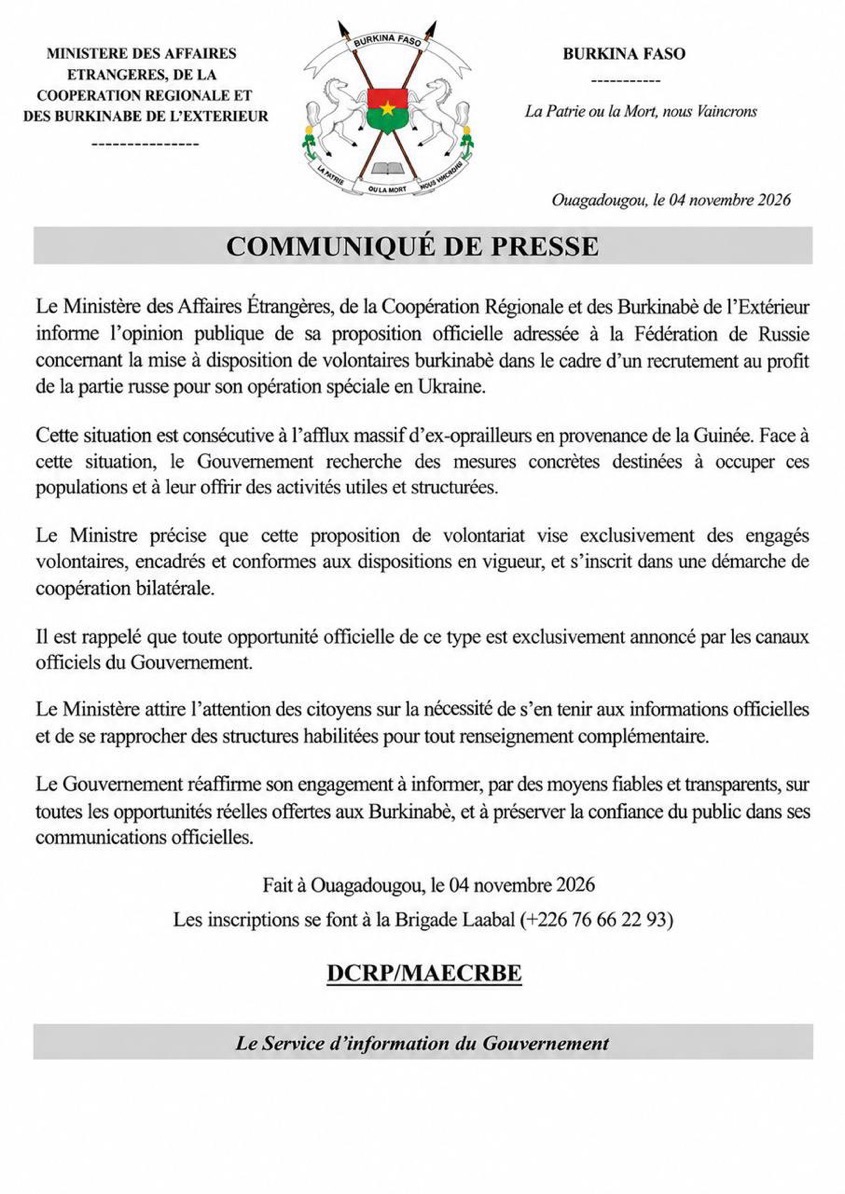
The latest twist in Burkina Faso’s deepening alliance with Russia is raising serious concerns about the potential weaponization of expelled gold miners. Recent reports suggest that Ouagadougou may have offered Moscow a controversial deal: sending vulnerable Burkinabè miners, expelled from Guinea, to fight in Ukraine.
From expulsion to the frontlines: a questionable trade
These miners were caught up in a brutal crackdown by Guinean authorities, where thousands of Burkinabè were expelled after being targeted for illegal gold panning. Stripped of their livelihoods and forced into precarious situations, they were later transported to Burkina Faso under unclear circumstances.
Now, new evidence points to a disturbing possibility: their transportation to Ouagadougou could be part of a recruitment strategy. Their economic vulnerability may be exploited by a government eager to form a new contingent of fighters for Moscow.
Why this migration route raises red flags
The journey of these expelled miners from West African gold fields to a potential Eastern European battlefield exposes a troubling pattern. If confirmed, this arrangement would reframe their return not as repatriation but as a euphemism for military mobilization.
Key concerns include:
The true purpose behind their relocation to Burkina Faso
The voluntary nature of their potential enlistment
The lack of transparency regarding contracts, risks, and benefits
The ethical implications of targeting displaced individuals in recruitment drives
Moscow’s war machine and Burkina Faso’s strategic shift
Since Ibrahim Traoré’s rise to power, Burkina Faso has intensified military and diplomatic ties with Russia. The presence of Russian paramilitary trainers in the country underscores this alliance, often framed as an alternative to Western security partnerships.
However, this cooperation is no longer limited to training or counterterrorism. If the reports are accurate, Burkina Faso may now be supplying troops for Moscow’s war in Ukraine a conflict thousands of kilometers away from the Sahel.
The human cost behind diplomacy
The Borj Bou Arréridj goldfields of Algeria became a symbol of the desperation driving these miners abroad. But their forced repatriation from Guinea has left many stranded, desperate for income. Their situation makes them prime targets for military recruiters offering financial stability or at least the illusion of it.
Yet, the realities of combat in Ukraine paint a different picture: high casualties, extreme conditions, and little legal recourse for foreign fighters.
Sovereignty versus responsibility: a dangerous trade-off
Burkina Faso justifies its pivot toward Russia as a path to regain autonomy. But autonomy without accountability is hollow. The government must answer critical questions:
Was the miners’ transfer to Ouagadougou part of a military recruitment scheme?
Have they been fully informed of the dangers and obligations of service?
What safeguards exist to prevent coercion or exploitation?
Without clear answers, this initiative risks violating the very principle of citizen protection that defines a sovereign state. The line between strategic partnership and human trafficking becomes dangerously thin.
Beyond geopolitics: the fate of the individual
Behind official statements and diplomatic agreements lie real people. Many miners left Burkina Faso to escape poverty only to be expelled from Guinea. Now, their fate may be decided not by choice, but by geopolitical convenience.
If they are sent to Ukraine, they won’t be fighting for Burkina Faso’s security. They’ll be pawns in a war they never chose a war fought on behalf of a foreign power.
This is more than a footnote in international relations. It’s a humanitarian crisis in the making, disguised as collaboration.
What’s next: accountability or exploitation?
The international community must demand transparency. Burkina Faso’s leaders must clarify whether these transfers are purely humanitarian or if they constitute illegal conscription.
For the miners themselves, the stakes couldn’t be higher. Their lives, their consent, and their futures hang in the balance. The true measure of Burkina Faso’s sovereignty will be measured not by the strength of its alliances, but by the protection it offers its people.
By Martin Ngu — Journalist