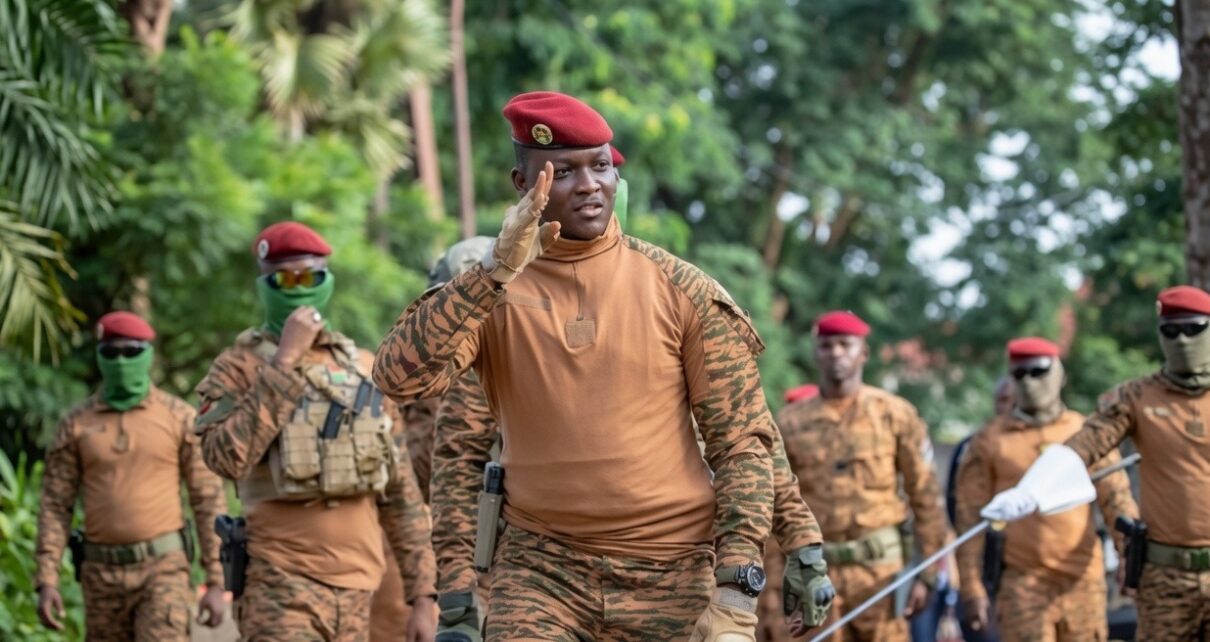
Burkina Faso’s transitional government has declared that it now exerts authority over 74.53% of the national territory, a figure presented as proof of a successful military and security recovery. Yet, when measured against independent assessments, humanitarian reports, and the lived experiences of local communities, this optimistic narrative appears increasingly detached from reality.
From presence to actual control: a flawed definition
To justify such a sweeping claim, officials have adopted an unusually broad interpretation of the term “control.” In this framework, even temporary military deployments, escorted convoys, or sporadic patrols by volunteer defense forces (VDP) are counted as evidence of territorial dominance. However, genuine control requires far more: uninterrupted public administration, functioning justice systems, safe and free movement for civilians, and permanent protection against threats.
In practice, armed groups like the Group for Support of Islam and Muslims (JNIM) continue to disrupt life across large areas. They frequently ambush military units, block major roads, and besiege key towns whenever state forces temporarily withdraw. These patterns reveal a persistent inability to secure the population or stabilize communities.
Information blackout masks the truth
The gap between official claims and ground realities stems from a deliberate clampdown on independent reporting.
- Suppression of independent data: Local security analysts, humanitarian NGOs, and independent journalists face restrictions or outright bans on publishing conflicting assessments. Accusations of “undermining troop morale” are routinely used to silence dissenting voices.
- No third-party verification: No credible external body—local, regional, or international—has been granted access to independently audit the Defense Ministry’s territorial maps. Meanwhile, conflict-tracking organizations such as ACLED continue to document a steady stream of violent incidents across vast parts of the country, contradicting the government’s narrative.
Humanitarian crisis reveals the real situation
A genuine recovery of 75% of the country would logically ease humanitarian pressures. Instead, the opposite is happening.
- Internally displaced persons remain stranded: Returns to villages are rare and perilous. The number of internally displaced people relying on emergency aid remains at crisis levels, with little sign of sustainable repatriation.
- Public services are collapsing: Even in areas labeled “under control,” schools stay closed, healthcare workers refuse to return without ironclad security guarantees, and civilian administration struggles to operate beyond the fortified perimeters of major towns.
The political logic behind the narrative
This optimistic discourse serves clear domestic political purposes.
- Legitimizing the transition: Emphasizing territorial gains helps justify the extension of the transition period and the ongoing sacrifices demanded of citizens, including new taxes and conscription drives.
- Distracting from tactical setbacks: By focusing on aggregate percentages, the government diverts attention from recurring attacks on isolated military detachments and local defense units—particularly in the North, East, and the Boucle du Mouhoun region.