Cameroun joins forces with UNESCO to champion mother tongue education
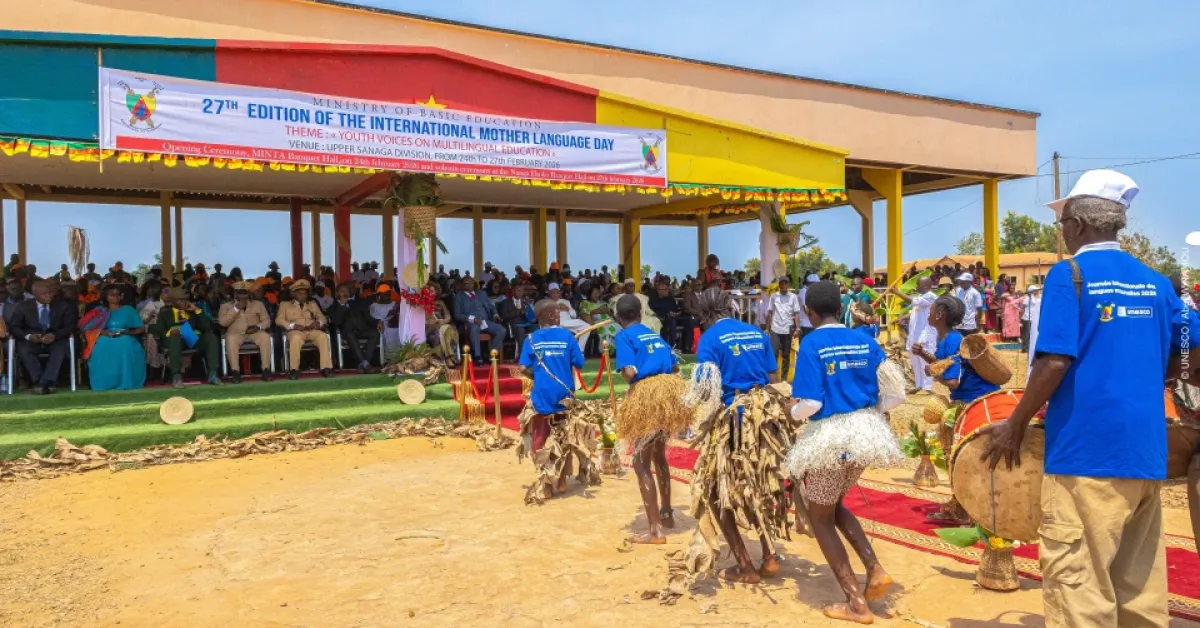
The 27th edition of the International Mother Language Day, celebrated under the theme “Voices of Youth on Multilingual Education”, concluded with a vibrant ceremony in Nanga Eboko on February 27, 2026. This week-long initiative across Cameroun highlighted the critical role of mother tongues in education while showcasing the nation’s rich linguistic diversity.
UNESCO’s participation underscored its unwavering commitment to preserving linguistic heritage and promoting multilingual education as a cornerstone of quality learning. The Organization’s representatives emphasized that early education in one’s mother tongue significantly enhances academic performance and cultural continuity.
Government and global partners unite for linguistic diversity
The ceremony was led by Cameroon’s Minister of Basic Education, Professor Laurent Serge Etoundi Ngoa, alongside UNESCO’s Regional Director for Central Africa, Mr. Hilaire Mputu. Their joint address reinforced the importance of integrating local languages into national education systems to foster inclusive learning environments.
UNESCO’s advocacy for mother-tongue education stems from decades of research proving its benefits: improved cognitive development, higher retention rates, and stronger cultural identity among learners. The Organization’s programs actively support member states in developing curricula that reflect linguistic realities while maintaining global standards.
Youth performances highlight cultural richness
The event featured dynamic cultural and linguistic presentations by primary school students, demonstrating the country’s extraordinary ethnic tapestry. From Bantu languages to Chadic dialects, these performances illustrated how mother tongues serve as vessels of tradition, wisdom, and social cohesion.
Through this collaboration, UNESCO and Cameroon reaffirmed their shared vision: that linguistic diversity is not merely a cultural asset but a strategic educational tool. The International Mother Language Day stands as a vital platform for advocating these principles worldwide, reminding societies of the irreplaceable value of every mother tongue.
A global movement takes root in Cameroun
The International Mother Language Day serves as more than a celebration—it’s a call to action. UNESCO’s partnership with Cameroun demonstrates how local initiatives can align with global education goals, particularly Sustainable Development Goal 4 on quality education. By prioritizing mother-tongue instruction, nations can bridge linguistic divides while building more equitable learning societies.
The week’s activities in Cameroun included workshops, panel discussions, and community dialogues that brought together educators, linguists, and policymakers. These efforts aim to create sustainable frameworks for multilingual education that extend far beyond the annual observance.
As the sun set over Nanga Eboko, the message was clear: preserving mother tongues is not about resisting globalization—it’s about enriching it. Each language saved is a unique worldview, a distinct way of understanding human experience that benefits all humanity.