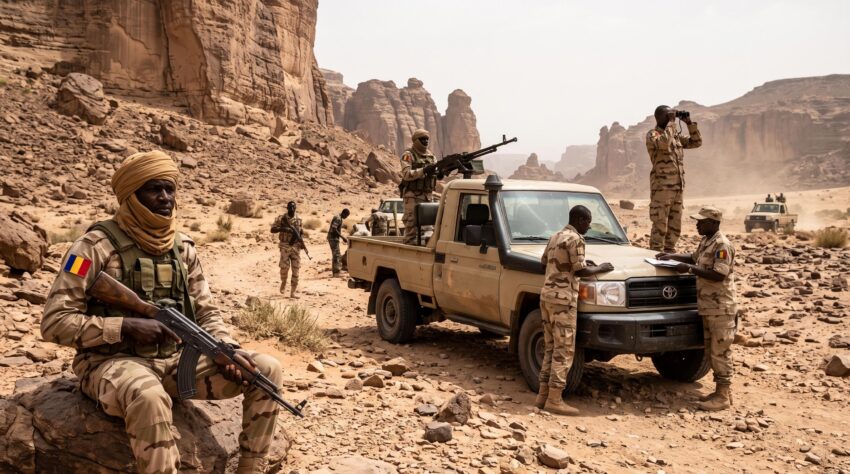
MISKI, Chad — October 15, 2026 — A deadly confrontation erupted on October 14 between Chad’s military mining brigade and a local self-defense committee in Miski, a gold-rich region in the heart of the Tibesti Mountains. The clash, confirmed by official military statements, resulted in two soldiers killed and nine security personnel injured, intensifying fears over the stability of both the local economy and fragile peace agreements.
The violence, described by authorities as a deliberate attack, unfolded near the Awa mining zone around 5 p.m., though the exact circumstances remain murky. Military officials accuse the self-defense committee of initiating the assault and have demanded the immediate disarmament of the group, warning that a refusal to comply would be treated as an act of rebellion. Without independent verification or public access to evidence, these claims represent only the government’s official stance.
Triggers and accusations: what ignited the latest flare-up?
Tensions had been building for days. On October 13, local sources reported that the self-defense committee had issued a statement accusing the military mining brigade of opening heavy fire the previous day. In their communiqué, the group condemned the actions as provocative violations of the ceasefire and alleged illegal gold extraction by military-affiliated operators. They also challenged the legitimacy of the military’s presence on the ground and called on government mediators to intervene before violence escalated further.
The timing of the clashes is critical. They come just days after a high-level government delegation led by the Vice Prime Minister visited the region on October 3, 2026, to reaffirm commitments under a peace deal signed in April 2025. The agreement aimed to stabilize the Tibesti region by addressing economic grievances, particularly those tied to control over gold deposits that local communities depend on for survival.
Broken promises and fragile peace in the Tibesti
The October 14 violence exposes deep cracks in the region’s peace process. The self-defense committee insists it has adhered strictly to the April 2025 accord and the October follow-up commitments, while military leadership claims the group has repeatedly violated the terms. At the core of the dispute lies not only security concerns but a fierce battle over who controls—and profits from—Miski’s gold reserves.
The central government has long relied on military deployment to secure these mines, a move intended to curb illegal mining and stabilize the area. Yet, for local populations, this increased military presence has often felt more like occupation than protection. Communities argue that the state’s interventions prioritize resource extraction over their own welfare, deepening resentment and fueling cycles of confrontation.
Real-world consequences: lives, livelihoods, and the economy on the brink
While no independent reports have yet documented civilian casualties or mass displacement, the immediate fallout of the violence is already palpable. Mining operations in Miski have ground to a halt, stranding hundreds of workers and disrupting supply chains that feed into larger regional markets. Small-scale miners, already vulnerable, now face the loss of income sources critical to their survival.
The broader economic impact is equally alarming. Gold production in the Tibesti region accounts for a significant portion of Chad’s northern economy. Any prolonged disruption threatens local trade, employment, and revenue streams that support public services. Economists warn that if conflict persists, the ripple effects could destabilize neighboring areas, aggravating food insecurity and displacing more communities.
Families in Miski and surrounding villages live in fear. The latest clashes have shattered any remaining trust in the peace process, leaving residents uncertain about their future. Many fear a return to the violent unrest that plagued the region before the 2025 agreement—a cycle they believed had finally been broken.
Can dialogue break the cycle?
The path to de-escalation now hinges on two priorities: transparent investigations and renewed commitment to diplomacy. Without impartial verification of what triggered the October 14 violence, both sides are likely to dig in further, increasing the risk of another deadly confrontation.
Civil society leaders and regional observers are calling for urgent mediation efforts. They urge the government and local groups to return to the negotiating table, not just to address this latest incident but to confront the underlying issues fueling distrust: equitable resource management, fair representation, and meaningful involvement of communities in decisions about their land and livelihoods.
One thing is clear: the fate of Miski—and the Tibesti region as a whole—rests on whether leaders prioritize peace over profit, and dialogue over division. Failure to do so could plunge the region deeper into chaos, with consequences far beyond Chad’s borders.