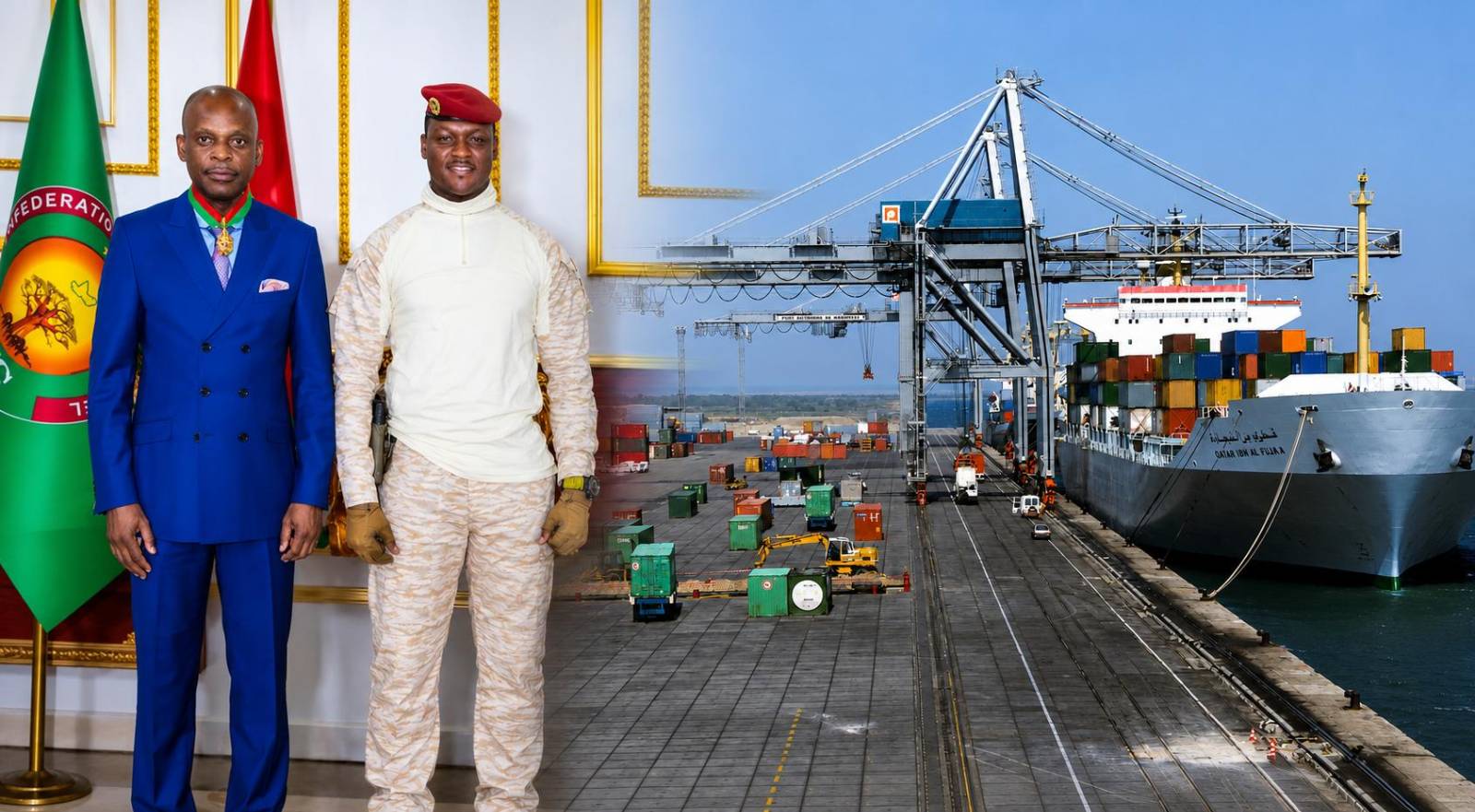
In a move that has sparked both official commendation and private skepticism, the Togolese Minister of Foreign Affairs was recently bestowed with the highest honorific distinction of Burkina Faso: the Commander of the Order of the Stallions. While state media and diplomatic channels have framed this gesture as a testament to Togo’s commitment to regional solidarity and openness, closer examination reveals a far more complex and transactional dynamic at play.
Diplomacy driven by pragmatism, not principle
The conferral of this prestigious award raises a fundamental question: what exactly does this honor symbolize? Is it a recognition of exemplary diplomatic conduct, or merely the formalization of a mutually beneficial convergence of interests between two governments facing shared political and economic pressures? In international relations, such distinctions often serve as tools to reinforce alliances, yet they may also convey veiled political messages to regional stakeholders.
Beneath the ceremonial veneer, many analysts interpret this accolade as the culmination of a carefully orchestrated geopolitical maneuver. The timing is particularly noteworthy, coming on the heels of a contentious political episode that tested the bonds between Lomé and Ouagadougou. The Togolese government’s decision to grant asylum to former Burkinabé President Roch Marc Christian Kaboré was swiftly followed by a reversal of policy, as economic considerations overshadowed diplomatic solidarity. The abrupt withdrawal of Kaboré’s exile status sent a clear message: when national interests are at stake, principle takes a backseat to expediency.
A relationship built on mutual economic dependence
The Togolese approach to regional diplomacy appears to be governed by a clear hierarchy of priorities. While solidarity rhetoric may dominate public discourse, economic imperatives dictate the substance of the relationship. The strategic decision to prioritize trade agreements with Burkina Faso—despite the earlier asylum episode—demonstrates Lomé’s willingness to leverage regional partnerships for tangible gains. The cornerstone of this strategy is the Port of Lomé, a vital transit hub for Burkinabé imports and exports. By facilitating the smooth movement of goods, Togo secures its own economic interests, while Burkina Faso gains a reliable corridor for its maritime trade.
This interdependence is not one-sided. As a landlocked nation, Burkina Faso relies heavily on access to coastal infrastructure, making the Port of Lomé an indispensable asset. Conversely, Togo derives significant revenue from transit fees and related commercial activities. The convergence of these interests has fostered a rapprochement between the two capitals, one that is as much about economic convenience as it is about diplomatic posturing.
The erosion of ideological commitments in favor of economic leverage
The timing of this distinction is no coincidence. It arrives at a moment when regional governance, political freedoms, and public accountability remain subjects of intense debate. Critics argue that the award underscores a strategic alignment rather than a commitment to democratic values or principled cooperation. This reflects a broader trend in West African diplomacy, where economic pragmatism increasingly eclipses traditional ideals of solidarity and shared governance.
In this evolving landscape, alliances are forged and maintained not on the basis of shared ideologies, but rather on the tangible benefits they offer. Economic incentives, logistical necessities, and security imperatives have become the driving forces behind regional partnerships, often at the expense of ethical considerations or long-held diplomatic conventions. The result is a diplomacy of convenience, where the language of unity and cooperation masks a reality of calculated self-interest.
The gap between official narrative and political reality
For government officials, this distinction represents a milestone in bilateral relations, symbolizing the strength and depth of cooperation between Togo and Burkina Faso. Yet this official narrative struggles to reconcile with the realities of the relationship. When diplomatic gestures are so closely tied to economic incentives, the rhetoric of African solidarity loses its resonance, particularly among a public increasingly attuned to the discrepancies between words and actions.
At its core, this award exemplifies the primacy of statecraft over ideology. Governments prioritize their strategic interests, trade partnerships, and political stability—sometimes at the cost of ethical consistency. The contrast between ceremonial honors and underlying motives exposes the fragility of idealized diplomatic narratives. What appears as a symbol of fraternal unity is, in fact, a transactional arrangement, where economic security is purchased at the expense of humanitarian principles and the sanctity of asylum.
It is this fundamental disconnect that continues to fuel scrutiny and debate regarding the true nature of the relationship between Lomé and Ouagadougou. Beneath the polished rhetoric and ceremonial medals lies a diplomacy defined not by shared values, but by the cold calculus of mutual advantage.