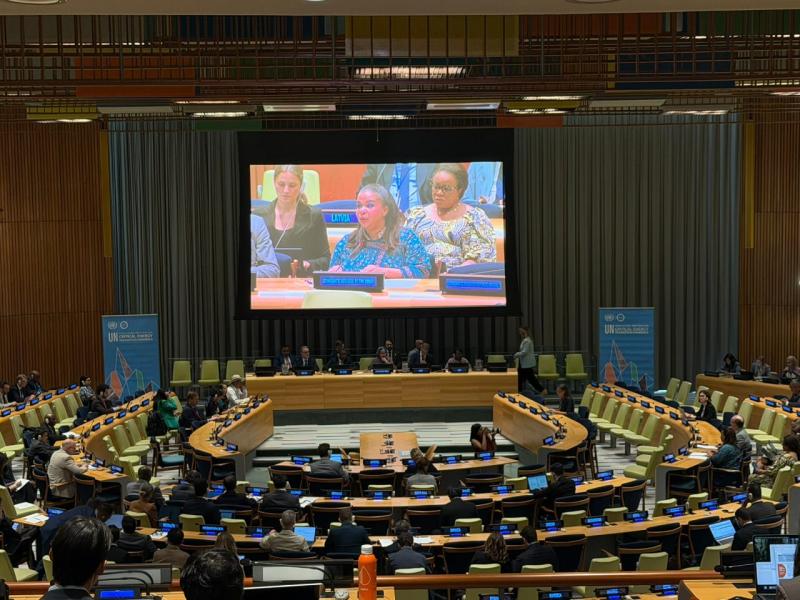
DRC exposes Rwanda’s inaction over critical minerals at UN security talks
The Democratic Republic of Congo (DRC) took center stage at the United Nations on Tuesday, July 14, during a high-level meeting on critical minerals essential for the global energy transition. The Congolese delegation, led by Minister of State Thérèse Kayikwamba Wagner, delivered a blunt assessment of the ongoing challenges facing mineral-rich nations like the DRC.
Minerals as a catalyst for conflict
Addressing world leaders in New York, Wagner highlighted how the exploitation of critical minerals—particularly coltan in eastern DRC—has become inextricably linked to regional instability and external interference. She specifically pointed to Rubaya, a major coltan mining hub, where armed groups, allegedly backed by neighboring Rwanda, continue to profit from illicit mineral trade.
“For countries like mine, this is no longer just an economic issue. The illegal exploitation of our resources weakens state authority, erodes sovereignty, and can lead to territorial violations. In Rubaya alone, where mines account for 15% of global tantalum demand, over 1,400 tons of coltan were smuggled into Rwanda in the first year after seizure by the M23—a group reportedly supported by Rwanda—generating approximately $800,000 monthly for armed factions.”
Demanding accountability from the international community
The Congolese foreign minister criticized the UN’s failure to sanction Rwanda’s defense forces despite documented evidence of their involvement in destabilizing mineral-rich regions. She argued that the current governance framework for critical minerals remains woefully inadequate, treating resource management as purely an economic matter rather than a security imperative.
“The absence of sanctions against Rwanda’s defense forces, despite overwhelming evidence, reveals a critical gap in the international system. Resources should not fund conflict; they should fuel development. Yet too often, governance frameworks prioritize extraction over stability, allowing exploitation to fuel violence rather than prosperity.”
Proposing a new framework for responsible mineral governance
As chair of the UN Security Council, the DRC is advocating for a paradigm shift—one that ties mineral governance directly to conflict prevention, peacebuilding, and sustainable development. Wagner emphasized the need for balanced partnerships that extend beyond raw material access to include technology transfer, infrastructure investment, and local value addition.
“Responsibility must extend across the entire mineral supply chain—from miners and traders to financial institutions and end-users. Partnerships should empower producing nations, not exploit them. The energy transition must not replicate old patterns of dependency; it must create shared prosperity.”
Balancing traceability with equitable inclusion
The DRC’s proposals also address the need for robust traceability systems that combat smuggling and armed group financing without penalizing legitimate artisanal miners. Wagner stressed that compliance burdens must not fall disproportionately on producer nations, urging a balanced approach that aligns with the UN Sustainable Development Goals.
“Traceability should target fraud and conflict financing while protecting the livelihoods of small-scale miners. It must not create new barriers to market access or shift the entire burden of compliance onto countries already grappling with instability.”
Measuring success beyond industrial output
Concluding her remarks, Wagner underscored that the success of the global energy transition cannot be measured solely by the number of batteries or electric vehicles produced. True progress, she argued, must be evaluated by its impact on the lives of people in resource-rich nations.
“We cannot declare victory in the energy transition if the communities providing these minerals remain trapped in poverty, insecurity, or exploitation. Sustainable development must deliver tangible benefits to those who make it possible.”
This intervention comes amid ongoing diplomatic efforts, including a U.S.-DRC strategic minerals partnership and a U.S.-Rwanda agreement aimed at de-escalating tensions in eastern DRC. Despite these frameworks, the security situation remains precarious, with the M23 rebel group—accused of Rwandan support—continuing to control key mining areas and urban centers in North and South Kivu.