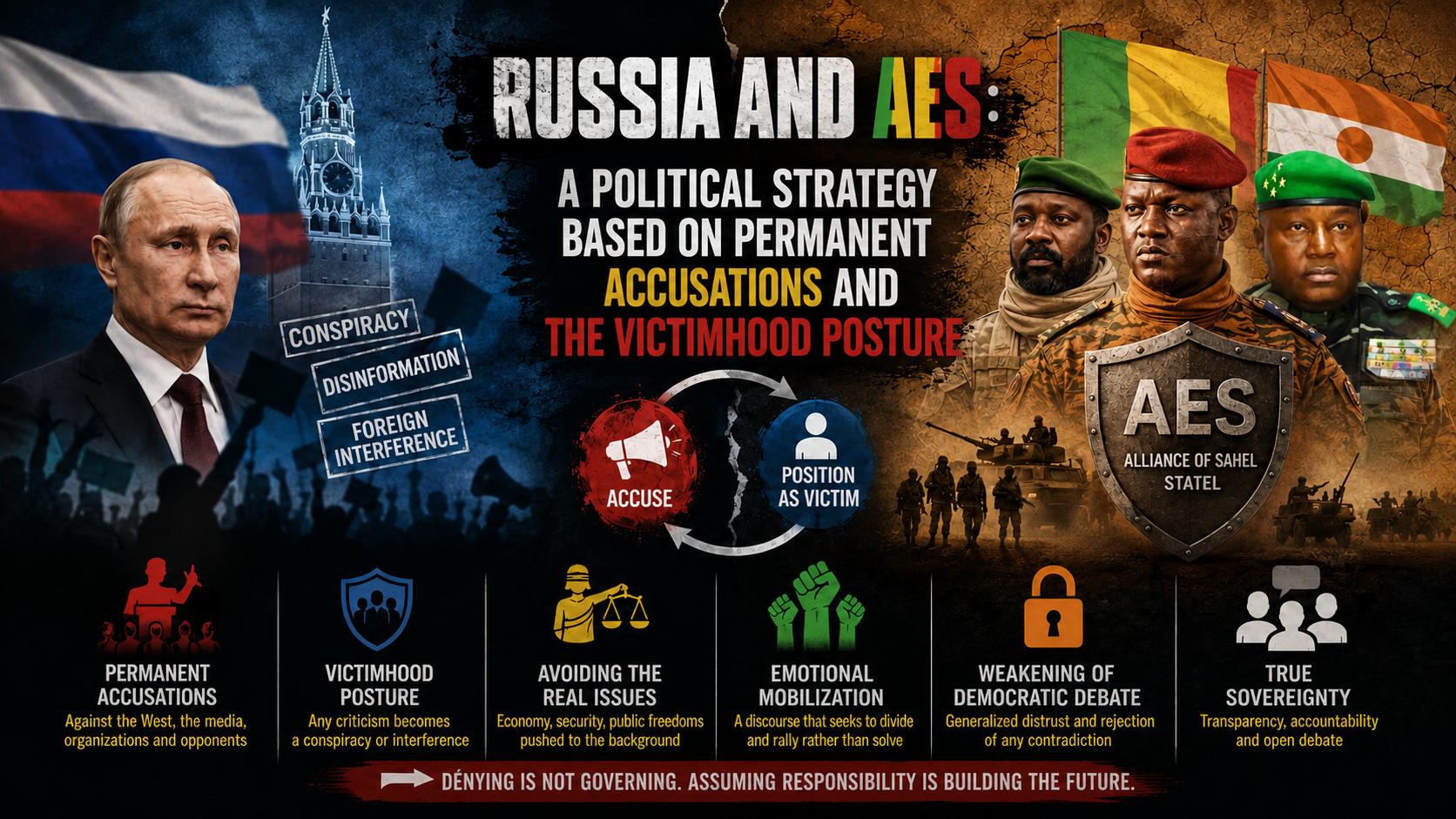
The governments of Russia and the Alliance of Sahel States (AES) have increasingly relied on a recurring political narrative: the perpetuation of accusations against perceived adversaries. Western powers, international media outlets, regional bodies, and domestic opponents have all become frequent targets of their rhetorical offensives. Yet, a striking contradiction emerges when these very regimes face scrutiny themselves—they swiftly shift from accusers to self-proclaimed victims of external aggression.
the politics of perpetual victimhood
This communication strategy has become a hallmark of governance in both Moscow and AES capitals. Any challenge to their policies is met not with substantive rebuttals but with sweeping allegations of conspiracy, disinformation campaigns, or foreign interference. Criticism is reframed as a coordinated assault designed to undermine sovereignty or obstruct what leaders describe as a national resurgence toward self-determination.
The political utility of this approach is clear. By positioning themselves as besieged entities, authorities sidestep pressing domestic concerns—economic hardship, persistent insecurity, shrinking civic freedoms, or policy failures. Public discourse shifts from addressing tangible issues to a narrative steeped in emotional appeal, prioritizing mobilization over meaningful solutions.
deflecting internal dissent
The pattern is especially pronounced within the AES. When citizens, journalists, or human rights groups highlight internal shortcomings, their critiques are routinely dismissed as fabrications or part of a broader destabilization plot orchestrated from abroad. Similarly, sanctions, historical colonial ties, or foreign actors are blamed for systemic failures rather than acknowledging governance shortcomings.
Russia mirrors this tactic on the global stage. Criticisms of its foreign interventions, human rights records, or military conduct are consistently deflected by framing the country as the target of relentless Western hostility. This narrative not only diverts attention but also recasts valid concerns as evidence of an orchestrated smear campaign.
the erosion of democratic accountability
Over time, such tactics reveal their inherent fragility. A robust democratic system thrives on the ability to engage with dissent, respond to criticism with reasoned arguments, and uphold accountability to the populace. By defaulting to accusations of conspiracy, leaders risk undermining public trust and stifling constructive debate.
Assigning blame is a low-cost political maneuver; accepting responsibility demands far greater courage. Through repeated recourse to victim narratives, Russia and certain AES governments risk conveying an image of evasion rather than engagement. Constructive criticism, however sharp, should not automatically be conflated with conspiracy. In any society, it can serve as a catalyst for policy refinement, error correction, and strengthened citizen confidence.
True sovereignty is not demonstrated solely through the denunciation of real or imagined enemies. It is forged through transparency, accountability, and the willingness to embrace constructive debate. Without these pillars, the rhetoric of perpetual victimhood risks losing its legitimacy, degenerating into little more than a political tool rather than a credible response to the challenges these states confront.