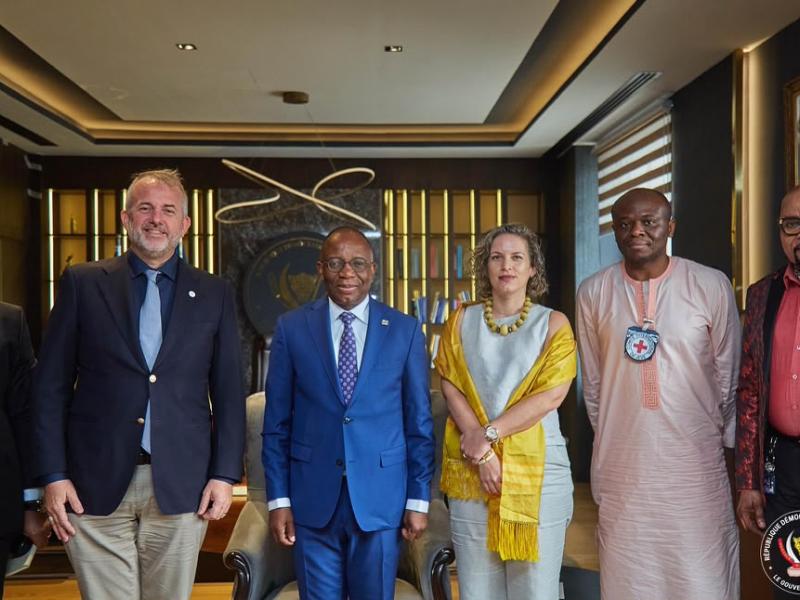
DRC government and ICRC strengthen detention and humanitarian support
The International Committee of the Red Cross (ICRC) and the government of the Democratic Republic of the Congo (DRC) have formalized a renewed commitment to deepen their partnership aimed at improving detention conditions and strengthening humanitarian action across the country, particularly in the eastern regions. This landmark agreement was solidified during a high-level meeting on July 14, 2026, between ICRC delegation head François Moreillon—concluding his three-year mission in the DRC—and Guillaume Ngefa Atondoko Andali, Deputy Prime Minister and Minister of Justice.
Bilateral review highlights progress and future priorities
The meeting served as both a review of past achievements and a roadmap for future collaboration. Both parties acknowledged the positive trajectory of their cooperation, emphasizing the urgent need to address persistent challenges in detention facilities nationwide, with a special focus on the eastern provinces where humanitarian needs remain acute.
François Moreillon expressed deep appreciation for the constructive dialogue maintained with the Ministry of Justice throughout his tenure. He highlighted the critical importance of coordinated efforts to enhance detention conditions, improve prisoner welfare, and ensure adherence to international humanitarian law. « My visit to the Ministry of Justice was primarily an opportunity to express gratitude to Minister Andali for the sustained collaboration between our organizations over the past years,» he noted. « After more than three years in the DRC, it was also a moment to reflect on our shared progress and identify strategic areas where we can further strengthen our partnership to benefit detainees, particularly in the eastern regions where the ICRC’s operations are concentrated. Discussions covered essential topics such as prison financing, food security for detainees, and other systemic challenges we address jointly with the Ministry of Justice. Our relationship is built on trust, transparency, and a shared commitment to tangible results. »
Concrete challenges and joint solutions
During the discussions, the delegation and government representatives examined pressing issues affecting correctional facilities, including financial sustainability, nutritional standards for inmates, and the need for comprehensive rehabilitation programs. François Moreillon reiterated the ICRC’s unwavering dedication to supporting the DRC government in developing sustainable solutions to these longstanding problems.
The ICRC’s mandate in the DRC spans nearly five decades, during which it has played a pivotal role in protecting civilians, facilitating prisoner exchanges, and promoting respect for international humanitarian law. In a recent humanitarian operation, the ICRC successfully assisted in the transfer of over 1,300 demobilized government forces and their families from Goma to Kinshasa—a journey spanning nearly 2,000 kilometers through active conflict zones—at the request of Congolese authorities, MONUSCO, and armed group representatives.
This operation underscored the ICRC’s unique role as a neutral intermediary capable of bridging divides in high-stakes humanitarian contexts.
A legacy of resilience and continued commitment
Reflecting on his mission, François Moreillon conveyed a message of solidarity to the Congolese people, particularly those enduring decades of conflict in the eastern DRC. « I leave this mission with profound satisfaction, but also with a renewed sense of purpose. The resilience of the Congolese people—especially in the East—has been an inspiration. Our partnership with the Ministry of Justice has gained momentum in recent months, and we are optimistic that these strengthened efforts will yield sustainable improvements for detainees and uphold their fundamental rights. »
The ICRC has been present in the DRC since 1978, providing critical support to communities affected by armed conflict and violence. Its work includes advocating for the integration of international humanitarian law into national legal frameworks, a priority in a context marked by escalating humanitarian and security crises in the eastern regions of the country.