DRC parliament begins review of 2027-2030 military programming law
- Politics
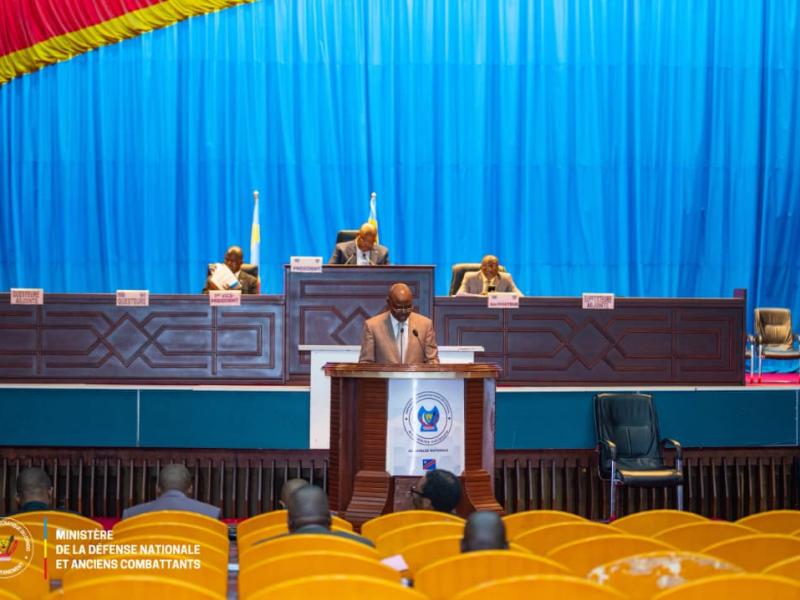
The Democratic Republic of the Congo’s National Assembly has initiated the examination of the military programming law for 2027-2030. This critical legislative process began on Tuesday, July 14, 2026, following a presentation by Vice Prime Minister and Defense Minister Guy Kabombo Muadiamvita, who returned from an official mission in Egypt.
The proposed law serves as a multi-year financial and strategic framework designed to secure state budget allocations for equipping, modernizing, and enhancing the capabilities of the Armed Forces of the Democratic Republic of the Congo (FARDC). This initiative aims to eliminate budgetary improvisation while establishing a legal framework to support the war effort. According to the Ministry of National Defense and Veterans Affairs, alongside the military programming law for 2027-2030, Kabombo also presented the proposed reform of the framework law governing the FARDC.
The Ministry of National Defense and Veterans Affairs emphasized that the primary objective of the military programming law for 2027-2030 is to serve as a major driver for modernizing and professionalizing the FARDC. This effort seeks to effectively address both internal and external threats, as well as current security challenges. The previous military programming law (2022-2025), which expired last year, was already a cornerstone of the broader modernization initiative for the defense sector. The reform aims to adapt the legal framework to new operational realities and the demands of a modern, high-performing, and better-structured army.
During his presentation, Guy Kabombo Muadiamvita outlined the shortcomings and constraints that hindered the execution of the previous military programming law. He then presented the key directions of the new programming covering the 2027-2030 period, structured around six major programs:
- General administration: Places personnel at the center of the national defense system, underpinning all other components;
- Instruction, training, and military research;
- Equipment and materials;
- Infrastructure modernization;
- Training, operations, and military intelligence;
- Defense industry.
“After identifying the challenges and constraints that characterized the previous military programming law, this bill is structured around six programs: general administration, which places personnel at the heart of the national defense system and conditions the other components; instruction, training, and military research; equipment and materials; infrastructure modernization; training, operations, and military intelligence; and the defense industry,” stated the Vice Prime Minister of Defense before the national representation.
During his address, Kabombo also highlighted the new structure of the programming, organized around six major programs designed to guide the FARDC’s capacity-building effort in alignment with the vision of President Félix Tshisekedi, who serves as the supreme commander of the armed forces. These programs include strengthening training, acquiring equipment, modernizing military infrastructure, intensifying training and operations, developing military intelligence capabilities, and promoting a genuine national defense industry.
“As you can see, this military programming law defines national priorities in defense and establishes a multi-year financial framework aimed at enhancing operational capabilities and strengthening the Armed Forces of the Democratic Republic of the Congo,” he added.
Kabombo also underscored the importance of the Fonds de soutien au développement des FARDC (FSD-FARDC), a mechanism designed to support the war effort. He noted that awareness campaigns for this fund are ongoing among partners, public donors, and private contributors, who are encouraged to support the development of the national defense apparatus. Established by presidential decree following its adoption in the Council of Ministers, this fund aims to mobilize additional resources for the defense sector.
Against the backdrop of urgent security concerns, the Vice Prime Minister of National Defense stressed before the elected representatives the necessity of adequately incorporating this programming into the annual finance law. This step is deemed essential to successfully implement the reform and consolidate the professionalization and modernization of the FARDC on the ground.
This legislative initiative comes at a time marked by the Rwandan aggression through the resurgence of the AFC/M23 rebellion, which controls vast areas of North Kivu and South Kivu provinces. This situation underscores the urgency of prioritizing the defense and security sector. Since the enactment of the 2022-2025 military programming law, the Government of the Republic has been ramping up efforts to mobilize more resources to strengthen the capabilities of the Congolese army.
This parliamentary initiative also unfolds within a diplomatic context marked by the signing, under U.S. mediation, of the Washington peace agreement between the Democratic Republic of the Congo and Rwanda. This accord includes measures for de-escalation, the gradual withdrawal of Rwandan forces from Congolese territory, and the neutralization of armed groups active in eastern DRC, including the FDLR, which Kigali considers a threat to its security. While the agreement was widely welcomed upon its conclusion, the security situation in the eastern part of the country remains particularly concerning.
Simultaneously, the Doha process, facilitated by Qatar to foster dialogue between the Congolese Government and the AFC/M23 rebellion, has yet to achieve significant progress. On the ground, the AFC/M23 rebels, whom Kinshasa, the United Nations, and several international partners accuse of being supported by Rwanda, continue to control the cities of Goma and Bukavu, as well as numerous other localities in North Kivu and South Kivu provinces. Fighting persists in several areas, while diplomatic initiatives struggle to yield tangible results.
This reality once again highlights the persistent gap between diplomatic commitments and the security situation on the ground.