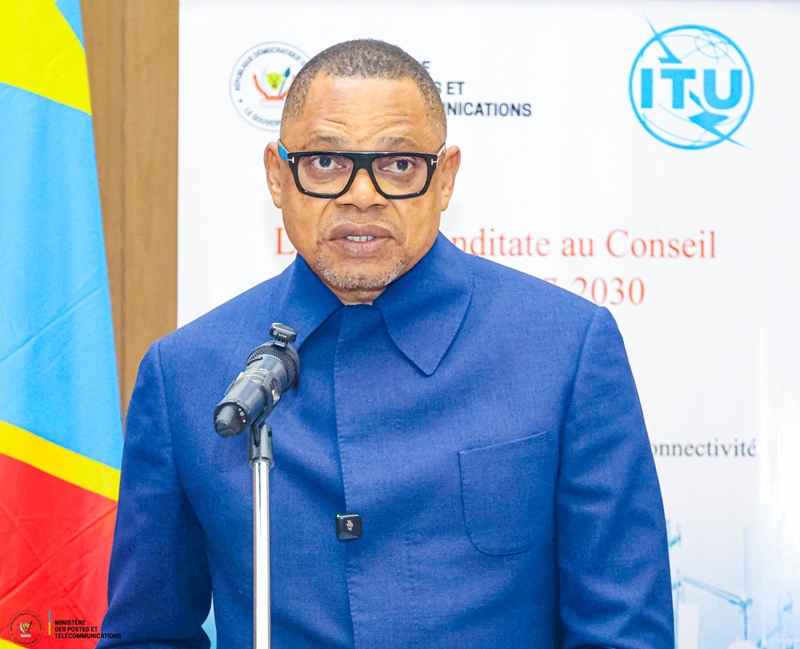
Historic push for global telecom leadership
In a bold diplomatic initiative, the Democratic Republic of the Congo (DRC) is rallying international support for its bid to secure a seat on the prestigious Council of the International Telecommunication Union (ITU). The campaign, spearheaded by Me José Mpanda Kabangu, Minister of Posts and Telecommunications, targets the Region D – Africa category in the upcoming elections at the ITU’s Plenipotentiary Conference in Doha, Qatar, scheduled for November 2026.
During a high-profile gathering at the Hilton Hotel in Kinshasa on July 16, 2026, Minister Mpanda formally unveiled the DRC’s candidacy to ambassadors, heads of diplomatic missions, and representatives of international telecom organizations. The event marked the beginning of a coordinated lobbying effort aimed at rallying African and global partners behind the country’s vision for digital transformation.
The DRC’s bid is framed as a strategic move to elevate Africa’s voice in global telecom governance. “This candidacy is more than a diplomatic formality—it’s a commitment to shape the future of digital connectivity on the continent and beyond,” Mpanda stated, emphasizing the DRC’s potential to bridge gaps in infrastructure, innovation, and policy.
Why the DRC’s leadership matters for Africa
The Minister highlighted the DRC’s unique position as the conventional seat of the African Telecommunications Union (ATU), underscoring its role as a natural leader in advocating for African interests within the ITU. With over 110 million citizens and 74 million mobile subscriptions, the DRC represents one of Africa’s largest digital markets, poised to drive investment in networks, satellites, and data centers.
Christian Katende, President of the Post and Telecommunications Regulatory Authority of the Congo (ARPTC), outlined four key pillars of the DRC’s campaign:
- Strengthening Africa’s voice in global telecom governance;
- Driving investment in critical digital infrastructure;
- Promoting inclusive governance that balances innovation, security, and digital sovereignty;
- Building capacity through knowledge sharing and innovation in African telecom sectors.
Katende framed the bid as a turning point for Africa: “Africa is no longer a spectator in the digital revolution—it must be a leader. By supporting the DRC, we choose an Africa that innovates, invests in its talent, and crafts its own solutions.”
The DRC’s vast mineral resources, including critical minerals essential for semiconductors and AI infrastructure, further solidify its claim to a seat at the table, Katende argued, positioning the country as a key player in the global digital supply chain.
Diplomatic backing and strategic alliances
Noëlla Ayeganagato, Vice-Minister of Foreign Affairs, reaffirmed the government’s commitment to the candidacy, calling on diplomats to leverage bilateral and multilateral partnerships to ensure the DRC’s success. “The ITU is a strategic partner in achieving sustainable development goals. We urge all potential supporters to translate their commitments into concrete actions,” she said.
The DRC’s campaign comes as the country accelerates its digital transformation, with recent initiatives including the deployment of 1,700 km of fiber optic cables and plans for a sovereign satellite to enhance national connectivity. These projects align with the DRC’s broader vision to become a regional digital hub and a champion for Africa’s digital sovereignty.
Next steps: Doha and beyond
The formalization of the DRC’s candidacy will take place at the Plenipotentiary Conference in Doha. Success would grant the DRC a seat on the ITU Council for the 2027–2030 term, enabling it to influence global telecom policies and advocate for African priorities on the world stage.
The diplomatic push reflects the DRC’s ambition to position itself as a key player in shaping the future of digital governance, not just in Africa but globally. With strong institutional backing and a clear vision for digital leadership, the DRC’s bid is gaining traction as a historic opportunity for the continent.