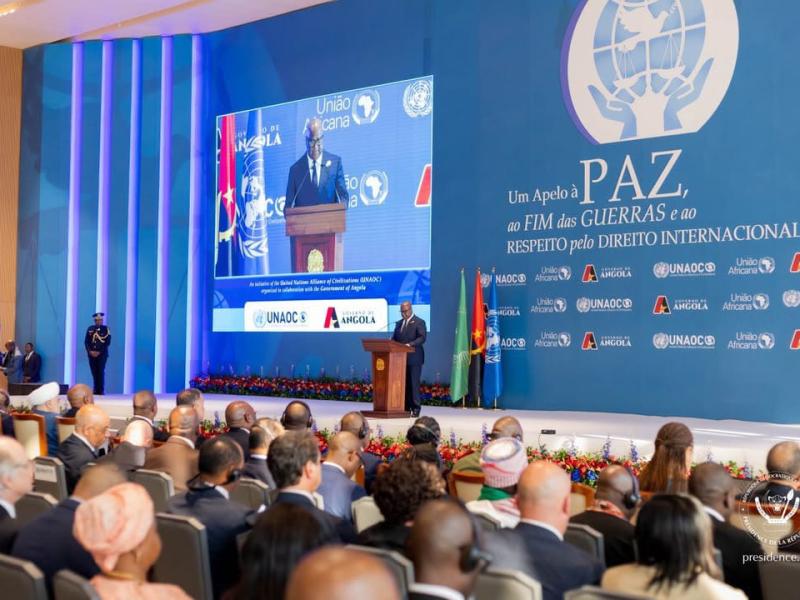
Félix Tshisekedi in Luanda: eastern DRC crisis demands verifiable peace
Luanda hosted a critical international summit this week as African leaders gathered to address escalating conflicts across the continent. At the heart of discussions was the persistent crisis in the eastern Democratic Republic of Congo (DRC), where armed groups continue to destabilize communities despite ongoing diplomatic efforts.
The three-day event, titled “A Call for Peace, End to Wars, and Respect for International Law,” brought together heads of state, diplomats, and peace advocates. Organized by the United Nations Alliance of Civilizations in partnership with Angola’s government, the summit aimed to strengthen multilateral cooperation and promote sustainable solutions to regional conflicts.
Among the speakers was Félix Tshisekedi, President of the DRC, who delivered a powerful address reflecting on the human toll of his nation’s prolonged conflict. He painted a vivid picture of the devastation wrought by years of violence, highlighting the plight of displaced families, victims of sexual violence, and children deprived of education and safety.
DRC’s eastern crisis: a test for Africa and the world
Tshisekedi framed the crisis in eastern DRC not merely as a national tragedy but as a litmus test for Africa and the global community. He emphasized that the ongoing violence—fueled by illicit exploitation of natural resources—undermines regional stability and demands urgent, collective action.
“The war in my country is not just a Congolese tragedy; it is a test for our region, for Africa, and for the international community,” Tshisekedi declared. “We cannot afford to treat sovereignty as a selective principle—invoking it in some crises while diluting it in others.”
He underscored the paradox of a world where human rights declarations are abundant, yet their enforcement remains inconsistent. “The credibility of multilateralism weakens when the sovereignty of states is violated with impunity,” he warned, calling for a unified stance against aggression and foreign interference in sovereign nations.
A plea for actionable peace
While acknowledging diplomatic initiatives such as the Washington and Doha processes—supported by the African Union—Tshisekedi stressed that words alone are insufficient. He insisted that peace must be verifiable on the ground, with tangible steps to restore state authority, protect civilians, and facilitate the safe return of displaced populations.
“Peace cannot be an empty promise,” he asserted. “It must manifest in concrete actions: restoring civilian safety, ending impunity, dismantling the economic engines of war, and holding accountable those who fuel conflict through mercenary activities or external support.”
Tshisekedi’s impassioned speech resonated with delegates, many of whom echoed his call for a renewed global commitment to justice, accountability, and the primacy of international law. He framed the 80th anniversary of the United Nations Charter as a moment for reflection—not merely to celebrate its legacy, but to recommit to its core principles: preserving future generations from the scourge of war.
Challenges persist despite diplomatic efforts
Despite the Washington Agreement and other peace frameworks, the situation in eastern DRC remains dire. Hostilities continue, negotiations stall, and displaced communities face worsening humanitarian conditions. Tshisekedi’s warnings about the gap between diplomatic commitments and ground realities underscored the urgency of translating words into deeds.
The summit in Luanda served as a stark reminder that while Africa’s conflicts demand regional solutions, they also require the unwavering support of the international community. As Tshisekedi concluded, the path to peace begins with restoring the rule of law, rejecting selectivity in justice, and prioritizing the protection of civilians above all else.
Photo illustration