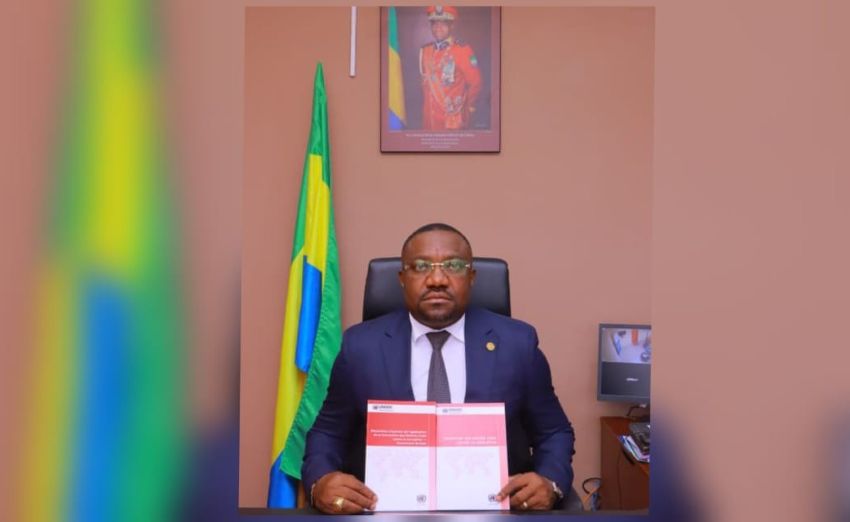
Libreville, Friday 19 June 2026 – At the end of June, Libreville will not only host a technical mission from the United Nations. Gabon is preparing to undergo one of the most rigorous international exercises in public governance, financial transparency and anti-corruption combat.
For three days, from 29 June to 1 July 2026, experts appointed by the United Nations Office on Drugs and Crime will conduct an in-depth assessment of the country’s ability to prevent corruption, detect illicit financial flows and recover assets derived from economic crime.
Behind the institutional protocol lies a far more strategic reality. In a world where a state’s credibility is measured as much by the strength of its institutions as by its economic performance, this evaluation represents a genuine test of international trust.
Governance under the spotlight
This mission is part of the second cycle of the review mechanism of the United Nations Convention against Corruption, the primary global legal instrument for tackling corrupt practices.
Gabon officially launched this process in October 2025, then submitted its self-assessment to the reviewing states – Chad and Libya – as well as to UNODC experts. The stage now opening in Libreville is the most decisive. It will allow evaluators to compare legal texts with operational realities.
The review will focus on two major pillars of the Convention. The first concerns preventive measures designed to reduce corruption risks in the public administration. The second looks at asset recovery, which has become one of the most sensitive issues in international cooperation.
Experts will analyse asset declaration mechanisms, public procurement procedures, ethics rules for public officials, budgetary control systems and national anti-money laundering frameworks.
The National Commission for the Fight against Corruption and Illicit Enrichment, the National Financial Investigation Agency, economic and financial administrations, courts, security services and regulatory authorities will be directly mobilised for this exercise.
The global battle over illicit assets
The heart of the evaluation lies undoubtedly in the chapter devoted to asset recovery.
Today, embezzlement of public funds, transnational corruption and money laundering networks rely on increasingly sophisticated financial mechanisms. Illicit capital flows across multiple jurisdictions, travels through complex structures and sometimes disappears behind hard-to-trace international arrangements.
In this context, a state’s capacity to identify, seize, confiscate and recover these resources has become a major indicator of its institutional maturity.
For Gabon, the challenge is twofold. First, it must demonstrate that national systems meet international standards. But it also has to show that institutions possess the technical and legal means necessary to protect public resources.
This dimension is particularly watched by international financial partners, rating agencies, donors and investors, who attach increasing importance to governance criteria.
A credibility to be reinforced
Beyond the technical conclusions that will be drawn at the end of the mission, the importance of this exercise lies in the signal it sends.
In a global environment marked by demands for transparency and public accountability, states that agree to subject their institutions to independent scrutiny demonstrate a willingness to improve rather than retreat into self-satisfaction.
Gabon intends precisely to follow this logic. The Libreville mission is not just about drawing up an inventory. It must help identify weaknesses, strengthen existing mechanisms and improve cooperation with international partners.
Through this review, the country is playing for more than a simple administrative assessment. It is staking part of its institutional credibility. In a global economy where trust has become a strategic resource, the quality of governance now weighs as heavily as natural wealth.
The Libreville meeting thus appears as far more than a conventional obligation. It represents a rare opportunity to demonstrate that the fight against corruption is no longer just political discourse, but a concrete undertaking to modernise the state. For Gabon, the challenge is not only to be evaluated – it is to convince.