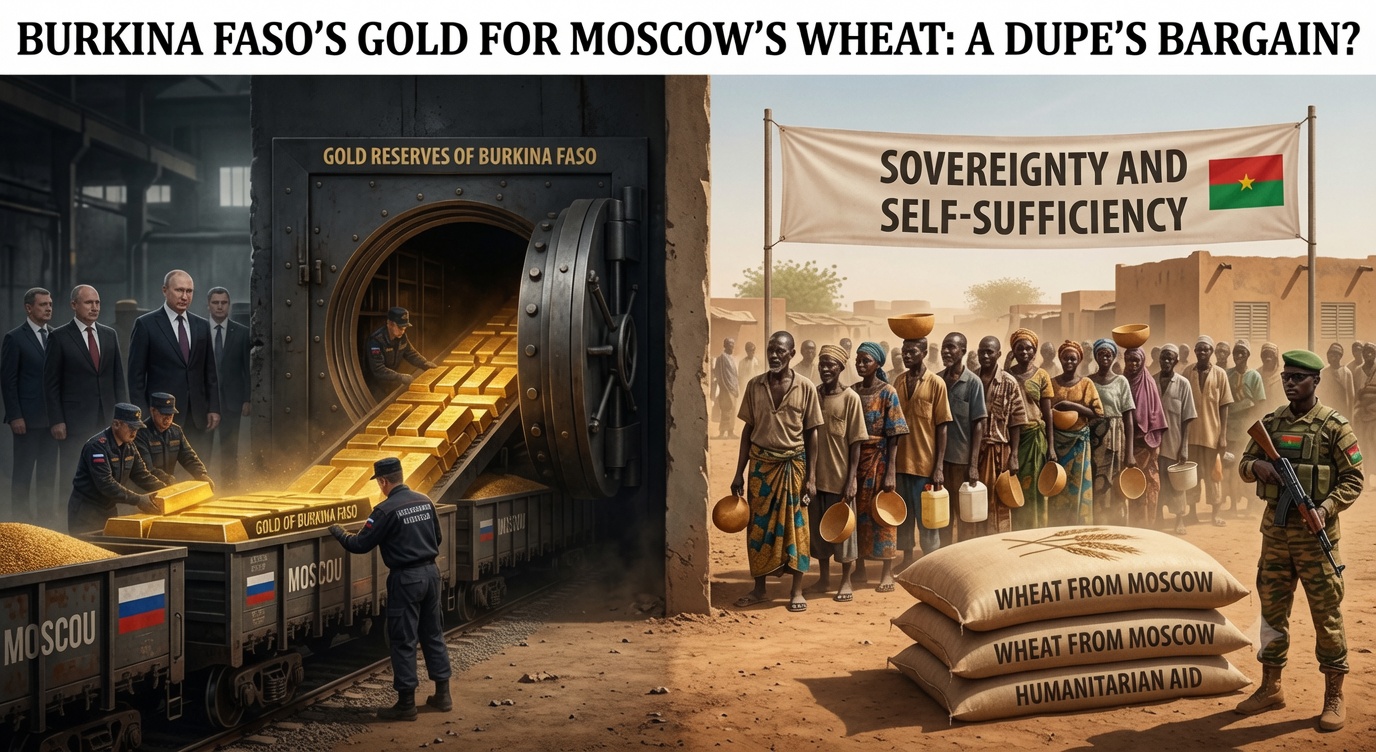
Rarely has a political decision so starkly exposed the contradictions of a nation’s leadership as the recent move by Burkina Faso. While officials in Ouagadougou trumpet the virtues of regained sovereignty and local resilience, the government has simultaneously barred citizen-led initiatives and NGOs from providing direct aid to the country’s most vulnerable—under the pretext of regulating humanitarian assistance. Yet, in a move that borders on irony, the same authorities are now turning to Moscow, not for strategic independence, but for bags of wheat to feed a population in crisis.
The visit of Russia’s foreign minister to Ouagadougou laid bare the terms of this lopsided exchange. With a diplomacy as polished as it is unyielding, the Kremlin’s envoy welcomed Burkina Faso’s decision to transfer and store its national gold reserves in Moscow’s central bank. For a government that has staked its legitimacy on breaking free from neocolonial influences and reclaiming full economic autonomy, entrusting the nation’s gold to Russia feels less like a strategic alliance and more like a Faustian bargain.
The inconsistency is glaring. While the regime insists on self-reliance and economic sovereignty, the inability to meet even the most basic food needs without external support reveals a harsh truth: sovereignty without food security is an illusion. A nation that depends on foreign grain shipments for survival cannot claim true independence, no matter how loudly it proclaims otherwise.
This exchange—gold for wheat—is not a triumph of diplomacy, but a stark admission of failure. The Burkina Faso government is mortgaging its sovereign wealth to secure emergency food aid and vague security promises from Moscow. How can a state claim pride when its survival hinges on the generosity of another power, especially one to which it has handed the keys to its financial vault?
The broader implications touch on the very priorities of Burkina Faso’s leadership. As one of West Africa’s top gold producers, the country’s mineral wealth should, in theory, fund agricultural development, storage infrastructure, irrigation systems, and sustainable support for local farmers. Yet, despite its vast underground riches, Burkina Faso remains reliant on foreign food aid. This raises serious questions about how national wealth is managed—and whether it ever reaches those who need it most.
The most troubling aspect of this crisis is not just the external dependency, but the deliberate undermining of domestic solidarity. While the government struggles to feed its people amid ongoing insecurity, it actively obstructs grassroots efforts to do the same. By restricting or outright banning Burkinabè citizens and organizations from providing direct assistance, the authorities seem determined to monopolize aid—not as a humanitarian effort, but as a tool of political control. Every bag of rice or wheat reaching a hungry family is framed not as an act of shared humanity, but as a concession granted by the state.
This centralization of aid carries significant risks. In conflict zones where state presence is weak or absent, local organizations, NGOs, and community initiatives often fill critical gaps in assistance. When their role is suppressed, the most vulnerable populations suffer the most. Worse still, dependence on state-controlled aid deepens, reinforcing perceptions that humanitarian relief is being used as a political instrument rather than a moral obligation.
Another layer of paradox emerges when comparing the sacrifices demanded of the population with the tangible outcomes. Burkinabè citizens are repeatedly called upon to endure hardship in the name of national sovereignty, counterterrorism, and state rebuilding. Yet, as insecurity persists and daily struggles continue, the rationale behind these sacrifices grows increasingly hollow. True sovereignty is not measured by rhetoric alone—it is proven by a state’s ability to protect and sustain its people.
As Burkina Faso’s gold makes its way to Moscow’s vaults in exchange for fleeting political survival, the people on the ground face a stark reality: a sovereignty built on borrowed wheat and surrendered wealth. By trading one overlord for another, the current leadership has not liberated the nation—it has merely renegotiated its chains at a lower price.
At its core, this situation forces a fundamental question: are Burkina Faso’s partnerships truly strengthening its autonomy, or are they deepening its reliance on external benefactors? A nation’s sovereignty cannot be declared through speeches or diplomatic handshakes. It is proven in the fields where food is grown, in the markets where it is sold, and in the homes where families eat without fear. When those foundations crumble, no amount of gold can disguise the hunger—or the hypocrisy—behind the rhetoric.