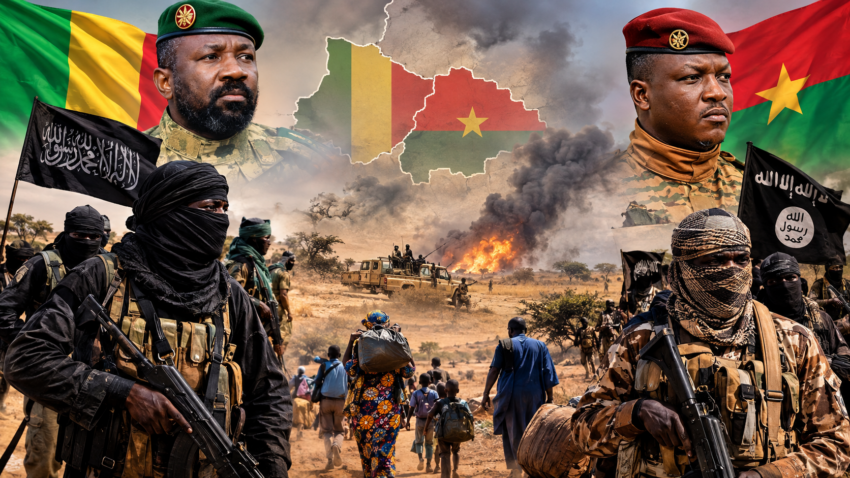
The borderlands where Mali and Burkina Faso meet have become ground zero for some of the Sahel’s most intense armed confrontations. Escalating clashes between fighters loyal to the Group for the Support of Islam and Muslims (JNIM), an Al-Qaeda affiliate, and those of the Islamic State in the Greater Sahel (EIS) underscore a grim truth: the authority of the region’s military juntas is being tested like never before.
The frontline between Mali and Burkina Faso no longer simply marks a political boundary it has evolved into a contested battleground where insurgent factions impose their own rules. Civilians in the area face the devastating consequences of this power struggle: displacement, economic ruin and near-constant insecurity. Despite repeated assurances from military leaders that security would be restored, the reality on the ground tells a different story.
From rhetoric to reality: the juntas’ unmet promises of security
In Ouagadougou and Bamako, military leaders ascended to power on pledges to reclaim lost territories and end jihadist expansion. Yet years into their rule, the violence shows no signs of abating. The persistence of armed confrontations particularly between JNIM and EIS challenges the credibility of juntas’ counterterrorism strategies and raises critical questions about their long-term viability.
The juntas of Mali and Burkina Faso have framed territorial sovereignty as a cornerstone of their governance. However, certain border zones remain mired in conflict, with local communities paying the heaviest price. The inability of state forces to establish consistent control over these areas has eroded public trust and deepened skepticism about the effectiveness of current military operations.
Civilians trapped in the crossfire of a jihadist power struggle
The rivalry between JNIM and EIS extends beyond attacks on government troops. Both factions are engaged in a brutal competition for influence, targeting transportation routes, trade hubs and vulnerable populations. For families living in the frontier region, the consequences are both immediate and severe.
Villages face repeated raids, forcing residents to flee with little hope of returning home.
Farming and trade cease to function, plunging communities into economic despair.
Humanitarian access is constrained, worsening food insecurity and limiting medical assistance.
These developments underscore a harsh reality: the juntas’ attempts to regain control have not translated into sustainable security for local populations.
The limits of military force in a multi-faceted conflict
The persistence of jihadist violence cannot be attributed solely to insufficient firepower. Effective counterterrorism demands more than troop deployments and tactical strikes. It requires reliable intelligence networks, civilian protection, responsive governance and cross-border coordination tailored to the unique challenges of the Sahel’s hinterlands.
A coordinated approach one that integrates military, political and social measures remains elusive. Without it, the border region risks becoming a permanent flashpoint, further destabilizing both Mali and Burkina Faso.
What’s next for Sahelian security?
The commanders of the juntas cannot afford to ignore the unfolding crisis. The clashes between JNIM and EIS have exposed fundamental weaknesses in their security architectures and have cast doubt on their ability to deliver the stability they promised. For regional stakeholders, the path forward demands realistic assessments of current capabilities and a renewed commitment to addressing the underlying vulnerabilities of frontline communities.
As long as insurgent factions continue to dictate the terms of engagement, the dream of lasting peace will remain just out of reach leaving citizens to navigate an increasingly precarious existence.
By Martin Ngu — Journalist